Nancy Shang | Founder and CEO | Published August 2026
SUS304とSUS316Lの主な違いは、全般的な耐食性ではなく耐塩化物性にあります。大半の赤ワインや白ワインの製造においては、SUS304で十分な信頼性が得られます。沿岸部のセラー、塩分を含む水源、塩素系殺菌剤との長時間の接触など、塩化物濃度が高い環境においては、SUS316Lを採用する追加コストに見合う価値が生まれます。
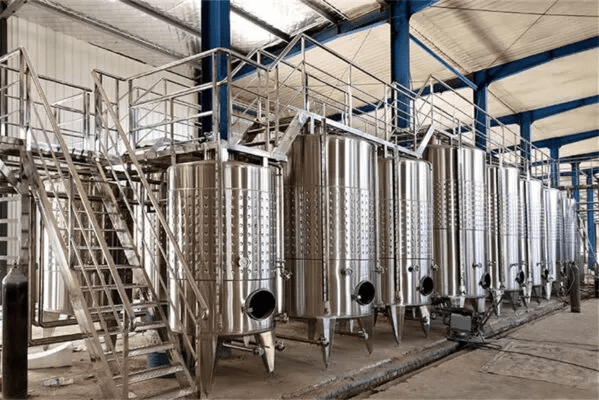
鋼種選びは単に「より良い鋼材を買う」だけではない理由
SUS316LがSUS304より高価なのは、モリブデンが含まれているためです。モリブデンは腐食全般ではなく、特に塩化物による孔食に対する耐性を向上させます。塩化物濃度の低い地域の水道水を使用して標準的なCIP洗浄を行っているワイナリーでは、316Lの割増料金を支払っても実質的なメリットはほとんどありません。一方、沿岸部にあるワイナリー、塩分濃度の高い井戸水を使用しているワイナリー、あるいは塩素系殺菌剤を高頻度で使用しているワイナリーでは、判断基準がまったく異なります。
多くのタンク購入ガイドは、ここで説明を終えてしまいます。つまり、合金の組成を記載するだけで、実際にタンクに何を入れるのか、あるいはタンクがどこに設置されるのかという点に結びつけていないのです。
仕様表:実際に公開されている情報
| 仕様 | 5,000Lタンク | 10,000Lタンク |
| 選択可能な鋼種 | SUS304 / SUS316L | SUS304 / SUS316L |
| 内殻(インナーシェル)の厚み | ~3.0mm | ~3.0mm |
| 外殻(アウターシェル)の厚み | ~2.0mm | ~2.0mm |
| 断熱 | 80~100mm ポリウレタン | 80~100mm ポリウレタン |
| 価格 | 非公開 — 見積りが必要 | 非公開 — 見積りが必要 |
These two capacity points are the examples MICET has published; other sizes exist but aren’t listed with the same shell and insulation detail, so treat anything outside 5,000L/10,000L as a quote-driven conversation rather than an assumed spec match.
SUS304 vs SUS316L: Direct Comparison
| Factor | SUS304 | SUS316L |
| Chloride/pitting resistance | Adequate for standard municipal water and moderate sanitizer use | Higher — molybdenum content improves resistance to chloride-driven pitting |
| Relative cost | Lower baseline cost | Premium over 304, typically driven by alloy content |
| Best fit by environment | Inland cellars, standard water supply | Coastal cellars, high-salinity water sources, heavy chlorine-based CIP |
| General wine contact | Suitable for red, white, most production | Suitable for all wine types; no downside beyond cost |
| Long-term maintenance | Standard passivation practices sufficient in most settings | More forgiving of inconsistent passivation in harsher environments |
Neither grade is a wine-style requirement in the way people sometimes assume — the alloy choice is driven by the tank’s environment and water chemistry, not by whether you’re fermenting Cabernet or Chardonnay.
Selecting a Grade: A Decision Framework
- Identify your water source’s chloride content.Well water and coastal municipal supplies run higher in chlorides than inland freshwater sources — a basic water test answers this before you spend money guessing.
- Review your sanitation protocol.Frequent chlorine-based sanitizer use accelerates the case for 316L even in an inland location, since repeated chlorine exposure compounds over the tank’s service life.
- Assess cellar proximity to salt air.A coastal facility with outdoor tank farms faces atmospheric chloride exposure on top of anything in the water supply.
- Weigh capacity against grade cost.At larger volumes like 10,000L, the per-liter cost difference between 304 and 316L becomes a larger absolute number — worth running against your actual environmental risk rather than defaulting to the premium grade out of caution.
- Confirm with your supplier which grade applies to which tank component.Some builds use 316L only for wetted surfaces in contact with wine and 304 for the outer shell — ask directly rather than assuming the whole vessel is one grade.
Where Wine Style Actually Matters
Wine style affects tank design more than it affects grade choice:
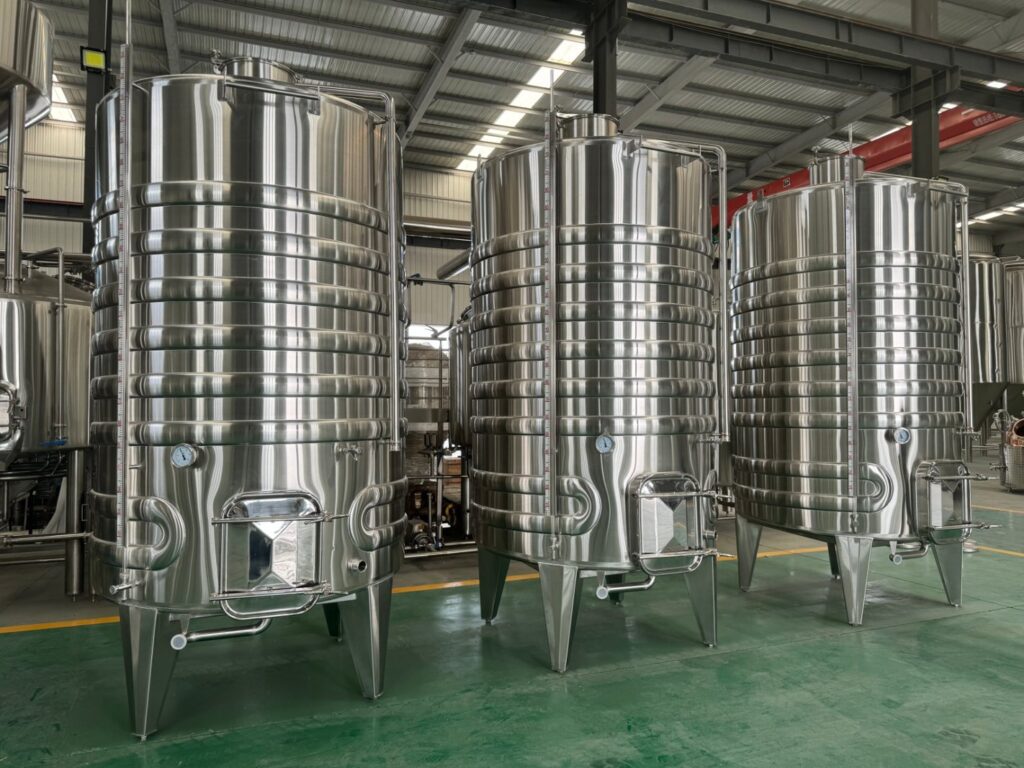
Red wine production often benefits from tanks with larger access ports for cap management during fermentation — a detail to confirm on the spec sheet rather than assume is standard across all vessel designs.
White and sparkling wine production leans more heavily on temperature control precision, since these styles typically ferment at lower, tighter temperature ranges than reds. The 80–100mm polyurethane insulation spec matters more here — thinner insulation makes it harder to hold a stable low-range fermentation temperature against ambient cellar swings.
Sparkling wine specifically, if tank-fermented under pressure (as in Charmat-method production), requires a tank rated for the pressure involved — a general-purpose wine fermentation tank isn’t automatically pressure-rated, and that’s a spec to confirm explicitly rather than infer from vessel size alone.
A Common Misstep: Assuming Thicker Shell Means Better Tank
A frequent misunderstanding in tank shopping is treating shell thickness as the primary quality signal. The published 3.0mm inner / 2.0mm outer shell spec is a starting point, not the full picture — insulation quality, weld integrity, and grade selection for the actual water and sanitation environment matter more for long-term performance than shaving a fraction of a millimeter off the shell spec sheet. A thinner-shell tank in the right grade for its environment will outperform a thicker-shell tank in the wrong grade for a chloride-heavy setting.
Trade-offs to Weigh
SUS304 tanks cost less and perform well for the majority of inland wineries running standard sanitation — but they carry more pitting risk if the water source or environment shifts (a new well, a move to more aggressive sanitizers) without a corresponding grade reassessment. SUS316L closes that risk gap but adds cost that doesn’t return value in a low-chloride setting — paying the premium without the environmental justification is money spent on a risk that wasn’t there.
Compared to generic catalog listings that present SUS304 and SUS316L as a simple upgrade tier, the environment-driven framework above tends to produce a more defensible purchasing decision, since it ties the grade choice to a measurable input — water chemistry and sanitation practice — rather than treating 316L as the “better” option by default.
FAQ
Q: Is SUS316L required by any wine industry standard?
A: No — grade selection is a facility and environment-driven decision, not a regulatory requirement tied to wine production itself. Confirm with your local health and safety code if unsure, since requirements can vary by jurisdiction.
Q: Can I mix SUS304 and SUS316L tanks in the same cellar?
A: Yes, this is common — a facility might use 316L for tanks closer to a coastal air intake or wash-down area and 304 for tanks in a more controlled indoor environment. The decision is per-tank, not facility-wide.
Q: Does insulation thickness change between the 5,000L and 10,000L tanks?
A: No — both published capacity points share the same 80-100mm polyurethane insulation spec and 3.0mm/2.0mm shell thickness range.
Q: What if I need a wine tank sized between 5,000L and 10,000L, or larger?
A: Those two figures are the published examples; other capacities exist but aren’t listed with the same spec detail, so a direct quote request is the reliable way to confirm shell and insulation specs for a different size.