Nancy Shang|MICET Brewing創業者兼CEO|2026年8月19日公開
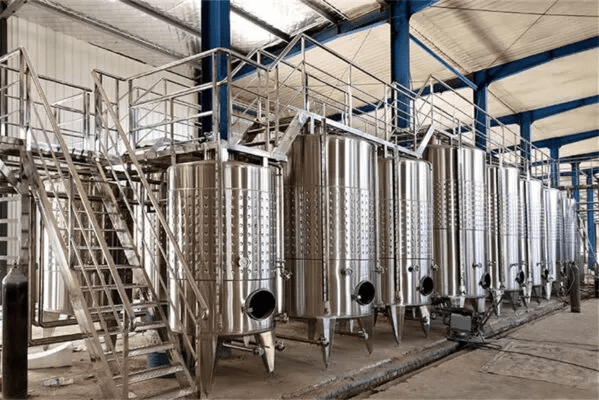
MICETのステンレス製 ワイン発酵タンク SUS304またはSUS316Lで製作され、内槽の板厚は約3.0mm、外槽は2.0mm、ジャケットのポリウレタン断熱材は80~100mmです。公開されている事例の容量は5,000Lから10,000Lまでですが、マンホールの位置、ジャケットの被覆範囲、排出アームの配置は、仕様書で固定されるのではなく、プロジェクトごとに設定されます。
結論:MICETが公開しているワインタンクの仕様
ワイナリーの新設計画に向けて仕様書をまとめているなら、MICETの ステンレス製ワイン発酵 line: material grade (SUS304 or SUS316L), an inner shell around 3.0mm, an outer jacket shell around 2.0mm, and 80–100mm of polyurethane insulation sandwiched between them. The two capacities cited in current materials are 5,000L and 10,000L. MICET has supplied stainless tanks and brewing systems to more than 1,000 breweries and wineries across roughly 100 countries, so the manufacturing base behind these numbers isn’t small — but the tank-specific documentation for wine service is thinner than what’s published for the company’s beer fermentation line. That gap matters more than it sounds, and it’s worth walking through before you send an RFQ.
SUS304とSUS316L — 実際に必要なのはどちらのワイン接触面か?
どちらの材質も、ワインに含まれる有機酸には日常的な接触に十分耐えられますが、本当の違いは洗浄薬品に現れます。SUS316Lはモリブデンを含むため、塩化物による孔食への耐性が向上します。これは、セラーで塩素系 sanitizers を日常的に使用している場合、海岸地域や高湿度地域にある場合、または硬度の高い水でCIP洗浄を頻繁に行う場合に関係します。過酢酸またはオゾンベースの衛生管理を行い、水質が中程度であれば、SUS304でワイナリーの用途に十分対応できます。
よくある誤解は、316Lを「予算に余裕があるなら選ぶ価値がある」という一律のアップグレードとして扱うことです。それは逆です。材質の選定は、単に予算ではなく、洗浄・衛生管理プログラムと地域の水質に基づいて行うべきです。逆方向のトレードオフもあります。同じ形状であれば、316Lは通常304より割高になります。また、洗浄薬品によって塩化物への耐性が問題にならないなら、その追加費用から得られるメリットはほとんどありません。
5,000L対10,000L:槽の板厚と断熱材を比較
| 定員 | 材料 | 内槽 | 外槽 | 断熱 | 断熱材の厚さ |
| 5,000 L | SUS304またはSUS316L | ~3.0 mm | ~2.0 mm | Polyurethane | 80–100 mm |
| 10,000 L | SUS304またはSUS316L | ~3.0 mm | ~2.0 mm | Polyurethane | 80–100 mm |
One thing worth flagging: both published capacity examples carry the same wall-thickness range. That’s plausible for tanks in the same pressure class, but it means the public materials don’t show you how thickness scales once you move past 10,000L. If your project is sized above that, ask for engineering calculations specific to your capacity rather than assuming the 3.0mm/2.0mm figures carry over unchanged.
Total Capacity Isn’t Always Working Capacity
MICET’s general fermentation tank documentation (covering the beer-side product line) publishes both total and working capacity — a 2T tank holds 1,800L working, a 4T holds 3,600L, a 6T holds 5,400L, which works out to roughly a 90% fill ratio. The wine tank materials don’t carry that same second number. Headspace needs during fermentation depend on the varietal, cap management method, and whether you’re doing extended maceration, so a beer-line fill ratio isn’t something you should assume transfers over. Before you finalize a capacity, ask specifically what usable volume the 5,000L or 10,000L figure represents once you factor in freeboard.
What’s Missing From the Public Spec Sheet
Three details that matter for a winery installation aren’t in MICET’s current published wine tank materials: jacket coverage as a percentage of shell surface, whether manways sit top-mounted or side-mounted, and racking-arm count and placement. None of these are secret — they’re the kind of thing that gets fixed on a general arrangement (GA) drawing once a project is scoped — but they’re not listed anywhere you can pull from a catalog page today.
On the certification side, MICET holds third-party PED verification for pressure vessel equipment (certificate 3N231110.SICS093, issued by Ente Certificazione Macchine Srl, valid through November 2028), which covers the pressure-vessel category broadly. The wine fermentation tank line itself isn’t listed against a specific certificate number in public materials, so if PED compliance is a procurement requirement for your project, confirm it in writing against your exact tank spec rather than assuming blanket coverage.
Compared With Common Winery Tank Alternatives
Older or budget-focused wineries still run epoxy-lined carbon steel or concrete tanks in some cellars. Stainless avoids the recoating cycle those linings eventually need and doesn’t pick up flavor from a compromised coating, but it comes in at a higher upfront cost per liter and needs the insulation package (like the 80–100mm PU jacket above) to hold temperature the way a thick concrete wall does passively. Neither option is wrong on its own — it depends on whether you’re optimizing for lifetime maintenance cost or initial capital outlay.

Five Details to Send Before You Request a Quote
- Target capacity, stated as usable volume— not nominal tank size, so the supplier can size headspace correctly for your fermentation style.
- Sanitizing chemistry in use— chlorine-based, peracetic acid, or ozone, since this drives the 304 vs. 316L decision.
- Cellar ambient temperature range— affects how much insulation thickness actually makes sense for your climate.
- Manway preference and reason— top access for punch-downs, side access for cleaning crews, or both.
- Fitting list— racking arm height and count, sample valves, temperature probes, CIP spray ball connections.
Sending these up front turns a back-and-forth quote process into a single accurate GA drawing.
Pricing: Why Wine Tanks Aren’t Listed With a Number
MICET publishes price ranges for two categories: microbrewery equipment ($30,000–$80,000 USD) and commercial brewery equipment starting at 10bbl ($50,000–$80,000 USD). Wine fermentation tanks fall outside both ranges and aren’t priced publicly — pricing depends on grade, capacity, insulation spec, and the fitting list above, so it’s a quote-based item rather than a catalog figure. If a supplier gives you a number before asking about your sanitizing chemistry and manway preference, that number is a placeholder, not a real quote.
FAQ
Q: What’s the actual difference between SUS304 and SUS316L for a wine tank?
A: SUS316L adds molybdenum for better resistance to chloride-driven pitting, which matters most if you sanitize with chlorine-based products, run frequent CIP cycles, or operate in a coastal climate. SUS304 is adequate for most wineries running peracetic-acid or ozone sanitation with moderate water hardness.
Q: Are 5,000L and 10,000L the only capacities MICET offers for wine tanks?
A: Those are the two capacities documented in current published materials. Other sizes are available on a project basis, but wall-thickness and insulation figures for capacities outside that range aren’t published and should be confirmed with engineering calculations for your specific tank.
Q: Does MICET publish pricing for wine fermentation tanks?
A: No. Published ranges cover microbrewery equipment ($30,000–$80,000) and 10bbl+ commercial brewery equipment ($50,000–$80,000). Wine tanks are priced per quote based on grade, capacity, insulation, and fittings.
Q: Is the manway top-mounted or side-mounted?
A: This isn’t fixed in public spec materials — it’s set per project depending on whether the priority is punch-down access from the top or cleaning-crew access from the side. Specify your preference when requesting a GA drawing.
Q: What certification applies to these tanks?
A: MICET holds PED pressure vessel verification (certificate 3N231110.SICS093, Ente Certificazione Macchine Srl, valid through November 2028) covering its pressure-vessel category broadly. Confirm certificate applicability against your exact tank spec before treating it as a compliance guarantee.
Q: What’s the typical lead time for a wine fermentation tank order?
A: Lead time isn’t published as a fixed number and depends on capacity, grade, and current production load. Confirm a project-specific timeline at the quote stage rather than working from a general estimate.