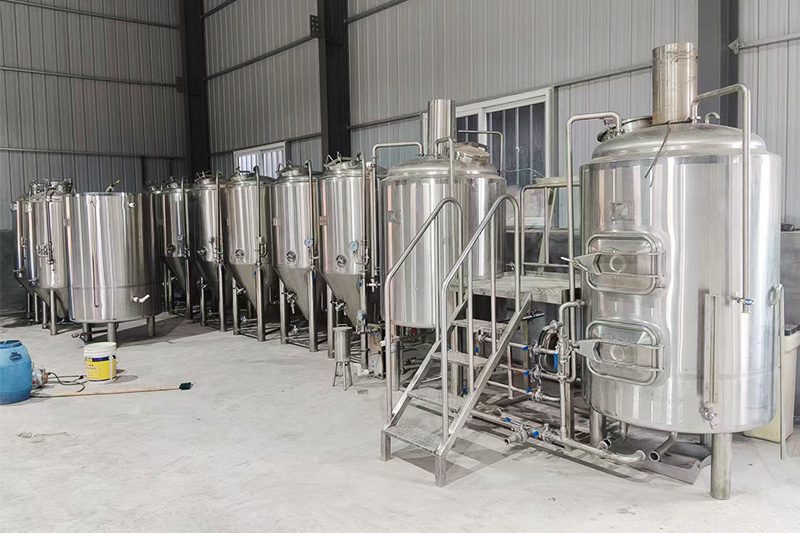
ブルーパブの立ち上げは、単にタンクを購入することだけではありません。不適切な 醸造設備 設備を選んでしまうと、フロアスペースを圧迫し、サービスを停滞させ、稼働しない設備に資金を固定化させてしまうことになります。優れた計画であれば、醸造、発酵、冷却、保管、そしてバーを一体として繋ぎ、仕込みから提供(グラス)までビールがスムーズに流れるよう設計します。
Brew pub equipment for sale should be selected around batch size, available space, daily beer demand, fermentation capacity, and how beer reaches the tap. A complete brewpub normally needs a brewhouse, fermenters, bright tanks or kegs, a glycol chiller, CIP equipment, controls, and a well-designed draft beer system.
記事概要
- ブルーパブ設備と一般的なブルワリー設備の違いとは?
- パブ・ブルワリーに実際に必要な醸造設備とは?
- 仕込設備の規模と容器の数はどう選ぶ?
- 発酵タンクはブルーパブの生産能力にどのような影響を与えるか?
- ブルーパブはブライトタンクから提供すべきか、それともケグから提供すべきか?
- グリコール冷却システムと生ビール供給システムがこれほど重要なのはなぜか?
- ブルーパブにはどの程度の醸造所自動化が必要か?
- ステンレス製醸造設備はレストランのレイアウトにどう収めるべきか?
- 醸造設備は新品、中古、それともハイブリッドで購入すべきか?
- 将来の成長を見据えたターンキー・ブルーパブはどのように計画すべきか?
- Frequently Asked Questions
ブルーパブ設備と一般的なブルワリー設備の違いとは?
ブルーパブは、ビールを製造する施設とお客様に提供する店舗という、二つの事業を一つの建物に組み合わせたものです。そのため、醸造システムの設計方法も変わってきます。
生産型ブルワリー(プロダクション・ブルワリー)では、パッケージング、倉庫スペース、パレットの移動、流通などが重視される傾向にあります。一方、パブ・ブルワリーでは優先順位が異なるのが一般的です。ビールは製造エリアからバーのタップ、サービングタンク、あるいはケグまでのわずかな距離を移動するだけで済む場合が多いためです。
Brewers Associationが米国市場の区分で用いる定義では、ブルーパブとは、ビールの25%以上を店内で販売し、本格的なフードサービスを行うレストラン併設醸造所です。同団体は、ビールを貯蔵タンクから直接提供することも可能であるとしています。
製造と提供のこのような直接的な関係は重要です。
レストラン向けの優れた醸造所は、設備を発注する前にいくつかの質問に答えられる必要があります。
- レストランの席数は何席か?
- 店内でどのくらいの量のビールを販売しますか?
- 常時タップにつなぐビールの種類(銘柄数)はどれくらいか?
- ビールは直接サービングタンクに送られますか?
- 醸造所はケグに充填しますか?
- 将来的に缶詰または瓶詰めを予定していますか?
- ブルワーは週に何回仕込みを行いますか?
- 醸造に使える床面積はどれくらいですか?
- お客様からブルーハウスが見えるようにしますか?
そのため、ブルーパブの計画は仕込設備(ブルーハウス)だけでなく、カスタマージャーニー全体から始める必要があります。
パブ・ブルワリーに実際に必要な醸造設備とは?
ブルーパブにおける主要な醸造設備は他の業務用ブルワリーと類似していますが、規模やレイアウトはよりコンパクトになるケースが一般的です。
一般的な構成には、次のものが含まれます。
| 製造エリア | 主な設備 | 目的 |
|---|---|---|
| 穀物の搬送・処理 | モルトミルおよびホッパー | 麦芽の準備 |
| 加熱工程 | マッシュタン、煮沸釜(ケトル)、ロイター、ワールプール | 麦汁の製造 |
| 麦汁冷却 | プレート式熱交換器 | 発酵前に麦汁を冷却 |
| セラー | 発酵タンク | 発酵および熟成 |
| 冷蔵保管 | Bright tanks or serving tanks | Hold finished beer |
| 冷却 | Glycol chiller | Maintain tank temperature |
| クリーニング | CIPシステム | Clean tanks and piping |
| 譲渡 | Pumps, valves and hoses | Move liquids |
| Service | Kegs, serving tanks and draft lines | Deliver beer to the bar |
| Controls | Electrical/control panel | Run pumps, heating and cooling |
The beer brewing equipment does not need to be unnecessarily complex. The right selection depends on the amount you need to brew, how often you brew, and how many beers you want available at one time.
The basic brewing process starts with the mash. Crushed malt and water enter a mash vessel, where enzymes help convert starch into fermentable sugars. The liquid then becomes wort, moves through lautering, enters the boil kettle, and reaches the whirlpool before cooling.
From there, wort enters a fermenter, where yeast begins fermentation.
Simple on paper. More difficult in a busy restaurant.
The real challenge is making every step fit the operating schedule.
仕込設備の規模と容器の数はどう選ぶ?
Many buyers begin with one question:
“Should I buy a 5 BBL, 10 BBL, or larger system?”
Batch volume matters, but it is only one part of the answer.
Suppose two restaurants both choose a 10 BBL brewhouse. One plans to brew twice per week. The other wants two brews per day. Their vessel needs, labor requirements, cooling loads, and fermentation capacity will be very different.
You should calculate:
Target beer sales ÷ realistic brewing days = required production per brew cycle
Then consider future growth.
Two-, Three-, and Four-Vessel Options
A compact system can combine several processes.
For example:
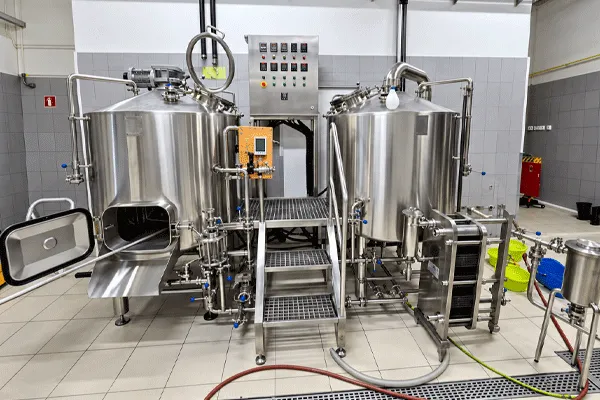
2-vessel
- Mash/lauter
- Kettle/whirlpool
A 3 vessel brewery can separate more functions. A common 3 vessel arrangement may use:
- マッシュタン
- Lauter tun
- Kettle/whirlpool
A 4 vessel system can separate mash, lautering, kettle, and whirlpool into individual process tanks.
More vessels can support faster turnaround, but they also increase cost, footprint, controls, piping, and cleaning work.
MICET’s existing brewery planning guidance similarly notes that two-vessel systems are compact, while three- and four-vessel layouts provide greater workflow capacity when more batches are needed.
For most brewpub projects, we therefore do not start with the number of vessels. We start with the production schedule.
発酵タンクはブルーパブの生産能力にどのような影響を与えるか?
The brewhouse gets attention because customers can see the tanks and watch the brewer work.
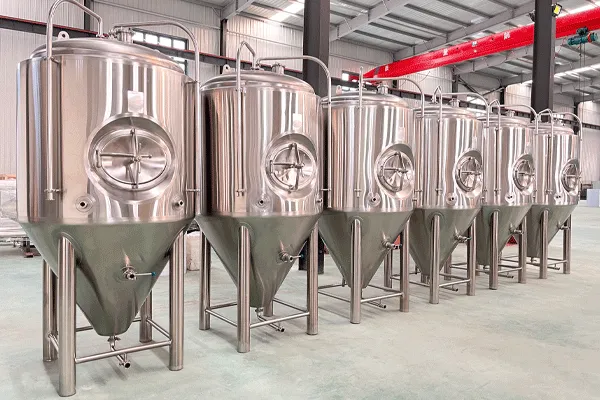
But 発酵タンク often control how much beer the business can actually produce.
A brewhouse may complete a brew within one working day. A fermentation vessel stays occupied much longer. Beer may then need additional conditioning or maturation before service.
This creates a simple rule:
Hot-side capacity means little if there is nowhere to put the next batch.
Imagine a brewhouse that can produce several batches each week but only has a few fermenters. Once those tanks are full, the brewer must stop.
That is why we plan the cellar around:
- Brew frequency
- バッチサイズ
- Fermentation time
- Number of beer styles
- Seasonal demand
- Tank cleaning time
- Future growth
The fermentation unit should also work with the cooling system. A jacketed stainless steel tank needs enough glycol capacity to hold fermentation temperature and later cool beer when required.
Tank geometry, sanitary fittings, insulation, welding, drainability, and jacket design also matter.
Do not judge a quotation only by vessel volume or seal head thickness listed on a specification sheet. Check how the entire tank is designed for sanitary commercial use.
Should a Brewpub Serve Beer From Bright Tanks or Kegs?
This decision can change the whole floor plan.
Some brewpubs transfer beer from fermenters into bright tanks, where beer can condition, clarify, and reach the desired carbonation before service.
Others fill a keg and use conventional draft storage.
Some use both.
Bright Tank Service
Bright tanks can work well when:
- Beer volume is predictable
- The bar serves large quantities
- Tank-to-tap distance is practical
- Fewer transfers are preferred
- Space is available for serving tanks
Keg Service
A keg-based system may provide more flexibility when:
- The business rotates many beers
- Cold-room space is available
- Kegs need to move between locations
- Distribution may be added
- Beer volumes vary by style
A brewpub may also use a dedicated bright tank unit for core brands while keeping seasonal beers in kegs.
The right choice depends on your selection of beer, storage area, bar design, and sales pattern.
The Brewers Association’s draught beer resources emphasize that beer quality does not stop at the brewery. Draft system design, pressure, gas balance, sanitation, and line cleaning all affect what customers finally drink.
That means the bar should be engineered as part of the brewery.
Not added at the end.
グリコール冷却システムと生ビール供給システムがこれほど重要なのはなぜか?
Cooling is one of the easiest systems to underestimate.
A chiller may need to support:
- Fermentation temperature
- Cold crashing
- Bright tanks
- Serving tanks
- Wort cooling support
- Draft beer lines in some layouts
When several tanks demand cooling at the same time, the peak load may be much higher than the average load.
That is why a proper cooling unit should be sized around the full process, not only the brewhouse.
A practical automatic cooling system may include:
- Glycol chiller
- Glycol reservoir
- Circulation pumps
- Supply and return piping
- Tank cooling jackets
- Temperature sensors
- Solenoid control valves
If a quotation specifies components such as Airtac electromagnetic valves, ask why that brand and model were selected, whether equivalent replacements are available locally, and how easily the valves can be serviced. Component availability can matter years after installation.
From Tank to Beer Tap
Temperature must also remain stable after the beer leaves the tank.
The Brewers Association notes that a glycol-chilled draft system is designed to maintain beer temperature between the cooler and the dispensing point.
For a restaurant with long beer lines, this becomes especially important.
Your draft beer system should therefore consider:
- Beer line length
- Walk-in cooler position
- Serving tank location
- Glycol trunk lines
- CO₂ or mixed gas
- Regulators
- Couplers
- Faucets
- Line-cleaning access
You can make excellent beer in the back of the building and still serve poor beer at the bar if the draft system is wrong.
ブルーパブにはどの程度の醸造所自動化が必要か?
Not every small brewery needs the same level of automation as a large industrial plant.
A brewer working on a compact system may prefer direct control over pumps, temperatures, and transfers. A busier operation may want more automation so one operator can supervise several process steps.
Useful brewery automation may include:
- 温度制御
- Heating control
- Pump start/stop
- Variable-speed pumps
- Tank cooling
- Timing
- Agitation
- Valve control
- Alarm functions
- Recipe step management
For example, a temperature controller can command a solenoid valve to open or close glycol flow to a tank.
A larger system may integrate more functions into a PLC and touchscreen interface.
However, automation should solve a business problem.
A restaurant that brews three times per week may not need the same control architecture as industrial brewery equipment running multiple shifts.
More automation can reduce repetitive labor. It can also add electrical complexity and service requirements.
We therefore ask:
What does the brewer need to control every day?
That question is more useful than simply asking for the most automated system.
ステンレス製醸造設備はレストランのレイアウトにどう収めるべきか?
A brewpub has one major constraint that many production breweries do not: customers and food service share the building.
That makes layout especially important.
The brewery may need to coexist with:
- Kitchen operations
- Dining areas
- Bar service
- Walk-in cold storage
- Customer walkways
- Fire exits
- Loading access
- Restrooms
- Staff areas
Your stainless steel equipment must therefore fit more than a production process.
Think in Product Flow
A simple flow could be:
Malt storage → milling → mash → kettle → wort cooling → fermentation → bright tank/keg → bar
Try to reduce unnecessary crossings.
Wet production areas also need suitable drainage. Tanks need working space around valves, manways, pumps, and piping.
If vessels are close to customers, appearance may matter too. A polished brewhouse can become part of the restaurant experience while still functioning as serious production equipment.
But appearance should never replace practical engineering.
Check:
- Ceiling height
- Door dimensions
- Floor loading
- Drain position
- Steam exhaust
- Electrical service
- Gas availability
- Water supply
- Chiller location
- Noise
- Maintenance access
A beautiful brewhouse that cannot be installed through the building entrance is not a good design.
醸造設備は新品、中古、それともハイブリッドで購入すべきか?
A search for brew pub equipment for sale will bring up new equipment, used systems, refurbished tanks, and complete packages.
Each option has a place.
New Equipment
New equipment makes sense when:
- The floor plan requires custom dimensions
- Tank quantity is fixed by a new production plan
- Controls must meet specific requirements
- Appearance matters in customer-facing areas
- Local electrical or certification requirements are important
中古設備
Used equipment may help reduce initial CAPEX when dimensions and specifications fit the project.
MICET currently offers refurbished brewery equipment in several capacity ranges and states that its refurbishment process includes inspection, cleaning, testing, and selected component replacement rather than simply selling random tanks “as-is.”
Hybrid System
For many brewpubs, the most interesting option is a hybrid approach.
For example:
- Refurbished brewhouse
- New control panel
- New pumps
- New sanitary valves
- New glycol system
- New draft system
- New fermentation capacity added as required
This approach can balance budget and operational reliability.
The most important point is compatibility.
A low purchase price is not useful if the system does not fit the building, utilities, batch plan, or local requirements.
Do not choose equipment only because it comes from one of the world’s top brands or appears on a list of top brands. Check the actual specifications, condition, support, and suitability for your project.
将来の成長を見据えたターンキー・ブルーパブはどのように計画すべきか?
A turnkey project should connect the process from raw material to the customer’s glass.
For us as a professional brewery equipment manufacturer, that means discussing more than tanks.
A complete project may involve:
- 生産目標
- Brewhouse capacity
- Number of daily brews
- Fermenter quantity
- Bright tanks
- Malt handling
- Heating method
- Glycol cooling
- CIP洗浄
- Utility requirements
- Bar and keg strategy
- Floor layout
- Controls
- Installation
- Commissioning
- Future expansion
MICET currently positions its commercial offering around turnkey layout planning, equipment matching, electrical and piping planning, installation guidance, training, and long-term support.
An Illustrative Brewpub Planning Case
Consider a restaurant investor who wants to produce several core beers on site.
Instead of immediately ordering a fully equipped set, we would first ask:
- What is weekly beer demand?
- How many core beers are planned?
- How many seasonal beers?
- Will the team brew once or several times per week?
- Will beer move into serving tanks or kegs?
- Is future distribution planned?
If demand is moderate, a compact brewhouse with enough fermentation capacity may make more sense than a larger hot-side system with too few tanks.
If demand grows later, the building should allow additional fermenters.
That is sustainable expansion.
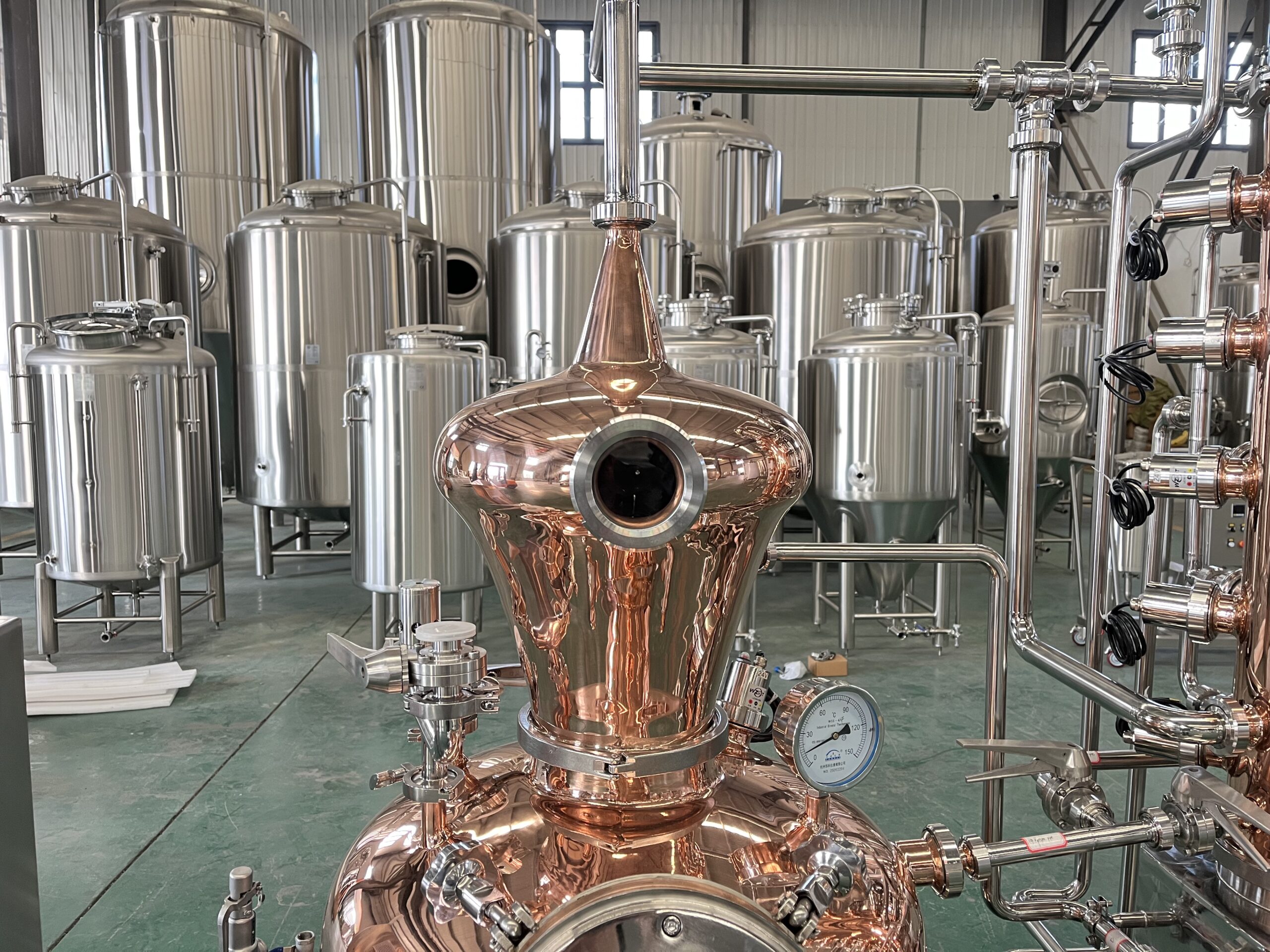
What About Distillery or Other Beverage Production?
Some investors also want a small distillery, cider operation, kombucha line, or other beverage production in the same project.
That should be planned carefully.
Different products can require different fermentation vessels, cleaning procedures, utilities, controls, and legal approvals. Do not assume one generic tank can automatically handle every application.
As a manufacturer of brewery and beverage brewing solutions, we recommend defining each process before selecting shared utilities or tanks.
Home Brewing Equipment vs Commercial Brew Pub Equipment
Some buyers reach this topic after years of home brewing.
That experience is useful. You already understand mash, wort, fermentation, recipe development, and the basic rhythm of brewing beer.
But commercial scale changes the equipment requirements.
| Home Brewing | Commercial Brewpub |
|---|---|
| Small kettle | Commercial brewhouse |
| Manual transfers | Sanitary pumps and piping |
| Small fermenter | Jacketed fermentation tanks |
| Refrigerator cooling | Glycol system |
| Basic cleaning | CIP procedures |
| Bottles/kegs | Integrated draft or packaging |
| Hobby schedule | Production schedule |
| Personal use | Commercial food-and-beverage operation |
Beer making at home focuses mainly on whether the recipe works.
Commercial beer brewing also asks whether the process is repeatable, cleanable, efficient, serviceable, and profitable.
A brewpub may still use a small pilot setup for recipe development, but home brewing hardware should not be confused with commercial equipment designed for repeated production.
Frequently Asked Questions
What equipment does a brewpub need to start brewing?
Most brewpubs need malt handling, a brewhouse, heat exchanger, fermentation tanks, glycol cooling, pumps, controls, cleaning equipment, bright tanks or kegs, and a draft beer system.
The exact configuration depends on production volume and how beer will be served.
What size brewhouse is best for a restaurant?
There is no universal best size.
Choose capacity based on weekly beer demand, expected batch frequency, number of fermentation tanks, available floor area, and future growth.
A smaller system that operates efficiently can be more useful than an oversized system that sits idle.
Is a 2-vessel or 3-vessel brewery better for a brewpub?
A two-vessel brewhouse often works well when space is limited and daily batch count is modest.
A three-vessel system can separate more processes and improve throughput when the brewer needs to complete multiple batches more quickly.
Do I need bright beer tanks in a brewpub?
Not always.
You can condition and serve beer using different arrangements, including fermenters, bright tanks, serving tanks, or kegs.
Bright tanks can be useful when you want dedicated conditioning, carbonation, storage, or direct tank-to-tap service.
Can I use 中古醸造設備 in a new brewpub?
Yes, provided the equipment condition, dimensions, sanitary design, capacity, pressure requirements, controls, and utilities fit your project.
Refurbished equipment should be inspected and tested before installation.
What should I send a brewery equipment manufacturer before requesting a quotation?
Provide:
- Target batch size
- Weekly or annual production
- Number of beer styles
- Building dimensions
- Ceiling height
- Door size
- Utility information
- Heating preference
- Desired automation
- Draft/keg plan
- Destination country
- 拡張計画
This allows the supplier to propose a system rather than simply quote isolated tanks.
Key Things to Remember Before Buying Brew Pub Equipment
- A brewpub is both a brewery and a restaurant, so production and customer service must work together.
- Choose equipment according to beer demand, not simply the largest vessel you can afford.
- The brewhouse is only one part of the system.
- Fermentation capacity can limit output before the brewhouse does.
- Decide early whether beer will move to bright tanks, serving tanks, or a keg.
- Treat the beer tap and draft system as part of beer quality control.
- Size the chiller around all cooling loads, not only one tank.
- A compact restaurant may benefit from a 2- or 3 vessel brewery, while higher throughput can justify more vessel separation.
- Use automation where it reduces labor or improves repeatability.
- Plan stainless steel equipment around drains, utilities, access, kitchen space, and customer traffic.
- New, refurbished, and hybrid systems can all work when specifications match the project.
- Leave space and utility capacity for additional fermenters.
- A successful brewpub project should connect brewing, cellar operations, cooling, cleaning, storage, and service into one practical system.
- Before buying any equipment for breweries, develop the production plan first and let the equipment follow it.
A brewpub does not need the biggest system. It needs the right system.
When the brew house, fermentation tanks, cooling, controls, kegs, and bar work together, your brewer can focus on producing consistent beer while the restaurant focuses on serving it. For investors and operators planning a new brewpub, that integrated approach is often the difference between simply owning brewing equipment and running a practical commercial brewery.