










Nancy Shang | Founder and CEO, MICET | Published August 21, 2026
Sizing commercial brewing equipment starts with monthly output, not brewhouse size. Divide target volume by brew days and turns per day to find brewhouse capacity, then size the fermenter cellar by tank occupancy. This guide walks through the arithmetic, two worked examples, and the spec fields to confirm before quoting.
Most procurement conversations I sit in start at the wrong end. A buyer opens with “we’re looking at a 20 BBL system,” and nobody has yet written down how many barrels per month the business plan requires. Brewhouse size is an output of the sizing exercise, not an input to it. Get the order wrong and you either buy a vessel that runs at 40% utilization for three years, or you buy one that hits its ceiling nine months after commissioning and forces a second capital cycle you did not budget for.
Compared with the equipment-listing pages that dominate this search category, which publish tank diameters and jacket details but leave the throughput math to the reader, what follows is the calculation itself, plus the assumptions you should challenge before signing anything.
The four inputs that decide everything downstream
Before any vessel size can be named, four numbers have to exist on paper. Everything in this guide is derived from them.
| Input | What it means | Where the number comes from |
| Target monthly packaged output (BBL) | Volume leaving the brite tank into package or trade, not volume knocked out | Sales forecast, distribution agreements, taproom throughput |
| Brew days per week | Days the brewhouse is actually staffed and running | Labour plan and shift pattern |
| Turns per day | Batches through one brewhouse in one working day | Cycle time of your longest brewhouse stage |
| Average tank occupancy (days) | Fill to empty, including crash, transfer and CIP | Your recipe mix, not a catalogue figure |
Two of these are business decisions, not engineering ones. Brew days per week and turns per day are labour questions, and they move the required brewhouse size more than anything else in the calculation. A brewery willing to run double-batch days can hit the same annual volume on a vessel roughly half the size, at the cost of longer shifts and a harder hiring problem.
A note on losses: volume shrinks between the kettle and the package. Trub and whirlpool losses, yeast crop, tank heels, filtration and packaging losses all take a share. In the worked examples below I use a combined 10% loss factor from knockout to package. That is a planning placeholder, not an industry statistic. If you already brew commercially, replace it with your own measured figure, which is often higher on heavily dry-hopped beer.
Step by step: sizing the brewhouse
Work through these in order. Each step produces a number the next step consumes.
Step 1 — Convert monthly output to brews per month. Divide the target monthly packaged output by the packaged yield of a single batch. Packaged yield equals brewhouse knockout volume multiplied by (1 − loss factor). At a 10% loss factor, a 15 BBL knockout yields 13.5 BBL packaged.
Step 2 — Convert brews per month to brews per week. Divide by 4.33, the average number of weeks in a month. Rounding this to 4 will understate your requirement by about 8%, which is enough to change the answer at the margins.
Step 3 — Test the result against your labour plan. Divide brews per week by the brew days per week you are willing to staff. The result is required turns per day. If it comes out above 2, either the brewhouse is undersized or the shift pattern needs to change. Three turns per day is achievable with a fast cycle and a disciplined crew, but it leaves no room for a stuck mash or a chiller fault.
Step 4 — Round to a real vessel size and re-check. Vessels come in standard increments, so the number from Step 1 will rarely land on one. Round up, then recalculate actual monthly capacity at the rounded size. Write down the utilization percentage this implies in year one.
Step 5 — Size the hot liquor tank against your worst day. HLT volume should cover strike and sparge for the largest single day, which means a double-batch day if you plan to run one. As a planning starting point, allow 1.5× brewhouse batch volume for single-batch operation and up to 2× where double-batch days are routine. Undersized hot liquor is one of the quieter causes of a brewhouse that never quite achieves its stated turns.
Step 6 — Confirm the cold liquor and glycol load before you fix the vessel size. Knockout rate is limited by heat exchanger capacity and cold liquor volume, not by the kettle. A brewhouse that can boil 30 BBL but can only chill it in four hours has just eaten the second turn you were counting on in Step 3.
Step by step: sizing the fermenter cellar
The cellar, not the brewhouse, is where most sizing plans fail. Fermenter count is driven by occupancy days, and occupancy is driven by your recipe mix.
Step 7 — Decide your fermenter-to-brewhouse ratio. Single-batch fermenters are simpler and give recipe flexibility. Double-batch fermenters halve tank count and floor space, but commit you to brewing the same recipe twice in a day and add a second-fill oxygen and temperature management problem. Most 10–50 BBL projects I have quoted settle on double-batch fermenters with two or three single-batch vessels kept for specialty runs.
Step 8 — Calculate fermenter fills per week. Brews per week divided by batches per fermenter. Eight brews per week into double-batch fermenters is four fills per week.
Step 9 — Apply occupancy. Required tanks = fills per week × (occupancy days ÷ 7). Occupancy runs from fill to the moment the tank is clean, passivated and ready for the next fill. A standard ale programme with a two-day turnaround typically lands around 16 days total. Lager, extended dry hop schedules and barrel-conditioned product run far longer, and this single variable can double your tank count on the same brewhouse.
Step 10 — Add brite capacity and headroom. Brite or serving tanks are sized around packaging cadence rather than fermentation. Allow enough brite volume to hold one full packaging run plus one tank in CIP. Then add one spare fermenter position to the layout even if you do not buy the tank. Retrofitting a glycol drop and drain into a finished cellar floor costs several times what it costs to rough it in during the build.
Two worked examples, side by side
Both examples assume a 10% total loss factor from knockout to package, 4.33 weeks per month, and 16-day average fermenter occupancy on a standard ale programme.
| Line item | Example A: 500 BBL/month | Example B: 1,200 BBL/month |
| Brewhouse knockout volume | 15 BBL | 30 BBL |
| Packaged yield per brew (−10%) | 13.5 BBL | 27 BBL |
| Brews required per month | 37.0 | 44.4 |
| Brews required per week | 8.6 | 10.3 |
| Brew days per week | 4 | 5 |
| Required turns per day | 2.2 | 2.1 |
| Achievable monthly output at 2 turns | 468 BBL | 1,170 BBL |
| Shortfall vs target | 32 BBL (6.4%) | 30 BBL (2.5%) |
| How the gap is closed | One extra brew day every second week | Occasional third turn or sixth brew day |
| Fermenter configuration | Double-batch, 30 BBL | Double-batch, 60 BBL |
| Fermenter fills per week | 4 | 5 |
| Fermenters required (16-day occupancy) | 9.1 → 10 | 11.4 → 12 |
| Installed fermentation volume | 300 BBL | 720 BBL |
| Brite tanks | 2 × 30 BBL | 3 × 60 BBL |
| HLT | 30 BBL | 60 BBL |
| Cellar volume ÷ monthly output | 0.64 | 0.60 |
Two things are worth pulling out of that table.
First, both examples land near a cellar-to-monthly-output ratio of 0.6. That ratio is a useful sanity check on any quotation you receive. If a supplier proposes a tank package that puts you well below 0.5 on a standard ale programme, ask them to show the occupancy assumption behind it.
Second, neither example hits its target at exactly two turns per day. Real capacity plans almost never do. The honest answer is to buy the vessel that gets you to roughly 95% of target and plan the remainder into overtime, rather than jumping a vessel size and running at 70% utilization for two years.
Occupancy sensitivity: what lager does to the same plan
Recipe mix changes tank count more than any other input. Using Example A’s 15 BBL brewhouse and four fills per week:
| Average occupancy (days) | Fermenters required | Installed volume (30 BBL tanks) |
| 12 (fast ale, quick turnaround) | 6.9 → 7 | 210 BBL |
| 16 (standard ale programme) | 9.1 → 10 | 300 BBL |
| 21 (dry-hopped and mixed portfolio) | 12.0 → 12 | 360 BBL |
| 30 (lager-weighted portfolio) | 17.1 → 18 | 540 BBL |
A brewery that shifts from an ale-led to a lager-led portfolio after commissioning needs nearly twice the cellar for the same brewhouse and the same monthly volume. This is the single most common reason a two-year-old brewery calls us about tank expansion while the brewhouse still runs at half capacity.
What our used brewhouse packages actually cover
Because this article is aimed at 10–50 BBL commercial sizing, I need to be direct about where our published used inventory stops.
| Field | Published specification (中古醸造設備 line) |
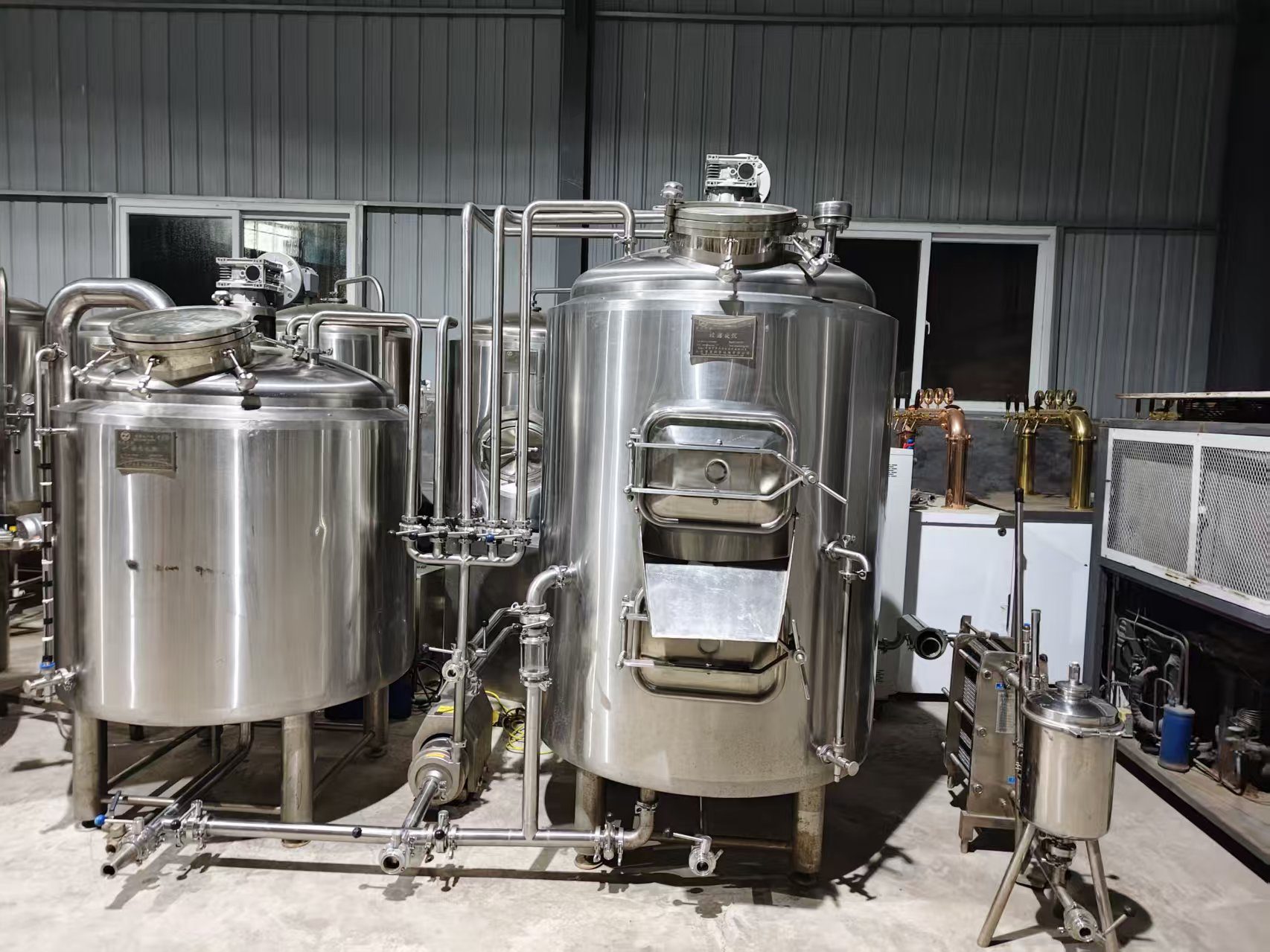
| Brewhouse capacity range | 2–10 BBL compact configurations |
| Vessel configuration | Mash tun + kettle + hot liquor tank package |
| Included ancillaries | Pumps, heat exchanger, control panel |
| Certificate numbers | Not disclosed for this line |
| Price | Not published — quote only |
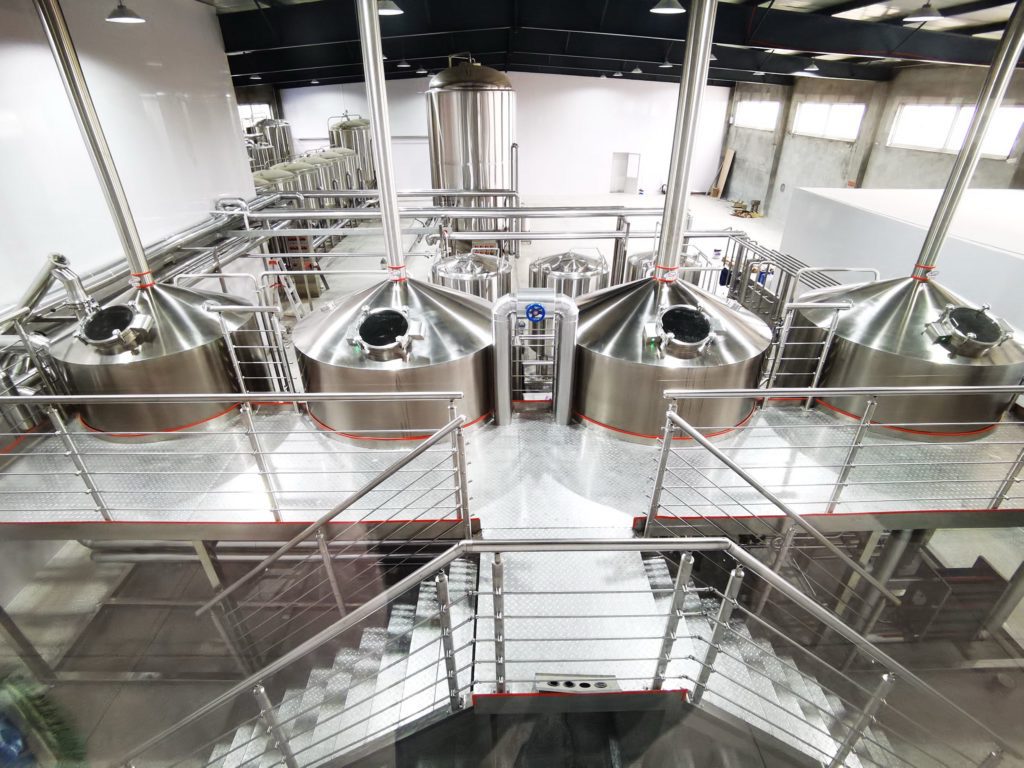
Our used brewhouse listings cap at 10 BBL. Only the lower end of the 10–50 BBL range in this article’s title can be met from used inventory, and only at the 10 BBL boundary. Above that, the sizing math holds exactly as written, but the equipment comes from our new-build line rather than from used stock.
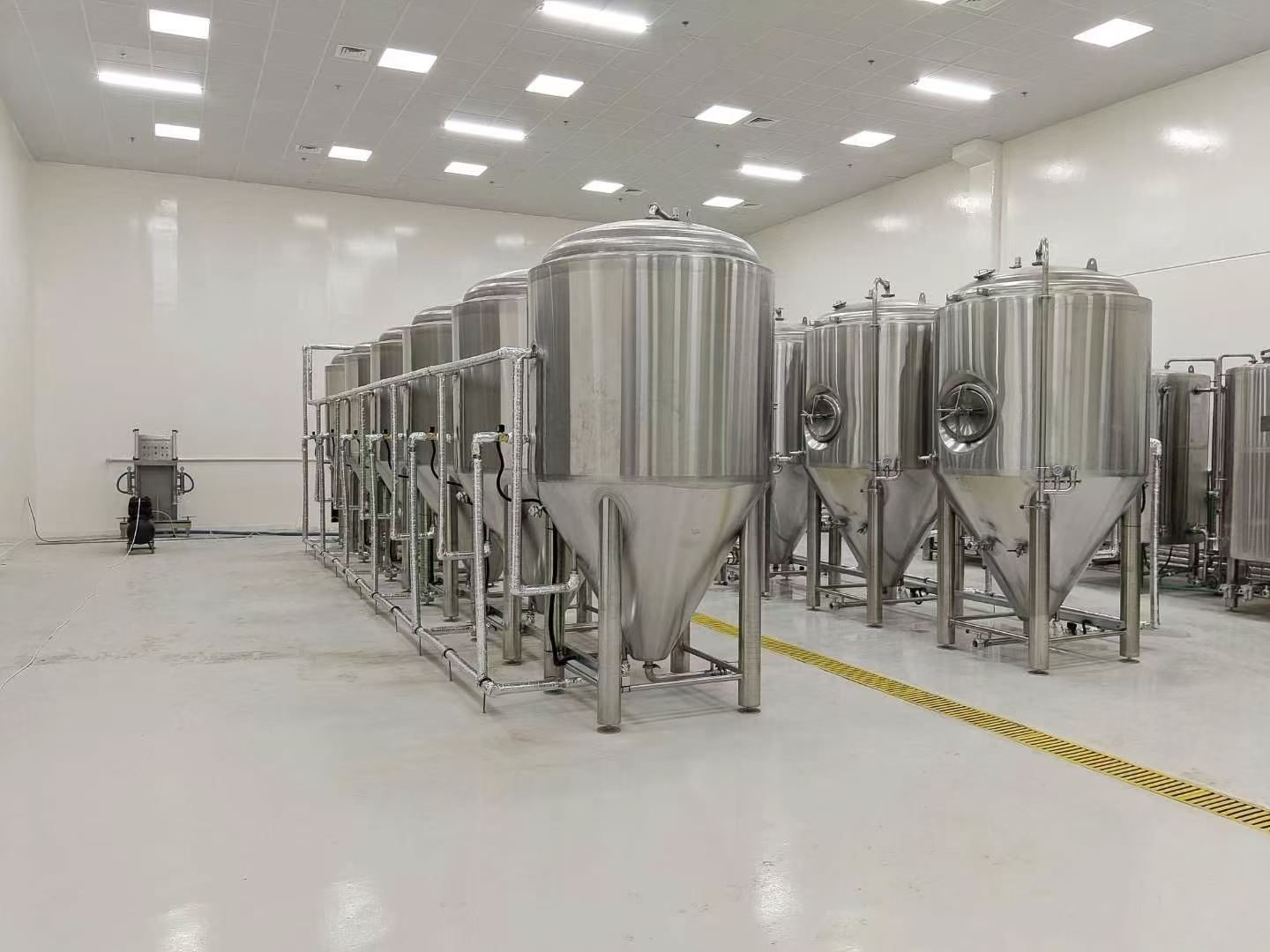
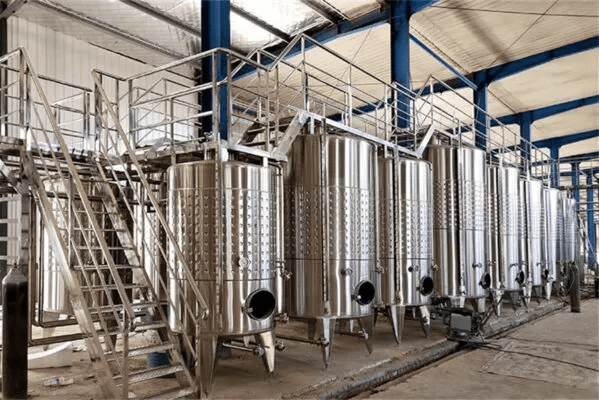
The used fermentation tank line reaches further. Published formats run 3–5 BBL, 10 BBL, 20 BBL and 40 BBL, alongside metric 2T, 4T and 6T vessels (2,000 L, 4,000 L and 6,000 L total capacity; 1,800 L, 3,600 L and 5,400 L working capacity). Construction is SUS304 stainless with a glycol jacket and polyurethane insulation, at 0.2 MPa design pressure and 0.3 MPa test pressure.
Read that against Example B and a gap appears immediately: the 60 BBL double-batch fermenters that example calls for are above our published used format ceiling of 40 BBL. A buyer running Example B’s numbers has three routes — new-build 60 BBL vessels, a larger tank count of used 40 BBL vessels with the brewhouse batch split differently, or a mixed cellar. I would rather set that out here than let it surface after a quotation request.
Pressure ratings, certificates, and what actually transfers
Procurement teams ask for certification early, and this is where used equipment differs sharply from new.
At company and product-line level, MICET holds a PED Verification under Directive 2014/68/EU, certificate number 3N231110.SICS093, issued by Ente Certificazione Macchine Srl (entecerma.it) on 10 November 2023 and valid through 9 November 2028, verified against EN 1626:2008. We also hold a voluntary Verification of Conformity, certificate ICR/VC/HM2507146, issued by ICR Co., Ltd. (icrqa.com) on 16 July 2025 and valid through 15 July 2030, covering brewery, brewing and fermentation equipment and pressure vessels within PED scope, referencing EN 1626:2008 and EN 10204:2004.
What that does not mean: these are organization and product-line credentials. They do not automatically attach to an individual second-hand vessel. Our used brewery equipment line carries no disclosed certificate numbers of its own. If a specific used vessel needs documented PED conformity for your jurisdiction, that has to be established for that vessel, and you should ask for it in writing before the purchase order rather than after.
Three document requests worth making on any 10–50 BBL used purchase, regardless of supplier:
- Material certification for the wetted shell (EN 10204 type, where available)
- Original design and test pressure records for each pressure-bearing vessel
- Weld and surface finish records, or a written statement that they are unavailable
A supplier that answers “unavailable” honestly is more useful to you than one that produces a company-level certificate and lets you assume it covers the tank on the pallet.
Where sizing plans go wrong
Sizing to the peak month. Annual volume divided by twelve is not your planning number, but neither is your best month. Sizing the brewhouse to a seasonal peak leaves capital idle for the rest of the year. Size to the average and absorb the peak with extra brew days.
Counting fermenters by volume instead of by occupancy. “We need 300 BBL of fermentation for 500 BBL a month” is a coincidence of the arithmetic in Example A, not a rule. Change the occupancy days and the volume answer changes with it.
Forgetting CIP in the occupancy figure. Fill-to-empty is not the same as fill-to-ready. Two days of turnaround per tank on a 10-tank cellar costs the equivalent of most of a tank.
Letting the glycol plant become the constraint. Chiller sizing is driven by simultaneous peak load — active fermentation plus crash cooling plus knockout — not by installed tank volume. Adding two fermenters to a cellar whose chiller was sized for ten is how crash schedules start slipping.
Assuming a used 10 BBL package scales. The brewhouse in a compact 2–10 BBL used package is engineered around that duty. Pumps, heat exchanger and control panel are matched to it. Those components rarely carry over cleanly into a 30 BBL project.
Ignoring floor and services before vessel selection. Ceiling height, door width, floor loading and drain capacity have killed more tank orders at my end than price ever has. Confirm them before the layout drawing, not after.
Your next step
Run Steps 1 through 4 on your own forecast before you request a single quotation, and bring the resulting brews-per-week figure to the supplier conversation instead of a vessel size. Two questions this guide has not answered, and that deserve their own analysis: how packaging line speed constrains brite tank turnover on a 30 BBL-plus cellar, and how to phase a cellar build so that the glycol plant and floor drains installed in year one still serve the tank count you reach in year four.
FAQ
Q: How do I calculate what size brewhouse I need for 1,000 barrels a month?
A: Divide 1,000 by your packaged yield per brew, then by 4.33 to get brews per week, then by your planned brew days to get turns per day. At a 10% loss factor and a 30 BBL brewhouse, packaged yield is 27 BBL, giving 37 brews per month, 8.6 per week, or about 1.7 turns per day across five brew days. A 30 BBL brewhouse covers 1,000 BBL per month with room to spare.
Q: How many fermenters do I need for a 20 BBL brewhouse?
A: It depends on fills per week and occupancy days, not on brewhouse size alone. Multiply fills per week by occupancy days divided by seven. A 20 BBL brewhouse running eight brews per week into double-batch 40 BBL fermenters at 16-day occupancy needs about nine fermenters. Shift to a lager-weighted portfolio at 30-day occupancy and the same plan needs seventeen.
Q: Can I buy a used 30 BBL brewhouse from MICET?
A: Not from our published used inventory, which caps at 10 BBL compact brewhouse packages. Used fermentation tanks are published up to 40 BBL and in 2T/4T/6T metric formats. Systems above 10 BBL are supplied from our new-build line. Availability of any used unit changes continuously, so confirm at enquiry.
Q: Does MICET’s PED certification cover used equipment?
A: The PED Verification (3N231110.SICS093, Ente Certificazione Macchine Srl, valid to November 2028) and the Verification of Conformity (ICR/VC/HM2507146, ICR Co., Ltd., valid to July 2030) are held at company and product-line level. They do not automatically transfer to an individual used vessel, and our used brewery equipment line has no disclosed certificate numbers of its own. Request vessel-specific documentation in writing before purchase.