










Nancy Shang | Founder and CEO, MICET | Published August 26, 2026
Industrial brewing equipment means brewhouse and cellar systems built for 30 BBL batches and above, where multi-zone jacketed tanks, dedicated steam and glycol plants, and PLC recipe control replace manual operation. At this scale, utility capacity and automation depth — not vessel volume alone — determine whether a plant meets its production targets.
Where the line between commercial and industrial actually sits
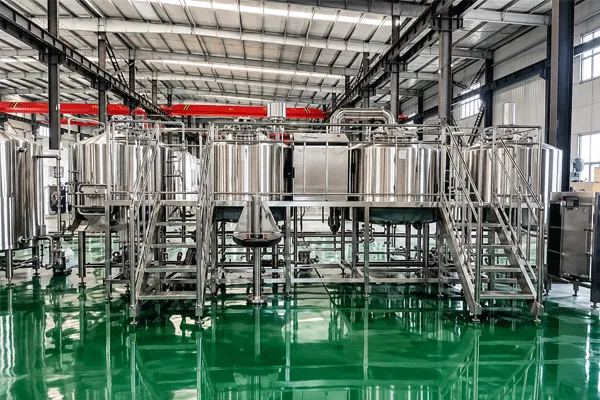
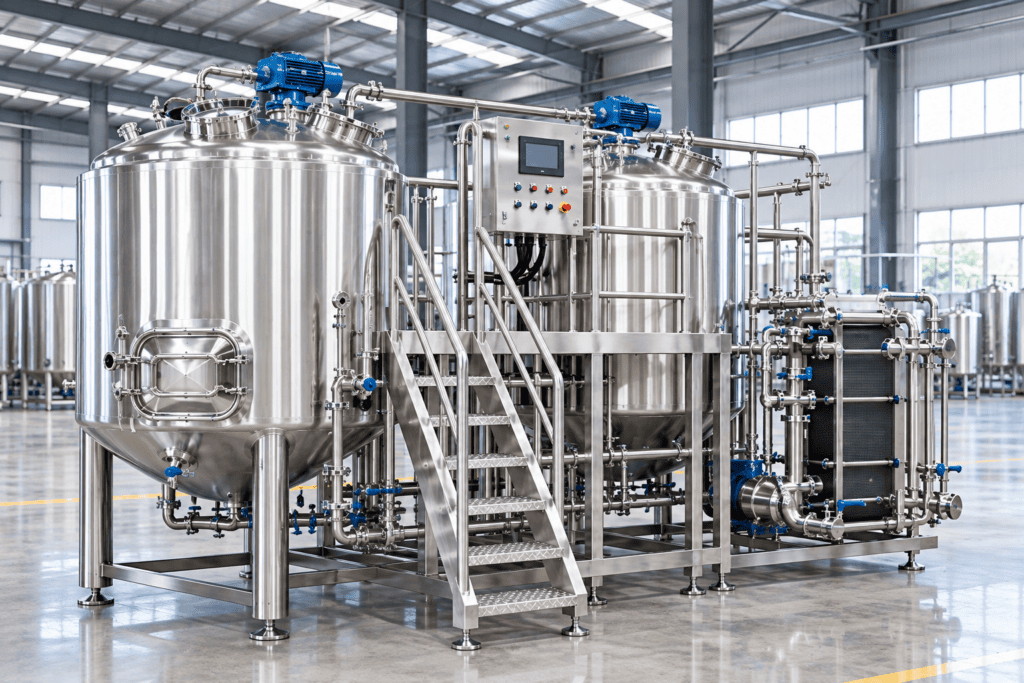
There is no regulatory definition of “industrial” in brewing. In procurement practice, the threshold shows up in three places that have nothing to do with marketing language: the utility plant becomes a separate engineering scope, the tanks stop being single-jacket vessels, and the control system stops being a panel and becomes a supervisory layer.
A 15 BBL brewhouse can run on a packaged steam generator and a single glycol chiller sized by rule of thumb. A 60 BBL brewhouse cannot. Once you cross roughly 30 BBL per batch, the peak boil steam demand and the peak crash-cooling load stop being a line item on the equipment quote and start being a building services decision that involves your electrical contractor, your gas supplier, and possibly your local utility.
| Dimension | Commercial scale (roughly 7–20 BBL) | Industrial scale (30 BBL and above) |
| Brewhouse configuration | 2-vessel or 3-vessel, often combined mash/lauter and kettle/whirlpool | 3-vessel or 4-vessel, separate lauter tun and whirlpool standard |
| Heating | Electric or direct-fire common; steam optional | Steam standard; boiler sized as separate scope |
| Fermenter jacketing | Single or dual jacket zone | Multi-zone (cone, lower cylinder, upper cylinder) with independent valves |
| Fermenter pressure rating | Typically 0.2 MPa design pressure class | Same pressure class, but hydrostatic head and seismic/wind loading drive shell thickness |
| Glycol plant | Packaged chiller, single loop | Dedicated glycol room, buffer tank, redundant pumps, often two-temperature loop |
| コントロール | Semi-automatic panel, manual step confirmation | PLC recipe control, data logging, remote monitoring |
| 政府間措置 | Portable CIP cart common | Fixed CIP skid with dedicated caustic/acid/rinse tanks |
| Typical decision owner | Founder or head brewer | Procurement manager plus plant technical director |
The row that catches most projects out is the glycol one. Equipment quotes at this scale frequently exclude the chiller, and a 30 BBL fermenter crash-cooling from 20°C to 2°C in 24 hours pulls a load that a chiller sized for the brewhouse alone will not cover.
Why the engineering changes, not just the numbers
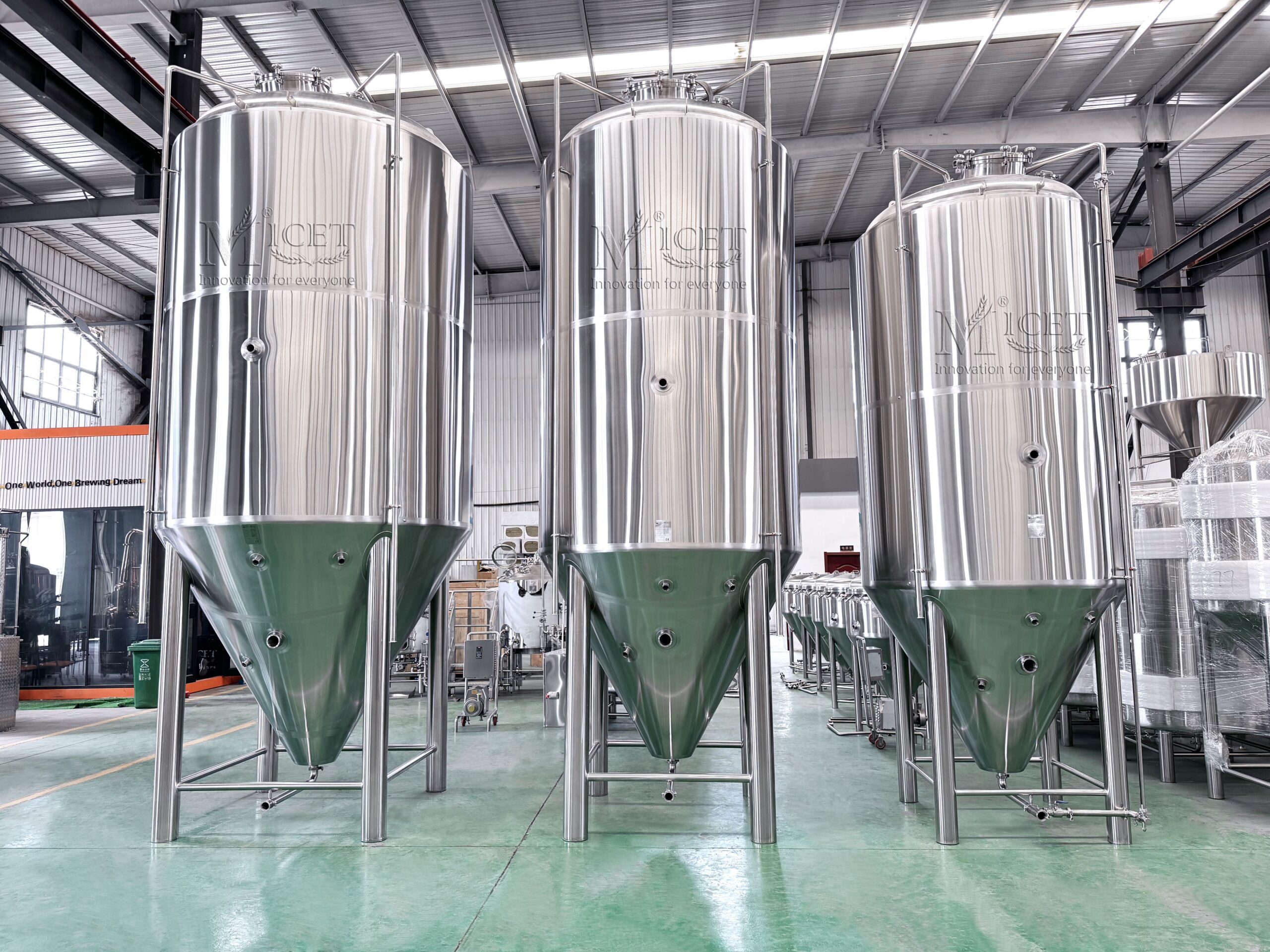
Jacket zoning and what it buys you
On a 10 BBL fermenter, a single dimple jacket wrapped around the lower cylinder is adequate — the liquid mass is small enough that convection distributes the temperature reasonably. Scale that vessel to 60 BBL and the geometry works against you. Taller cylinder, more hydrostatic head at the cone, more thermal stratification between the top of the beer column and the cone.
Multi-zone jacketing addresses this by letting you cool the cone independently for yeast harvesting while holding the cylinder at fermentation temperature, or by cooling top-down to induce circulation. The cost is more valves, more solenoids, more glycol distribution piping, and more control points. On a procurement checklist, the question is not “does it have a jacket” but how many independently valved zones, and whether each zone has its own temperature probe or shares one.
Utility loads become the critical path
Three utility figures should appear in your project documentation before you sign anything: peak steam demand in kg/hr during boil, peak glycol load in kW during crash cooling, and total connected electrical load in kW. Suppliers can provide these from the equipment design; the problem is that buyers often do not ask until after the deposit.
Hot liquor tank sizing deserves separate attention. At industrial scale the HLT is frequently specified undersized relative to double-batch or triple-batch brewing ambitions, and retrofitting a larger HLT into a completed brewhouse layout is expensive.
Automation depth is a spectrum, not a checkbox
“PLC controlled” covers everything from a PLC that runs the pumps to a system that executes a stored recipe, logs every step to a database, and alarms on deviation. When comparing quotes, ask which specific steps are automated: mash step ramps, lauter rake control and runoff turbidity response, kettle boil-off rate, whirlpool rest timing, fermentation temperature profile execution, and CIP cycle sequencing. A quote that automates the first and last of those is a very different product from one that automates all of them, and both may be described in the same two words.
Compared with the skid-packaged systems commonly marketed at the 5–10 BBL tier, industrial systems rarely ship as a single pre-plumbed unit. Field piping, platform steel, and utility tie-ins are separate work packages, and whether they sit inside the supplier’s scope or yours is the single largest source of budget surprise on these projects.
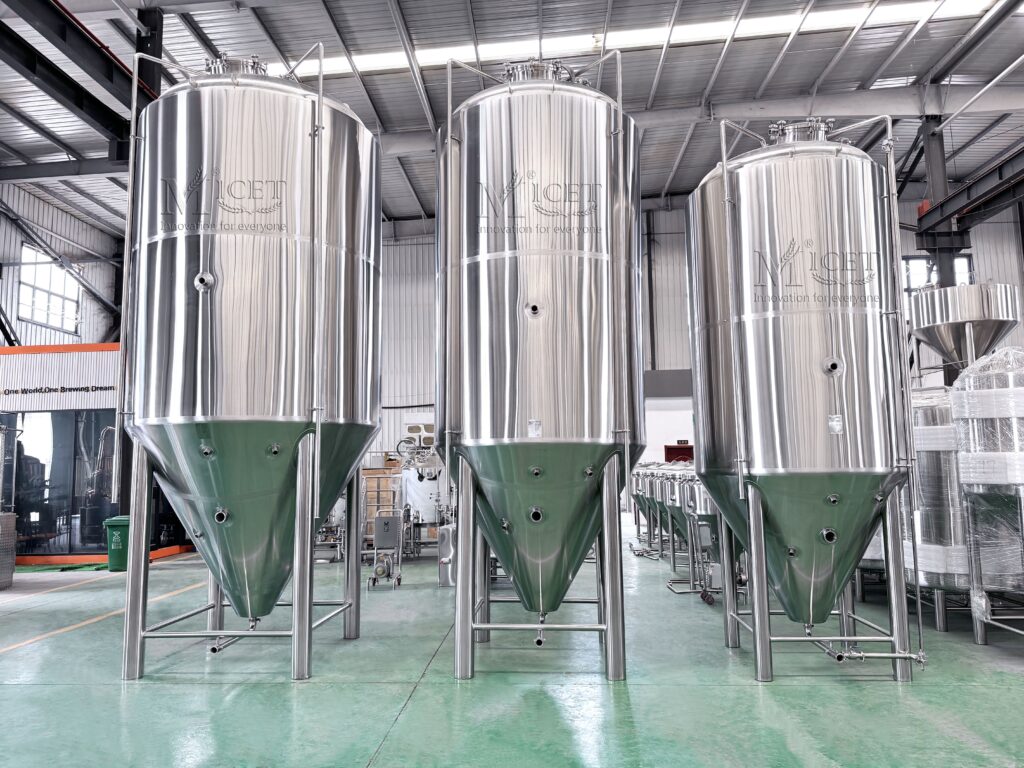
What “turnkey” includes — and what it usually doesn’t
Turnkey is a scope word, not a quality word. Ask any supplier to define it in the contract, because the boundary moves.
Commonly inside a turnkey brewery scope:
- Brewhouse vessels, platform, and internal piping
- Fermentation and brite tanks
- Glycol distribution piping and, sometimes, the chiller
- CIPシステム
- Control panel, PLC programming, and HMI
- Layout drawings and P&IDs
- Supervised installation and commissioning
- Operator training
Commonly outside it, even when the word “turnkey” appears in the proposal: the steam boiler and its permitting, building electrical service upgrades, floor drainage and trench work, glycol charge, compressed air, wastewater treatment, packaging line integration, local mechanical and electrical permits, and the visa and travel costs for supervising engineers.
Two of those are worth flagging specifically. Boiler permitting varies enormously by jurisdiction and can add months to a schedule with no relationship to equipment lead time. And wastewater — a brewery producing at industrial volume generates effluent with a BOD load that municipal systems increasingly meter and surcharge.
MICET’s own project scope covers design, manufacture, and overseas installation, with service centres in France, Australia, Canada, Argentina, and Chile, and confirmed sales agents in ten countries including the USA, UK, Italy, and South Africa. Regional presence affects response time on commissioning issues; it does not automatically mean local spare parts stock, which is a separate question to ask.
Where refurbished equipment fits in an industrial project
This is the section where the honest answer is narrower than the topic suggests.
MICET’s used equipment catalog does not currently reach industrial scale on the brewhouse side. Published used brewhouse configurations run from 2 BBL to 10 BBL, supplied as a mash tun plus kettle plus hot liquor tank package with pumps, heat exchanger, and control panel included. There is no 30 BBL or larger used brewhouse listed. If your project needs an industrial-scale brewhouse, it will be new-build.
The used fermentation tank listings reach somewhat higher but still stop short of industrial cellar scale:
| パラメータ | Published value (used fermentation tanks) |
| BBL sizes listed | 3–5 BBL, 10 BBL, 20 BBL, 40 BBL |
| Metric sizes listed | 2T / 4T / 6T (2,000 L / 4,000 L / 6,000 L total capacity) |
| Working capacity (metric sizes) | 1,800 L / 3,600 L / 5,400 L |
| Shell material | SUS304ステンレス鋼 |
| 冷却 | Glycol jacket |
| 断熱 | Polyurethane |
| Design pressure | 0.2 MPa |
| Test pressure | 0.3 MPa |
| Jacket zone count | Not published |
| Manway type and orientation | Not published |
| Certificate numbers for used units | Not disclosed |
A 40 BBL used fermenter is a real option for a 30 BBL brewhouse running single batches, or as a cellar addition to an existing industrial plant. What it is not is a route to filling an industrial cellar at 60–120 BBL vessel sizes — those sizes are not in the used listings.
So the practical fit for refurbished equipment on an industrial project is narrow but genuine: pilot and R&D systems alongside a main industrial line, brite tank or ancillary vessel top-ups, and cellar capacity added between major expansion phases. Buying used to build an entire industrial plant is not something the current catalog supports, and anyone telling you otherwise about their own inventory should be asked for the specific vessel list with serial numbers.
One further caution. The used equipment listings reference “ASME/CE” craftsmanship in general terms, without registration numbers or a named issuing body attached to individual units. Treat that as a description of build practice, not as certification of the specific vessel you are buying. Ask for the documentation package on the actual unit before it ships.
Certification: read the scope line, not the logo
At industrial scale, pressure vessel compliance stops being a formality. Fermenters and brite tanks fall within the scope of the EU Pressure Equipment Directive, and site inspectors in many jurisdictions will ask for documentation.
MICET holds a PED Verification, certificate number 3N231110.SICS093, issued by Ente Certificazione Macchine Srl, covering brewing equipment, beer equipment, brewery equipment, and pressure vessels against Directive 2014/68/EU with verification to EN 1626:2008. It was issued November 10, 2023 and runs to November 9, 2028. A second, voluntary Verification of Conformity, ICR/VC/HM2507146, issued by ICR Co., Ltd., covers brewery, brewing, and fermentation equipment and pressure vessels under PED 2014/68/EU with reference to EN 1626:2008 and EN 10204:2004, issued July 16, 2025 and valid to July 15, 2030.
Both are organization-level verifications held by the manufacturer. They are not per-unit certificates, and they do not automatically transfer to an individual used or refurbished vessel — no certificate numbers are disclosed for the used product lines. If a specific used tank needs documented PED status for your installation, that has to be established for that tank, in writing, before purchase.
If your industrial project includes a packaging line, a separate document applies: a Machinery Directive and EMC attestation, M.2025.206.C131636, issued by UDEM, covering bottle, keg, and can filling machines and automatic filling lines under 2006/42/EC and 2014/30/EU, valid to December 15, 2030.
Checking validity dates matters more than checking that a certificate exists. A certificate that expires mid-project creates a documentation gap at exactly the moment your inspector arrives.
Budget: what is published and what requires a quote
Published price ranges cover the smaller end of the catalog only:
- Microbrewery equipment: 30,000–80,000 USD
- Commercial brewery equipment, minimum 10 BBL system: 50,000–80,000 USD
For 30 BBL and larger industrial systems, no price range is published. Those require a quotation. I would rather say that plainly than publish a number that collapses the moment your project has a real utility scope, a real building, and a real freight route attached to it.
What moves an industrial quote most: vessel count and sizing in the cellar (usually the largest single line), automation depth, whether the glycol plant and boiler sit inside scope, platform and steelwork, and installation supervision travel. Freight at this scale involves multiple containers or breakbulk, and the difference between FOB and DAP terms on an industrial order is not a rounding error.
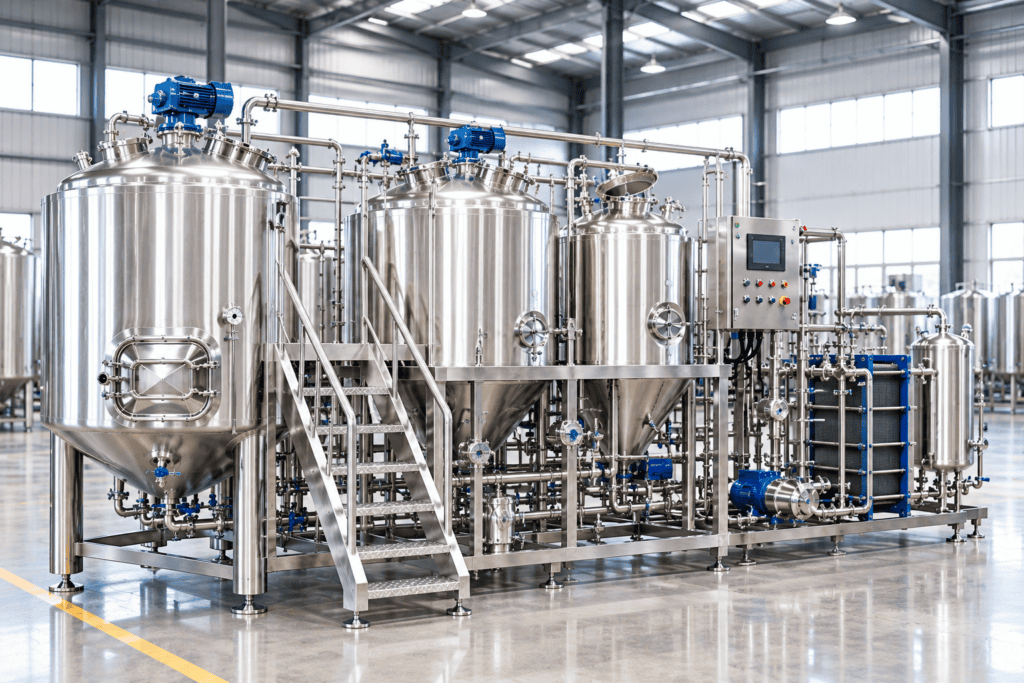
The misstep that costs the most: buying brewhouse capacity you can’t ferment
Procurement conversations gravitate to the brewhouse because it is the visible, photogenic part of the plant. But brewhouse capacity is measured in batches per day, and annual output is limited by fermentation capacity — tank days, not brew days.
A 30 BBL brewhouse capable of three turns per day is producing 90 BBL of wort daily. If your cellar holds six 30 BBL fermenters, and your average tank residency including cold conditioning is 18 days, you can fill roughly one fermenter every three days at best. The brewhouse is idle most of the week and you have paid for automation you cannot use.
Run the cellar arithmetic first: target annual barrels, divided by 52, gives weekly volume; multiply weekly volume by average tank residency in weeks; that is your required fermentation capacity. Size the brewhouse to fill that cellar at a turn rate you can actually staff. A second common version of the same error is sizing the cellar correctly but forgetting brite tank capacity, which then bottlenecks packaging.
A procurement sequence that holds up at industrial scale
- Fix the production target in barrels per year, with a separate figure for year one and year five. Both numbers drive different decisions.
- Calculate required fermentation capacityfrom the residency arithmetic above, then size the brewhouse to fill it.
- Request peak utility figures in writing— steam kg/hr, glycol kW, connected electrical load kW — before comparing quotes.
- Get the scope boundary in the contract, listing explicitly whether boiler, chiller, glycol charge, field piping, drainage, and permits are included.
- Verify certification against the specific equipment being supplied.Check certificate numbers, issuing body, scope wording, and expiry date. For any used vessel, ask for its own documentation.
- Confirm freight terms, port of discharge, and who handles customs clearance.Ask what happens to the schedule if a container is held.
- Agree the commissioning plan and payment milestones, including how long supervising engineers stay on site and what triggers final payment.
- Pin down spare parts— which items are stocked regionally, which ship from the factory, and lead time for each. Gaskets, seals, solenoid valves, and pump seals are the ones that stop production.
Step 5 is the one most often deferred and most expensive to fix late.
What to do next
If you are at the stage of comparing industrial quotes, the highest-value thing you can do this week is request the peak utility figures from every supplier on your shortlist and take them to your building services engineer before you take the equipment prices to your finance team. Utility infeasibility kills more industrial brewery projects than equipment pricing does.
The question this article has not covered is packaging line integration — how filling speed, brite tank capacity, and cellar turn rate have to be balanced against one another, and how a mismatch there strands capacity you have already paid for. That deserves its own treatment.
FAQ
Q: At what size does brewing equipment become “industrial”?
A: There is no regulatory definition. In practice the threshold sits around 30 BBL per batch, where steam heating becomes standard, glycol plant becomes a separate engineering scope, and fermenter jacketing moves to multiple independently valved zones. The engineering changes matter more than the number itself.
Q: Can I build an industrial brewery from used equipment?
A: Not from MICET’s current used catalog. Published used brewhouse configurations run 2–10 BBL, and used fermentation tanks are listed up to 40 BBL (or 6,000 L total capacity). Refurbished units fit as pilot systems, cellar additions, or ancillary vessels alongside a new industrial line — not as the industrial line itself.
Q: Does MICET’s PED certification cover used tanks?
A: The PED Verification 3N231110.SICS093 from Ente Certificazione Macchine Srl and the Verification of Conformity ICR/VC/HM2507146 from ICR Co., Ltd. are organization-level documents held by the manufacturer. No certificate numbers are disclosed for the used product lines. If a specific used vessel requires documented PED status, that needs to be confirmed for that unit in writing before purchase.
Q: What does a 30 BBL industrial brewing system cost?
A: No price range is published for systems at 30 BBL and above; these require a quotation. Published ranges cover microbrewery equipment at 30,000–80,000 USD and commercial systems from 10 BBL at 50,000–80,000 USD. Industrial pricing depends primarily on cellar vessel count, automation depth, and whether utility plant sits inside the supply scope.