










Nancy Shang | Founder & CEO | Published July 2026
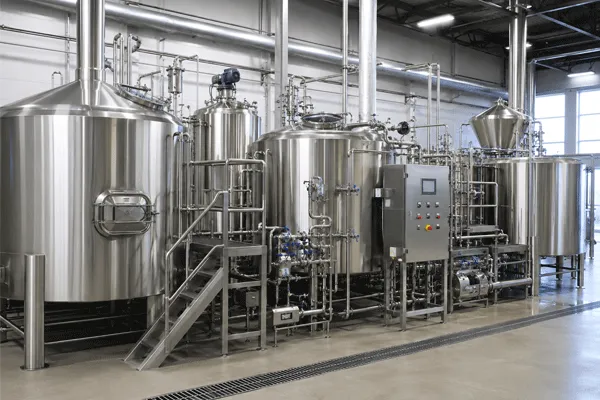
A fermentation tank is the pressure-rated vessel where yeast converts wort into beer — not just a stainless cylinder with a cone on the bottom. In this product line that means a 0.2 MPa design pressure, a 0.3 MPa test pressure, a glycol jacket, and polyurethane insulation, all specific enough to check against a spec sheet before you buy.

The Definition That Actually Matters
Most explanations stop at “a vessel where sugar turns into alcohol.” That’s true but not useful when you’re the one signing a purchase order. A fermentation tank in commercial brewing is a sealed, pressure-rated pressure vessel with three jobs running at once: holding the wort under controlled pressure while CO2 builds up, maintaining a target temperature through a glycol jacket regardless of ambient conditions, and letting yeast and trub settle out through a conical bottom so they can be removed without draining the whole batch.
That third job is why cylindroconical tanks replaced flat-bottomed and horizontal designs in most modern breweries — the cone lets yeast collect and get cropped through a bottom valve instead of scooped by hand. Older open fermenters and horizontal lagering tanks still exist and still work for specific beer styles, but they trade off pressure control and automated yeast handling to do it.
What’s Actually on the Spec Sheet
Here’s where the generic definition stops and the purchasing decision starts. Current fermentation tanks in this range carry:
| Spec | Value |
| Shell material | SUS304 stainless |
| Capacity (barrel line) | 3–5 bbl / 10 bbl / 20 bbl / 40 bbl |
| Capacity (tonnage line) | 2T / 4T / 6T — 2,000L / 4,000L / 6,000L total |
| Çalışma kapasitesi | 1,800L / 3,600L / 5,400L (tonnage line) |
| Jacket | Glycol jacket |
| Isolasyon | Polyurethane |
| Design pressure | 0.2 MPa |
| Test pressure | 0.3 MPa |
Two of these numbers matter more than they look. Design pressure is the ceiling the vessel is built to hold under normal operation — CO2 produced during active fermentation raises internal pressure well above atmospheric, and 0.2 MPa is the working ceiling for this class of tank. Test pressure, at 0.3 MPa, is what the tank gets pressure-tested to before it ships — a 50% margin over design pressure, which is the buffer that keeps a tank safe under a pressure spike, not the number you should be running at day to day.
Working Capacity Isn’t Total Capacity
This trips up more first-time buyers than material grade does. A 2,000L tank (the “2T” designation) has a working capacity of roughly 1,800L — the remaining headspace exists for krausen (the foam layer during active fermentation) and CO2, not because the tank is oversized. Size a fermentation cellar off total capacity instead of working capacity, and the cooling load, the CIP cycle time, and the actual batch count per week will all be off by roughly 10%.
The Unitank Confusion
The other common mix-up: assuming any fermentation tank can double as a bright tank. A unitank — a fermenter fitted with carbonation stones or carbon rods — can carry out both fermentation and the carbonation/conditioning step a separate bright tank would otherwise handle. A standard fermentation tank without that hardware can’t skip the bright tank step; it ferments, but conditioning and carbonation still need a second vessel downstream. Confirm this distinction from the spec sheet, not from the word “fermenter” alone, before assuming you can cut a tank out of your build.
New vs. Used: What Actually Changes
Buying a used fermentation tank doesn’t change the pressure rating math, but it changes what you need to verify before relying on it:
- Confirm the tank still meets its original 0.2 MPa design / 0.3 MPa test rating — ask for the original certificate rather than assuming the rating is unchanged, especially if the tank shows any weld repairs.
- Check the glycol jacket for cracked welds at the shell transition, the most common failure point after a tank has been moved between sites.
- Inspect the polyurethane insulation for compression or delamination — degraded insulation raises glycol consumption even when the shell itself is sound.
- Ask why the tank was decommissioned. A capacity upgrade and a contamination or valve failure carry very different risk profiles for the buyer.
A new tank comes with a spec sheet you can hold the seller to. A used one comes with history you have to reconstruct — the four checks above are the minimum, not a full inspection.

Certification: What to Ask For
Pressure vessels in this category can carry third-party verification rather than a manufacturer’s own declaration. One documented example: Ente Certificazione Macchine Srl issued a Pressure Equipment Verification (certificate 3N231110.SICS093) covering brewing equipment, beer equipment, and pressure vessels against the EU’s 2014/68/EU Pressure Equipment Directive, tested to EN 1626:2008, valid through November 2028. If a supplier tells you a tank is “CE compliant” without naming who tested it, that’s a self-declaration, not third-party verification — the two aren’t interchangeable, and it’s worth asking which one you’re getting.
What This Costs
Standalone fermentation tank pricing isn’t published as an individual line item. What is published: microbrewery equipment packages run 30,000–80,000 USD, and commercial brewery systems starting at 10bbl run 50,000–80,000 USD — both cover full brewing systems, not a single tank. A one-off fermentation tank purchase, new or used, needs a direct quote, and the number moves with capacity, shell thickness, and whether the glycol jacket ships full or partial. Sixteen years of building tanks to this spec doesn’t change the fact that a bare tank’s price depends on the exact configuration — anyone quoting a flat number without asking your capacity and pressure requirements first is guessing.
FAQ
Q: Is a fermentation tank the same thing as a bright tank?
A: No. A fermentation tank runs primary fermentation; a bright tank handles final conditioning and carbonation before packaging. A unitank fitted with carbonation hardware can do both — a standard fermenter without that hardware can’t.
Q: What does “0.2 MPa design pressure” actually mean for daily operation?
A: It’s the pressure ceiling the tank is built to handle during normal fermentation, when CO2 buildup raises internal pressure above atmospheric. It’s not a number you push toward routinely — the 0.3 MPa test pressure exists as the safety margin above it.
Q: Does total tank capacity tell me how much beer I’ll actually get per batch?
A: No — working capacity is lower than total capacity, roughly 1,800L in a 2,000L tank, because headspace is reserved for krausen and CO2. Size your cellar off working capacity, not the number on the tank’s nameplate.
Q: Can I skip a bright tank if I already have fermentation tanks?
A: Only if those tanks are unitanks fitted with carbonation stones or carbon rods. A standard fermentation tank still needs a separate bright tank for conditioning and carbonation.