










Nancy Shang | Founder & CEO | Published July 2026
A datasheet listing “stainless steel, CE-compliant” tells you almost nothing about build quality. Judging a 2–10 BBL brewhouse — new or refurbished — comes down to five checkable items: weld type, jacket coverage, control panel components, valve specs, and pressure test records. Here’s how to walk through each one before you commit.

What’s Actually in a 2–10 BBL Compact System
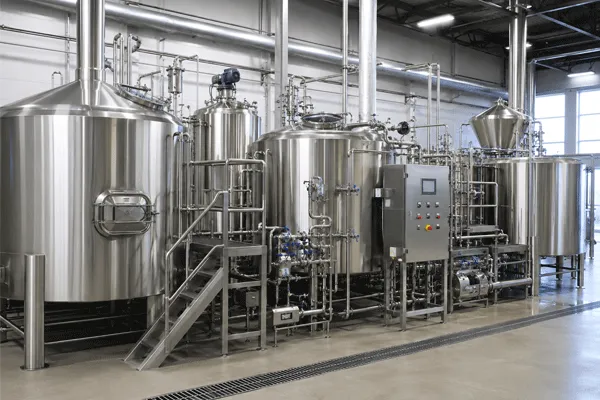
Before getting into inspection criteria, it helps to know what a compact brewhouse in this range typically includes as a package: a mash tun, kettle, and hot liquor tank (HLT), plus pumps, a heat exchanger, and a control panel. That’s the baseline configuration — the differences between one supplier’s version and another’s show up in the five items below, not in the parts list itself.
Step 1: Check the Weld Type, Not Just “Stainless Steel”
Ask specifically whether the shell and pipe welds use TIG (argon-shielded) welding rather than MIG or stick welding — TIG is the standard for food-contact stainless because it produces a cleaner, more controllable weld with less risk of the pitting or crevices that trap bacteria. A well-executed pipe weld is fully penetrated with a single start and stop point, smooth on the inside, and free of the dark discoloration that signals overheating during the weld. If a seller can’t tell you the welding process used, or the equipment shows visible black or blue discoloration around joints, that’s a gap worth pressing on before price negotiation, not after.
Step 2: Verify Jacket Coverage and Insulation
A heating or cooling jacket that only wraps part of the vessel wall will underperform even if the tank looks identical to a fully-jacketed one from the outside. Ask for the jacket coverage as a percentage of vessel surface area, not just “yes, it has a jacket.” Insulation thickness matters the same way — a thin insulation layer on paper can still be marketed as “insulated” while performing noticeably worse on temperature hold and glycol consumption. Get the actual thickness figure in writing, and don’t accept “industry standard” as an answer in place of a number.
Step 3: Confirm What’s Actually in the Control Panel
“Control panel included” can mean a basic on/off switch bank or a PLC with temperature and pressure monitoring — the parts list alone doesn’t distinguish them. Ask for the panel’s component brands (not just “imported” or “industrial-grade”), whether it includes automated temperature control loops or requires manual adjustment, and whether wiring and components carry their own certification separate from the tank’s. A control panel is the part most likely to fail first on a used system, since electrical components age differently than stainless steel.
Step 4: Check Valve and Fitting Specs
Valve material and grade affect both product safety and how long the system runs without a leak. Confirm the valve body material matches the vessel grade (a food-grade tank paired with a lower-grade valve is a mismatch that shows up as contamination risk, not a cosmetic issue), and ask whether valves were pressure- and leak-tested individually or only as part of a system-wide test. Sanitary tri-clamp fittings should show a smooth, unbroken sealing surface — a scratched or pitted gasket surface on a used system is a maintenance cost you’re inheriting, not a solved problem.

Step 5: Request the Pressure Test Record
A pressure test record should state the test pressure applied, the hold duration, and whether the vessel held that pressure without drop. Don’t accept a verbal “it’s been tested” — ask for the number and the date. On a used system, a pressure test performed before your purchase, on your specific vessel, is worth more than a certificate for the same tank model from years earlier, since welds, valves, and jackets degrade individually over time.
Quick Checklist: Red Flags During a Walkthrough
- A supplier that can’t name the welding process (TIG vs. MIG vs. stick) used on the shell
- Jacket or insulation claims given as adjectives (“well insulated”) instead of thickness or coverage numbers
- A control panel description limited to “included” with no component brand or certification detail
- Certifications referenced generically (e.g., “ASME/CE craftsmanship”) without a certificate number or issuing body named
- No pressure test record available, or a record that predates the specific unit being sold by more than a couple of years
- Visible weld discoloration or pitting on a system marketed as “like new”
That fourth point is worth sitting with. A supplier’s marketing page that says a product is built to “ASME/CE” standards without naming a certificate number or the body that issued it isn’t lying, exactly — it’s giving you a craftsmanship reference, not a verifiable compliance document. Treat that phrasing as a starting point for a question, not as proof.
New vs. Refurbished: What Changes in the Evaluation
The five checks above apply to both new and used equipment, but the weight shifts. On a new system, the manufacturer’s spec sheet and factory test records answer most of these questions directly, and your job is mainly confirming the paperwork matches the physical unit. On a refurbished or used 2–10 BBL system, none of the five checks can be taken on faith from the original build — welds, jackets, and control panels have all had time to age independently, and a system that shipped as one grade of quality five years ago isn’t guaranteed to still perform at that level today. Compared to buying sight-unseen off a listing photo, a walkthrough that runs through all five items before final agreement catches the deferred-maintenance costs that a clean stainless exterior hides.

What This Costs
Microbrewery equipment packages in this compact range run 30,000–80,000 USD, and commercial systems starting at 10bbl run 50,000–80,000 USD. Where a specific system lands in that range depends directly on the five factors above — a fully-jacketed system with a PLC-based control panel and documented TIG welds costs more than a partially-jacketed system with a basic switch panel, even at the same nominal BBL rating. Anyone quoting a flat number without asking about weld type, jacket coverage, or control panel components first is pricing the BBL rating alone, not the actual build.
FAQ
Q: Is CE marking enough to confirm build quality on its own?
A: Not by itself. CE compliance can be a manufacturer’s self-declaration rather than third-party-verified — ask whether an independent test body issued a certificate number, and treat a generic “ASME/CE craftsmanship” reference as a starting question rather than a finished answer.
Q: What’s the single most important item to check on a used brewhouse?
A: The pressure test record for that specific unit, dated close to your purchase — it’s the one item that tells you the vessel’s current condition rather than its condition when it left the factory.
Q: Does jacket coverage actually change performance, or is it a minor spec?
A: It changes performance directly. Partial jacket coverage means slower, less even heating or cooling than full coverage, even on tanks that look identical from the outside.
Q: Should a control panel on a used system be inspected differently than the tank itself?
A: Yes. Electrical components typically age and fail on a different timeline than stainless steel — a well-preserved tank can still carry a control panel that needs replacement parts sooner.