

A conical fermenter can make yeast collection easier, but choosing the wrong system may create leaks, cleaning problems, or limits on future production. FastFerment offers an accessible starting point for small batches. Understanding its design and limitations helps brewers decide when a commercial fermentation tank becomes the better investment.
The FastFerment conical fermenter is a food-grade plastic fermentation system designed mainly for homebrewing and small-batch beer, wine, and cider production. Its cone-shaped body, bottom valve, and removable collection ball help separate yeast and sediment. It is useful for learning conical fermentation, while commercial stainless steel fermenters offer greater capacity, integrated cooling, sanitary cleaning systems, and pressure-rated options.
Artikel schets
- What Is the FastFerment Conical Fermenter?
- How Does the FastFerment Collection Ball Work?
- What Are the Main Features and Benefits for Homebrewers?
- What Problems Can Occur With a FastFerment?
- Can FastFerment Handle Primary and Secondary Fermentation?
- How Do Temperature Control and Oxygen Exposure Affect Results?
- How Does FastFerment Compare With Commercial Stainless Steel Fermenters?
- When Should You Upgrade From FastFerment to a Larger Tank?
- What Changes When Moving From 30L to 300L, 500L, or 1000L?
- How Should You Choose Your Next Conical Fermenter?
1. What Is the FastFerment Conical Fermenter?
The FastFerment conical fermenter is a compact fermentation system made for homebrewers, small-batch winemakers, and hobby beverage producers. Unlike a conventional fermentation bucket or glass carboy, it has a cone-shaped bottom that directs yeast and sediment toward a removable collection chamber.
The familiar 7.9 US gallon model has a total capacity of approximately 30 liters. It is commonly used for batches of about 5 US gallons, leaving space for foam during active fermentation. The main vessel is made from food-grade HDPE plastic rather than stainless steel.
Its standard components include:
| Component | Main Function |
|---|---|
| Conical HDPE body | Holds the fermenting beverage |
| Bottom collection ball | Collects settled yeast and sediment |
| Union valve | Separates the main vessel from the collection chamber |
| Screw-top lid | Provides access for filling and cleaning |
| Airlock | Releases fermentation gas |
| Thermowell | Allows temperature measurement |
| Wall-mount brackets | Support the vessel |
| Hose and fittings | Support transfer to another container |
The cone is the most distinctive part of the design. As fermentation slows, yeast and other solids settle toward the bottom of the vessel.
This makes a FastFerment different from a flat-bottomed bucket, where sediment spreads across the floor of the container.
It also makes the product interesting to brewers who want to understand how larger conical fermentation systems work before investing in commercial equipment.
The 7.9-gallon model and its accessories are documented in FastFerment product specifications.
2. How Does the FastFerment Collection Ball Work?
The collection ball is one of the reasons homebrewers choose this type of equipment.
During fermentation, yeast and trub settle toward the bottom of the cone. The bottom valve connects the main vessel to a small removable chamber where some of this material can collect.
When used according to the manufacturer’s instructions, the system allows the brewer to isolate the collection chamber after sediment has settled.
The concept is simple: separate settled material without transferring the entire batch to another vessel.
Why Is Yeast Collection Useful?
Yeast harvesting can be useful for brewers who want to study yeast behavior or manage repeated small batches.
A removable collection chamber may reduce unnecessary handling, but harvested yeast is not automatically suitable for reuse. Its condition depends on strain, fermentation history, sanitation, storage, and other factors.
For a small homebrew setup, the process can be convenient.
However, the collection chamber introduces extra connections that must remain clean and correctly sealed.
The brewer should inspect:
- Collection-ball threads
- Valve seals
- Gaskets and O-rings
- Connection surfaces
- Sediment buildup
- Signs of leakage
Do not unscrew the collection ball while the valve is open or while the assembly is under unsafe pressure.
How Is This Different From Commercial Yeast Harvesting?
A commercial stainless steel conical fermenter normally uses a sanitary bottom outlet for collecting or discharging yeast.
Instead of a small detachable collection ball, larger systems may transfer yeast to a dedicated collection vessel through suitable valves and piping.
This allows operators to manage larger volumes without relying on small threaded plastic fittings.
The underlying idea is similar, but the engineering requirements are very different.
3. What Are the Main FastFerment Features and Benefits for Homebrewers?
A FastFerment can be an attractive step up from a standard fermentation bucket.
For home brew applications, it introduces several process features normally associated with professional conical vessels.
Easier Sediment Management
The cone concentrates settling yeast and sediment near the bottom.
This can make removing sediment easier than using a flat-bottomed bucket, although some solids may still remain inside the vessel.
Less Need for Additional Transfers
Some beer recipes can complete fermentation and conditioning in one container.
That may reduce the need to move beer into another carboy solely for routine sediment separation.
Fewer transfers can also reduce handling time and potential exposure to oxygen.
Temperature Monitoring
The included thermowell provides a place to insert a suitable temperature probe.
This helps the brewer monitor liquid temperature rather than relying only on room temperature.
Monitoring, however, is not the same as active temperature control.
Compact Installation
The system can be mounted to the wall using appropriate supports. A compatible floor stand may also be available.
This makes the design useful where the brewer has limited floor space.
Practical Learning
Perhaps its greatest benefit is educational.
A brewer can learn how conical geometry affects yeast settling, how bottom valves work, and why sanitation becomes more important when a vessel has additional connections.
These are useful lessons before moving into professional beer production.
4. What Problems Can Occur With a FastFerment?
A plastic conical system has advantages, but it also has maintenance challenges.
A leaking valve, damaged thread, or poorly seated gasket can cause product loss. Because the FastFerment has several removable connections, users need to pay close attention during assembly and cleaning.
Leaks Around the Bottom Valve
A leak may occur when a seal is damaged, a connection is assembled incorrectly, or a fitting is overtightened.
The correct response is to inspect the joint and follow the manufacturer’s assembly procedure.
Do not assume that additional tightening always fixes a leak. Excessive force may damage plastic threads.
Sediment Clogging
Some beer recipes produce more trub or sediment than others.
A small outlet may become blocked by settled solids, especially when the batch contains a large amount of hop material or other particles.
This is one reason commercial fermenter outlet sizing is based partly on product characteristics and solids handling.
Cleaning Around Connections
The collection ball, bottom valve, hose, and threaded fittings all require attention.
If residue remains in a connection, it can become a contamination risk for the next batch.
A small system may be cleaned manually, while larger commercial vessels often use integrated Clean-in-Place (CIP) equipment.
Scratches and Material Wear
Food-grade plastic can be suitable for fermentation, but damaged surfaces are harder to inspect and clean.
Avoid abrasive cleaning tools and chemicals or temperatures that exceed the manufacturer’s instructions.
When a plastic vessel develops deep scratches, permanent odors, or damaged fittings, replacement may be more practical than continued use.
A simple maintenance checklist can prevent many problems:
| Item | What to Check |
|---|---|
| Main body | Cracks, scratches, discoloration |
| Collection ball | Seal condition and cleanliness |
| Bottom valve | Movement and leakage |
| Lid | Gasket condition |
| Airlock | Clear gas-release path |
| Thermowell | Secure fitting |
| Mounting system | Stable support and fasteners |
| Transfer hose | Cleanliness and wear |
These checks matter even for small homebrew batches.
5. Can FastFerment Handle Primary and Secondary Fermentation?
A major selling point of the FastFerment system is that a brewer may be able to complete primary fermentation and subsequent conditioning in the same vessel.
During primary fermentation, yeast converts fermentable sugars in the wort into alcohol and carbon dioxide.
After the most active stage, yeast and particles begin settling. The cone helps concentrate some of that material at the bottom.
Removing settled sediment may make additional transfers unnecessary for certain recipes.
However, this does not mean that every beer requires a separate secondary fermentation stage.
Many ales can remain in the primary vessel until they are ready for packaging. Other products may need extended conditioning, clarification, maturation, or transfer for specific process reasons.
The correct approach depends on the product, not on the fermenter manufacturer’s marketing claims.
Does the System Eliminate Racking?
Not entirely.
Even if beer remains inside the same vessel during fermentation and conditioning, it must eventually move into a keg, bottle, or another container.
The system may reduce the number of transfers, but it does not eliminate every transfer or every risk of oxidation.
A careful brewer should still use clean transfer equipment, suitable hoses, and good handling procedures.
For commercial breweries, minimizing oxygen exposure becomes even more important because larger production batches may spend longer in storage and distribution.
6. How Do Temperature Control and Oxygen Exposure Affect Fermentation?
Yeast performance depends strongly on temperature.
If a batch becomes too warm, fermentation may produce unwanted flavors. If it becomes too cold, yeast activity may slow or stop before fermentation is complete.
The FastFerment thermowell helps a brewer monitor temperature, but the standard plastic vessel does not provide the integrated glycol cooling normally found on commercial jacketed fermentation tanks.
A homebrewer may therefore use a temperature-controlled fermentation chamber or another suitable external cooling arrangement.
Why Temperature Monitoring Is Not Enough
Imagine a brewer measuring a fermentation temperature above the desired range.
The thermowell tells the brewer what is happening.
It does not remove the heat.
For small batches, an external fermentation chamber may provide enough cooling.
For a 500L or 1000L commercial system, cooling becomes an engineering requirement.
Commercial equipment commonly uses a temperature sensor, controller, cooling valve, glycol jacket, and chiller.
This makes it possible to manage the heat generated during fermentation more consistently.
What About Oxygen?
The FastFerment airlock allows fermentation gas to escape while limiting outside air exchange.
However, opening connections or transferring beer can still introduce oxygen.
A plastic fermenter should not be treated as a pressure-rated vessel unless its manufacturer explicitly certifies that capability.
Never pressurize a standard FastFerment to perform forced carbonation or pressure transfers.
Commercial unitanks can support controlled-pressure operations only when the vessel and its safety equipment are designed and rated for those conditions.
7. How Does FastFerment Compare With Commercial Stainless Steel Conical Fermenters?
The biggest difference is not simply plastic versus stainless steel.
It is the complete operating environment.
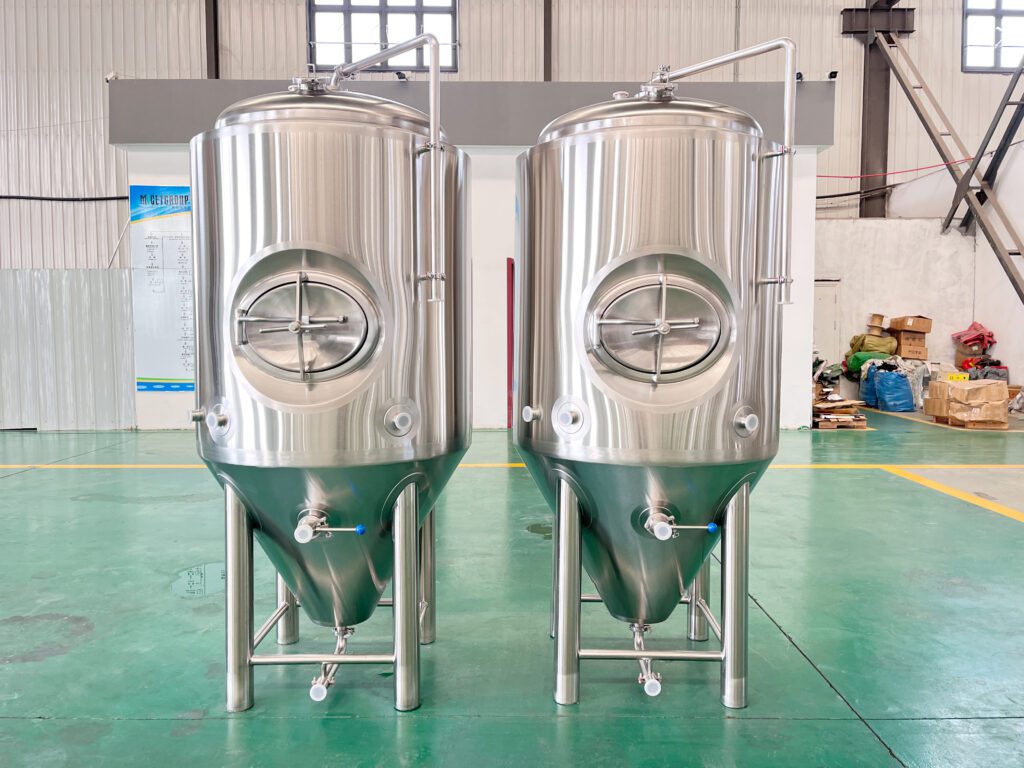
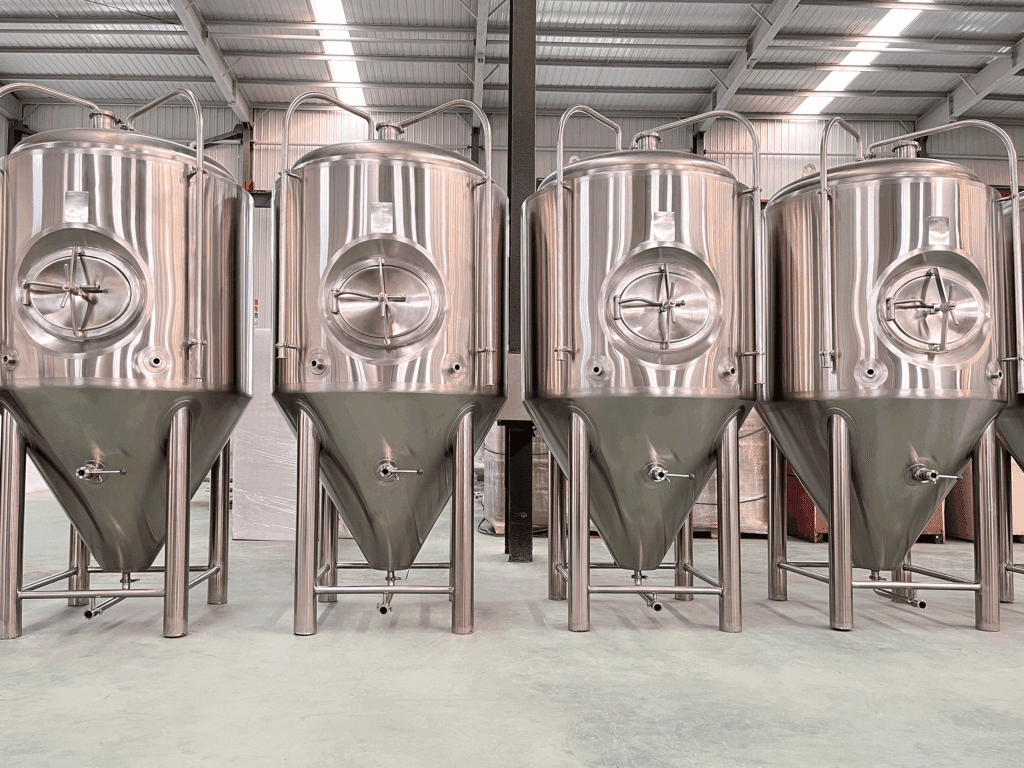
A FastFerment is designed mainly for small-batch fermentation. A commercial conical fermenter is designed for repeated production, larger working volumes, reliable cleaning, temperature management, and integration with other brewery systems.
| Functie | FastFerment 7.9 Gallon | Commercial Stainless Steel Conical Tank |
|---|---|---|
| Typical application | Homebrewing and small-batch testing | Microbrewery and commercial production |
| Materiaal | Food-grade HDPE plastic | Commonly SUS304 or SUS316L |
| Total capacity | Approximately 30L | Often hundreds to thousands of liters |
| Yeast collection | Removable collection ball | Sanitary cone outlet |
| Temperature measurement | Thermowell | Industrial temperature sensors |
| Active cooling | External system if required | Integrated glycol jacket options |
| Pressure operation | Not assumed pressure-rated | Available on suitably rated vessels |
| Schoonmaken | Mainly manual | Manual and/or CIP-ready |
| Product transfer | Hose and small fittings | Sanitary valves and process piping |
| Automatisering | Limited | Manual, semi-automatic, or PLC options |
| Packaging integration | Small batches | Kegs, cans, bottles, or brite tanks |
The choice depends on what the brewer needs to accomplish.
For someone experimenting with recipes at home, a commercial tank may be unnecessary.
For a brewery selling hundreds of liters every week, a small plastic vessel usually creates too much manual handling and too little process capacity.
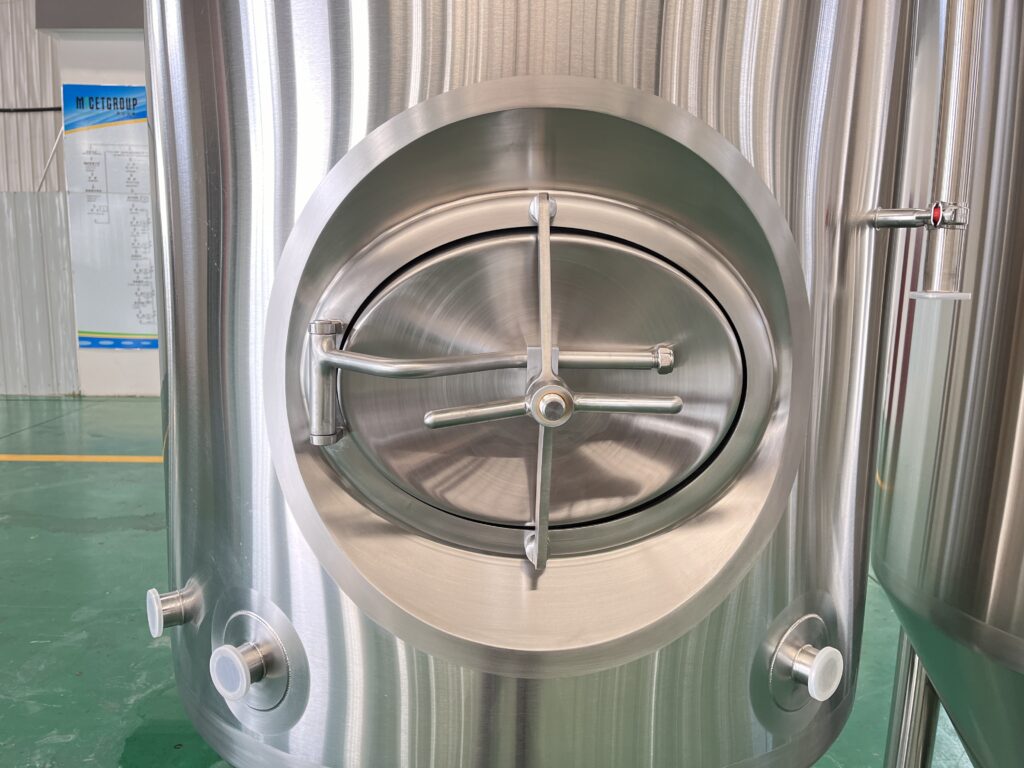
A professional system can also offer features such as insulation, cooling jackets, sampling valves, a racking arm, and an engineered sanitary outlet.
MICET’s gebruikte 500L fermentatietank provides an example of a commercial configuration with a stainless steel conical body, cooling jackets, insulation, and CIP-ready internals.
These are differences in production capability, not just appearance.
8. When Should You Upgrade From FastFerment to a Larger Tank?
There is no fixed batch count that tells every brewer when to upgrade.
The decision depends on production goals, equipment utilization, sales demand, and the amount of manual work involved.
A homebrewer producing one batch occasionally may be happy with a FastFerment for years.
A small business planning weekly production or wholesale distribution faces a different situation.
Signs You May Need More Capacity
Consider a larger system when:
- You regularly need many small batches of the same product.
- Fermentation space limits production.
- Manual cleaning takes too much time.
- You need reliable temperature control.
- Several recipes must ferment simultaneously.
- You need better batch records and repeatability.
- Packaging requires more consistent output.
- You are preparing to operate a licensed commercial brewery.
At this point, the business case extends beyond the purchase price of one fermenter.
You should consider the cost of labor, cleaning, cooling, maintenance, utilities, and production delays.
Does a Bigger Tank Automatically Save Money?
No.
Larger tanks need more investment and may require a glycol system, additional floor space, stronger utilities, and installation support.
However, a correctly sized commercial tank can reduce the number of separate batches needed to achieve a target volume.
For a growing producer, this can simplify scheduling and improve operating consistency.
The key is to match capacity with realistic demand.
9. What Changes When Moving From 30L to 300L, 500L, or 1000L?
Moving from a homebrew conical to commercial fermentation is more than purchasing a bigger version of the same container.
The process becomes more complex as working volume increases.
A FastFerment 7.9-gallon model has a total capacity of approximately 30L, with a typical working batch around 5 US gallons or 19L.
For comparison, a commercial system may use 300L, 500L, or 1000L working-volume tanks.
Illustrative Capacity Comparison
| System | Illustrative Working Batch | Relative to a 19L Homebrew Batch |
|---|---|---|
| FastFerment 7.9G | 19L | 1 batch |
| Commercial pilot fermenter | 300L | About 16 batches |
| Commercial fermenter | 500L | About 26 batches |
| Commercial fermenter | 1000L | About 53 batches |
These are volume equivalents only. They do not represent actual weekly output because fermentation time, cleaning, transfer losses, and production scheduling must also be considered.
The comparison illustrates why equipment scale changes the operating model.
What Becomes More Important?
1. Temperature management
A small batch may be cooled in a fermentation chamber. A larger production system normally needs dedicated cooling equipment.
2. Cleaning
Manually washing one compact plastic vessel is very different from cleaning a 1000L stainless steel fermentation tank.
CIP design, drainage, chemical compatibility, and inspection access become important.
3. Yeast management
Larger yeast quantities require appropriate collection, handling, sanitation, and storage procedures.
4. Production scheduling
A commercial brewery may operate several fermenters simultaneously. One vessel may contain a lager while another produces an ale or cider.
5. Quality control
The brewer may need routine batch records, gravity measurements, temperature history, and consistent operating procedures.
6. Packaging
A homebrewer can fill a few bottles or a keg. A commercial producer needs a packaging plan that matches finished beer output.
Illustrative Upgrade Scenario
Consider a small beverage startup currently testing recipes with 19L batches.
The team develops a beer that receives strong demand from local customers and decides to move toward a 500L production target.
At the testing stage, the main questions are recipe quality and customer response.
At the commercial stage, the questions change:
- Can the brewhouse produce enough wort?
- How many fermentation tanks are needed?
- How long will each beer occupy a tank?
- What glycol cooling capacity is required?
- How will the tanks be cleaned?
- How will the beer be transferred?
- Will finished beer go into kegs or cans?
- Does the building have enough space and drainage?
This is an illustrative scenario, not a published MICET customer project.
It shows why the next investment should be planned as a production system rather than simply replacing a small fermenter with a larger one.
10. How Should You Choose Your Next Conical Fermenter?
If you are moving beyond homebrew production, begin with your actual production requirements.
At MICET, our engineering approach focuses on how the fermentation equipment will work with the brewhouse, cooling system, cleaning process, and packaging plan.
Before requesting a quotation, prepare the following information:
| Requirement | What to Specify |
|---|---|
| Product | Beer, cider, wine, kombucha, or another beverage |
| Batch capacity | Desired working volume |
| Production frequency | Batches per week |
| Fermentation schedule | Typical vessel occupancy |
| Temperatuur | Required fermentation and conditioning range |
| Materiaal | SUS304 or SUS316L where appropriate |
| Pressure | Atmospheric or pressure-rated operation |
| Yeast handling | Collection or discharge requirements |
| Schoonmaken | Manual cleaning or CIP |
| Verpakking | Keg, bottle, can, or bulk transfer |
| Utilities | Electricity, glycol, water, drainage |
| Lay-out | Floor space, ceiling height, access |
| Expansion | Expected future capacity |
New or Refurbished Commercial Fermentation Tanks?
Both may be worth considering.
A new tank offers opportunities to customize its dimensions, fittings, cooling arrangements, and controls around the project.
A refurbished tank may offer a lower initial investment, provided the buyer can verify its condition, cleaning suitability, cooling system, and pressure documentation where applicable.
MICET supplies customized brewing and fermentation systems as well as used or refurbished equipment for suitable projects.
For reference, our used 1000L fermentation tank page describes a stainless steel conical design with insulation, glycol cooling, sanitary fittings, and refurbishment-related information.
Why Work With an Equipment Manufacturer?
When moving from fast ferment homebrew systems to commercial production, buyers need more than a tank catalog.
The equipment must fit:
- The available building space
- Production batch sizes
- Cooling requirements
- Operator workflow
- Cleaning procedures
- Utility connections
- Packaging schedules
- Future expansion plans
MICET supports stainless steel tank customization, brewhouse systems, CAD and 3D layout planning, integration of glycol cooling and other auxiliary equipment, installation guidance, and long-term technical support.
We help craft breweries, brewpubs, commercial beverage producers, cideries, and other B2B customers evaluate the complete production setup.
A small conical fermenter can be a useful place to learn.
When your production goals grow, the next step is choosing an integrated fermentation system designed around your process.
If you are planning to expand from small batches into commercial production, share your current batch size, target output, beverage type, and facility requirements with the MICET engineering team.
We can help you evaluate a suitable new or refurbished commercial fermentation configuration.
Frequently Asked Questions
What is a FastFerment conical fermenter?
The FastFerment is a homebrewing fermentation system with a cone-shaped plastic body, bottom valve, and removable collection ball. The popular 7.9 US gallon version has approximately 30L total capacity and is commonly used for batches around 5 US gallons.
Is FastFerment suitable for commercial brewing?
It is primarily designed for homebrewing and small-batch use. A commercial brewery generally needs larger capacity, more robust sanitation arrangements, active cooling, and equipment suited to its production and regulatory requirements.
Does FastFerment eliminate racking?
It may eliminate the need for a separate secondary vessel in some brewing processes, but finished beer must still be transferred for packaging or serving. Good transfer practices remain important for reducing oxygen exposure.
Can FastFerment be used for wine and cider?
Yes, the system is marketed for small-batch beer and wine production and may be suitable for cider making when used within its material and operating limits. The required cleaning, headspace, and fermentation procedures depend on the beverage.
Can you pressure-ferment or carbonate beer in a FastFerment?
Do not assume a standard plastic FastFerment is pressure-rated. It should not be used for pressure fermentation, forced carbonation, or pressure transfers unless the manufacturer explicitly approves that use and provides the required specifications.
What is the main advantage of a commercial stainless steel conical fermenter?
A commercial stainless steel conical fermenter can provide larger working volume, integrated glycol cooling, more robust cleaning capability, sanitary yeast handling, and suitable pressure-rated options. These features support repeatable production and integration into a professional brewery.
Belangrijkste opmerkingen
- FastFerment is a specific homebrewing product, not a generic name for every conical fermenter.
- The common 7.9-gallon version uses food-grade HDPE plastic and has approximately 30L total capacity.
- Its collection ball helps manage yeast and sediment during small-batch fermentation.
- The cone design can reduce some unnecessary transfers but does not remove every transfer requirement.
- Valves, threads, gaskets, and the collection ball need careful cleaning and inspection.
- A thermowell helps monitor temperature, but active cooling usually requires additional equipment.
- Standard FastFerment systems should not be treated as pressure-rated vessels.
- Commercial stainless steel conical tanks support larger production volumes and more advanced process integration.
- The best time to upgrade depends on sales demand, batch frequency, production efficiency, and future growth.
- Moving from 30L homebrewing to 300–1000L commercial production requires planning beyond tank capacity.
- Cooling, sanitation, layout, utilities, and packaging are important parts of a commercial brewery project.
- Working with an experienced manufacturer can help match fermentation equipment with the complete production process.