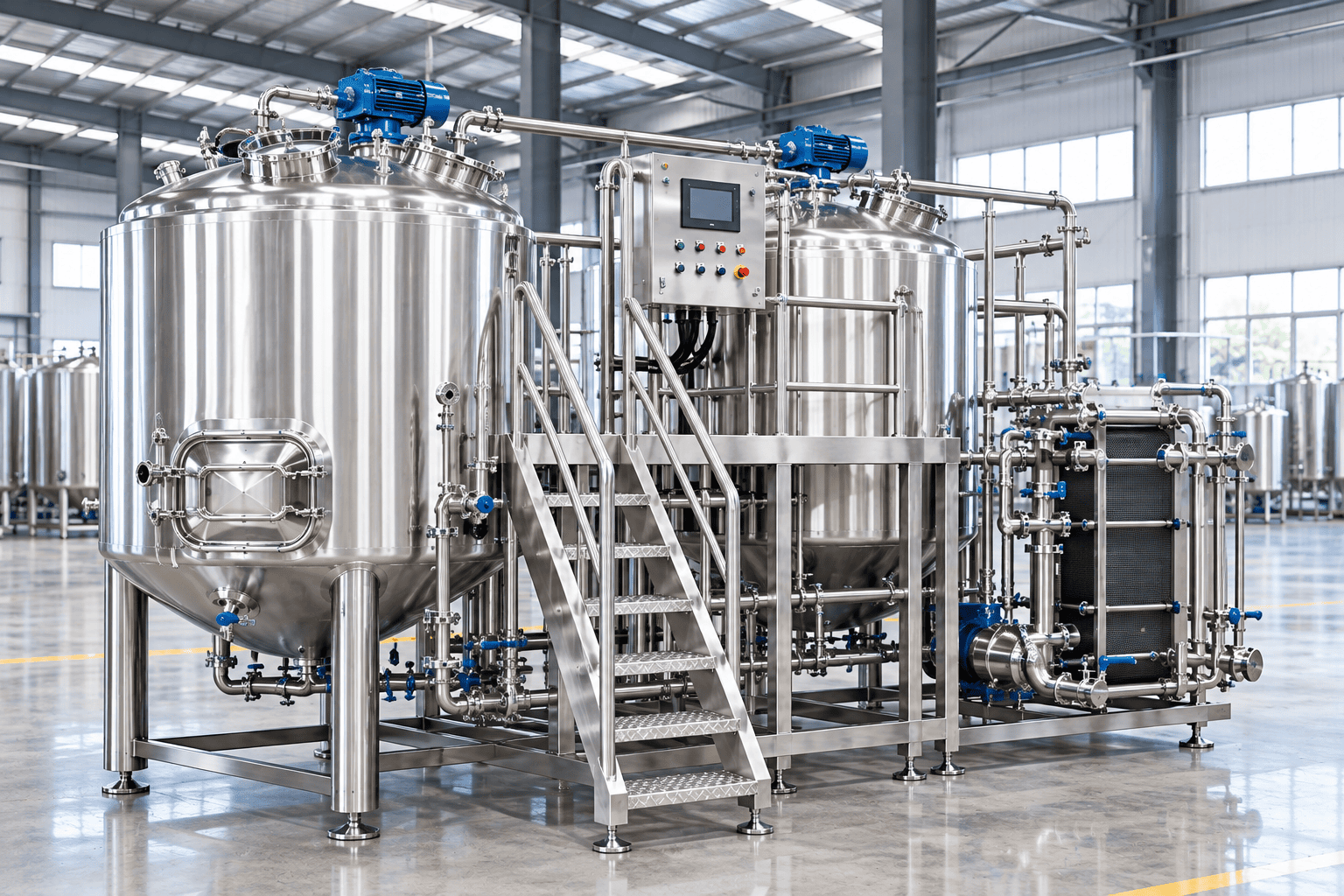
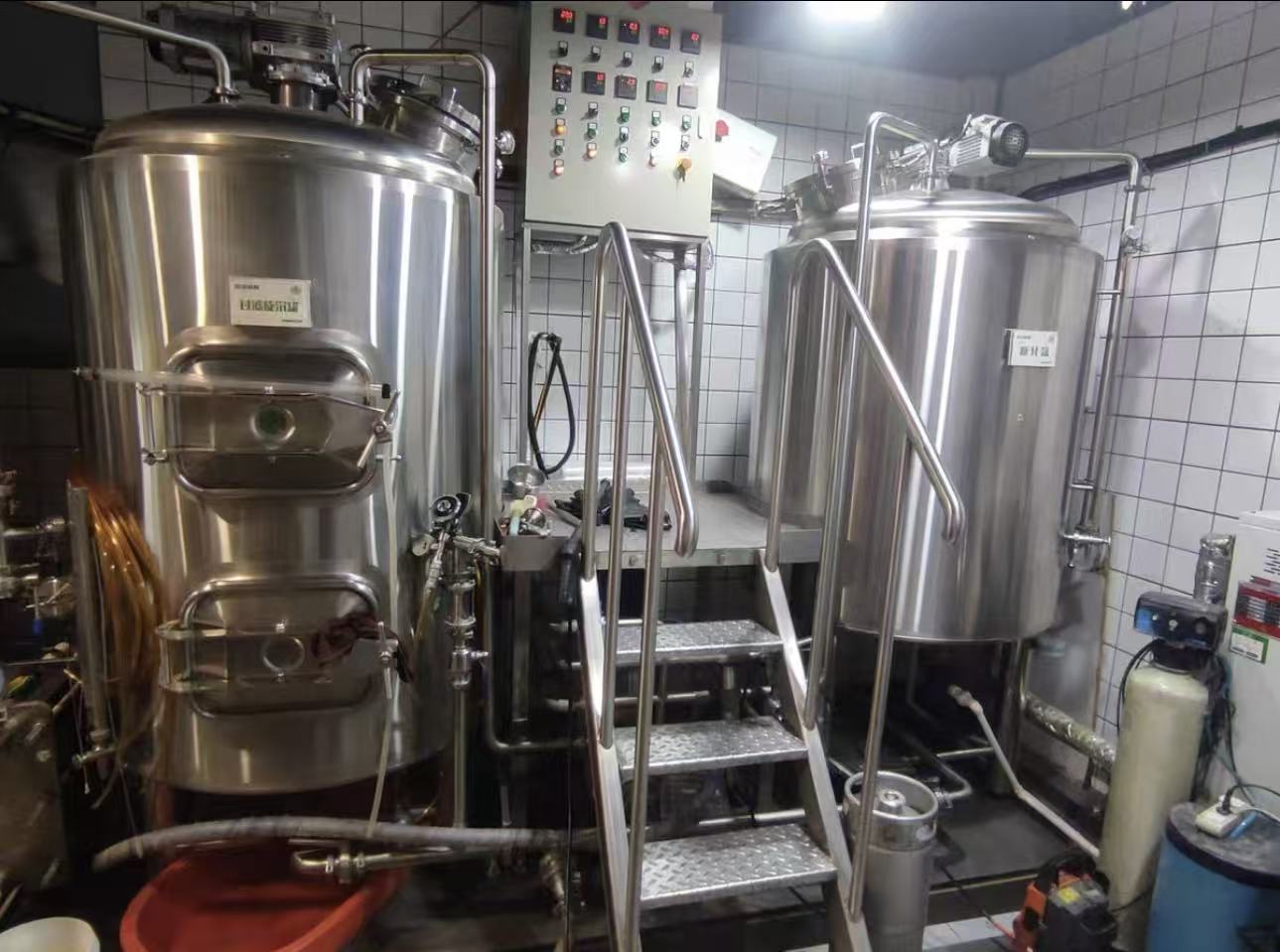
Het kopen van de verkeerde gebruikte tank kan een goede deal veranderen in een kostbare fout. Verborgen schade, gebrekkige hygiëne, een verkeerde drukclassificatie of ontbrekende aansluitingen kunnen de productie vertragen. De verstandige aanpak is om de fermentatietank te inspecteren, de specificaties te controleren en de apparatuur af te stemmen op uw werkelijke proces.
Gebruikte fermentatietanks te koop kunnen een kosteneffectieve keuze zijn voor brouwerijen en wijnmakerijen, kombuchaproducenten, cidermakers en drankprojecten wanneer de tank van roestvrij staal is, goed geïnspecteerd is, geschikt is voor de werkdruk, hygiënisch is en afgestemd is op de batchgrootte, koelbehoeften, aansluitingen, transportbeperkingen en toekomstige uitbreidingsplannen.
Samenvatting
Gebruikte fermentatietanks kunnen de projectkosten verlagen en de levertijd verkorten, maar alleen als de staat van het vat, de aansluitingen, de koelmantel, de drukclassificatie en de reinigingsgeschiedenis zorgvuldig worden gecontroleerd.
Een roestvrijstalen fermentor heeft doorgaans de voorkeur voor professionele bier- en drankenproductie, omdat deze hygiënische reiniging, duurzaamheid en commercieel gebruik op lange termijn ondersteunt.
Voor elk proces boven 15 psi adviseert het Maintenance and Engineering Subcommittee van de Brewers Association om een tank met ASME-certificering te gebruiken.
Hygiëne moet serieus worden genomen. Brouwerijhygiëne omvat meer dan basis-CIP, en meerdere factoren in de productieomgeving kunnen een zuivere bierproductie bevorderen of schaden.
Roestvrij staal kan beschadigd raken door ongeschikte chemicaliën. De Draught Beer Quality Manual van de Brewers Association waarschuwt dat zoutzuur roestvrij staal aantast en niet mag worden gebruikt voor het reinigen van tapleidingen.
Een betrouwbare leverancier van gebruikte tanks moet kopers vóór de aankoop helpen bij het controleren van tekeningen, foto's, specificaties, accessoires, laadwerkzaamheden, verzending en installatievereisten.
Artikel schets
Wat zijn gebruikte fermentatietanks?
Waarom kopen brouwerijen gebruikte fermentoren?
Welke soorten fermentatietanks zijn beschikbaar?
Hoe inspecteert u een gebruikte roestvrijstalen tank?
Welk formaat fermentatietank moet u kiezen?
Welke drukclassificatie en veiligheidsdetails zijn belangrijk?
Welke invloed hebben reiniging, desinfectie en passivering op de waarde van de tank?
Gebruikte fermentor versus nieuwe fermentor: welke is beter?
Wat moet inbegrepen zijn bij de aankoop van een gebruikte tank?
Hoe kunnen B2B-kopers een betrouwbare fabrikant of leverancier vinden?
Wat zijn gebruikte fermentatietanks?
Gebruikte fermentatietanks zijn eerder gebruikte vaten die zijn ontworpen voor gecontroleerde fermentatie. In een brouwerij is de tank de plek waar gist wort omzet in bier. Bij andere drankenprojecten kan een fermentor ook worden gebruikt voor wijn, cider, kombucha of andere gefermenteerde dranken. De belangrijkste taak is eenvoudig: het product veilig opslaan en tegelijkertijd temperatuurregeling, hygiëne en processtabiliteit ondersteunen.
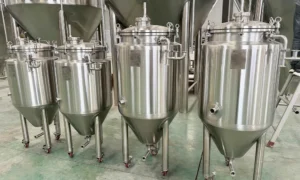
Een professionele fermentatietank is doorgaans gemaakt van roestvrij staal. Veel bierfermentoren hebben een conische bodem, omdat gist en bezinksel zich onderin kunnen verzamelen en via de uitlaat kunnen worden verwijderd. Dit helpt brouwers bij het beheer van gistoogst, klaring en reiniging.
Voor B2B-kopers is een gebruikte fermentatietank niet zomaar tweedehands apparatuur. Het is een productiemiddel. Als de tank degelijk is gebouwd en goed is onderhouden, kan deze nog vele jaren meegaan. Als er verborgen gebreken zijn, kan dit leiden tot kwaliteitsproblemen, reparatiekosten of vertragingen bij de installatie.
Waarom kopen brouwerijen gebruikte fermentoren?
Veel eigenaren van startende brouwerijen zoeken gebruikte apparatuur omdat het initiële budget krap is. Een nieuw brouwhuis, glycolsysteem, fermentoren, helderbiertanks, verpakkingslijn en installatiewerk kunnen snel duur worden. De aanschaf van een gebruikte tank kan helpen de initiële investering te verlagen en meer budget over te houden voor grondstoffen, de inrichting van het proeflokaal, personeelstraining en marketing.
Gevestigde brouwerijen kunnen ook gebruikte fermentoren kopen wanneer ze snel hun capaciteit moeten uitbreiden. Als de vraag naar bier sneller groeit dan verwacht, kan wachten op nieuwe tanks op maat de productie vertragen. Een goede gebruikte fermentor kan soms sneller in het project worden opgenomen, vooral wanneer de tank al uit voorraad beschikbaar is.
Een lage prijs is echter niet het enige doel. De beste deal is de tank die past bij uw batchgrootte, plafondhoogte, koelsysteem, procesdruk, reinigingsmethode en dranktype. Een tank die goedkoop is maar ongeschikt, is geen voordelige keuze. Het leidt gegarandeerd tot vertraging.
Welke soorten fermentatietanks zijn beschikbaar?
Er zijn verschillende veelvoorkomende typen tanks die worden gebruikt bij de drankproductie. De beste keuze hangt af van het product, het proces en de indeling van het gebouw.
| Tanktype | Algemeen gebruik | Belangrijkste voordeel |
|---|---|---|
| Conische fermentor | Bier, cider, kombucha | Eenvoudige verwijdering van gist en bezinksel |
| Cilindrische fermentatietank | Wijn, drankopslag, fermentatie | Eenvoudig ontwerp en flexibel inzetbaar |
| Unitank | Biervergisting en carbonisatie | Kan vergisten en conditioneren in één tank |
| Helderbiertank | Bierconditionering en serveren | Ondersteunt carbonisatie en helder bier |
| Storage tanks | Wijn, water, drankbasis, afgewerkte vloeistof | Flexibele opslag en buffering |
| Tank met mantel | Bier-, kombucha-, wijn- en drankenproductie | Temperatuurregeling |
| Geïsoleerde tank | Koude opslag of gecontroleerde vergisting | Vermindert warmteverlies |
Voor de bierproductie is een conische vergister vaak de meest gebruikelijke keuze. Voor projecten met kombucha, wijn, cider en sap kan het tankontwerp anders zijn. Sommige producenten hebben mangaten aan de bovenkant nodig. Andere hebben mangaten aan de zijkant nodig. Sommige hebben koelmantels nodig. Andere hebben sanitaire sproeibollen, aftaparmen, carbonatiestenen, monsternamekleppen of CIP-aansluitingen nodig.
Als professionele fabrikant van brouwerij-, distilleerderij-, wijnmakerij-, kombucha- en drankapparatuur vragen we kopers meestal eerst naar het product. Een tank voor lagerbier is niet altijd hetzelfde als een tank voor kombucha. Een wijnopslagtank is niet altijd hetzelfde als een drukbestendige biervergister.
Hoe inspecteert u een gebruikte roestvrijstalen tank?
Voordat u een gebruikte tank koopt, is inspectie essentieel. Alleen foto's zijn niet voldoende. Een koper moet de binnen- en buitenkant, lasnaden, aansluitingen, poten, mantel, mangat, kleppen en het druklabel controleren, als dat aanwezig is.
Start with the internal surface. The inside should be smooth, clean, and free from deep scratches, dents, rust, heavy beerstone, pitting, or chemical damage. Light marks may be normal, but deep damage can affect cleaning and sanitation.
Controleer vervolgens de buitenkant. Bekijk de isolatiepanelen, aansluitingen van de koelmantel, de staat van de kuiltjesmantel, poten, voetplaten, hijspunten en de draagconstructie. Een tank die er aan de voorkant goed uitziet, kan aan de achterkant, onderkant of bij de mantelpoorten beschadigd zijn.
Checklist voor de inspectie van gebruikte tanks
| Inspectiepunt | Wat moet u controleren? | Waarom het belangrijk is |
|---|---|---|
| Inner surface | Scratches, rust, pitting, residue | Affects hygiene and cleaning |
| Welds | Cracks, rough welds, repair marks | Affects strength and sanitation |
| Koelmantel | Leaks, pressure test history, fittings | Affects temperature control |
| Manway | Seal condition, hinge, pressure rating | Affects safety and operation |
| Valves and ports | Size, thread, clamp standard, missing parts | Affects installation cost |
| Legs and base | Bent legs, weld damage, leveling feet | Affects stability |
| Pressure label | Rating, certification, test record | Affects safe use |
| Tank size | Diameter, height, working volume | Affects layout and batch planning |
| Shipping condition | Loading method, packaging, container fit | Affects landed cost |
A used tank should be inspected with both production needs and shipping needs in mind. A large tank may be a good price but expensive to move. Always check total cost, not only the listed price.
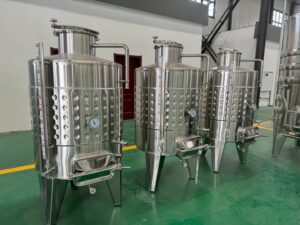
Welk formaat fermentatietank moet u kiezen?
Tank size should match your brewing system and production plan. If your brewhouse makes 10 barrels per batch, your fermenter should normally support that batch volume with enough headspace. If you plan double batching, you may need a larger vessel.
A common planning mistake is buying tanks only for today’s output. A startup brewery may begin small, but if sales grow, fermentation capacity can become the first bottleneck. On the other hand, buying tanks that are too large can waste floor space, cooling energy, and cash.
For beer, buyers often consider:
- Brewhouse batch size
- Fermentation time
- Number of batches per week
- Product mix
- Lagering time
- Dry hopping needs
- Cleaning schedule
- Available cellar space
- Future expansion plan
For kombucha, wine, cider, and other beverage projects, tank sizing depends on fermentation cycle, blending process, storage time, packaging speed, and product demand.
A good rule is to plan the cellar as a system. The fermenter, storage tanks, cooling unit, CIP station, piping, platform, and verpakkingsapparatuur should work together.
Welke drukclassificatie en veiligheidsdetails zijn belangrijk?
Pressure is one of the most important details in a used fermenter purchase. Some tanks are atmospheric. Some are low-pressure. Some are designed for fermentation pressure, carbonation, or serving. Never assume that a tank can safely hold pressure just because it looks strong.
The Brewers Association Maintenance and Engineering Subcommittee recommends brewers use an ASME-rated tank for any process requiring pressure above 15 psi. This matters for unitanks, bright beer tanks, pressure fermentation, carbonation, and any process where the vessel may be pressurized.
ASME explains that its certification programs are connected to public safety and quality, and buyers can use ASME certificate holder resources to verify certified companies.
For used tanks, buyers should check:
- Pressure rating
- Design standard
- Safety valve condition
- Pressure relief setting
- Vacuum relief protection
- Manway pressure compatibility
- Previous pressure test record
- Any repair or modification history
- Local code requirements
Do not use a non-rated tank for pressure work. That is not a place to save money.
Welke invloed hebben reiniging, desinfectie en passivering op de waarde van de tank?
A fermentation tank must be cleanable. A shiny outside does not guarantee a hygienic inside. In beverage production, sanitation affects flavor, shelf life, and product safety.
The Brewers Association notes that sanitation in a brewery involves more than good CIP practices because many items can work for or against clean beer production. The Brewers Association Draught Beer Quality Manual also warns that some acid cleaners can harm stainless steel; for example, hydrochloric acid corrodes stainless steel and should not be used for cleaning draught lines.
Passivation is another important topic. Stainless steel depends on a protective passive layer. When a tank has been repaired, scratched, aggressively cleaned, or exposed to hard water or acidic products, it may need proper cleaning and passivation. The American Homebrewers Association provides practical guidance on cleaning and passivating stainless brewing equipment, including sanitizing or final rinsing after cleaning steps.
For used tanks, buyers should ask:
- What product was previously used in the tank?
- Was it used for beer, wine, sour beer, kombucha, or another product?
- Was the tank cleaned with proper chemicals?
- Are there signs of pitting or corrosion?
- Has the tank been passivated?
- Can the supplier provide internal photos or inspection video?
- Are spray balls and CIP fittings included?
A used tank that was properly cleaned and maintained has higher value than a cheaper vessel with unknown history.
Gebruikte fermentor versus nieuwe fermentor: welke is beter?
A used fermenter and a new fermenter each have advantages. The right choice depends on budget, timing, customization needs, and risk tolerance.
| Decision Point | Used Fermenter | New Fermenter |
|---|---|---|
| Cost | Usually lower upfront cost | Hogere initiële kosten |
| Lead time | Often faster if in stock | Longer if custom manufactured |
| Customization | Limited to existing design | Fully customizable |
| Voorwaarde | Must be inspected carefully | New production condition |
| Warranty | May be limited | Usually clearer warranty terms |
| Fittings | Existing ports may not match your system | Can be designed to your process |
| Appearance | May show wear | New finish |
| Best for | Budget-sensitive expansion | Long-term custom projects |
Used tanks are attractive when the buyer needs an affordable and fast solution. New tanks are better when the buyer needs exact dimensions, specific ports, custom pressure rating, special jacket design, or brand-new appearance.
In our professional experience, many buyers use a mixed strategy. They may buy used fermentation tanks for quick capacity expansion and order new customized tanks for long-term growth. This can be a practical way to control cash flow while building production strength.
Wat moet inbegrepen zijn bij de aankoop van een gebruikte tank?
A used tank purchase should be clear. Before you pay a deposit or place a bid, confirm exactly what is included. A tank without valves, gaskets, fittings, or legs may cost more after replacement.
A good listing should include:
- Tank volume
- Working capacity and total capacity
- Material grade
- Tank diameter and height
- Jacket type
- Insulation information
- Pressure rating
- Manway type
- Valve and port list
- Cooling inlet and outlet size
- CIP spray ball
- Bemonsteringsventiel
- Racking arm
- Thermowell
- Temperature sensor compatibility
- Photos and video
- Loading method
- Packing method
- Shipping dimensions
- Condition notes
If a seller only says “fermentation tanks for sale” without clear specifications, be careful. A professional supplier should be able to provide a structured specification sheet.
Hoe kunnen B2B-kopers een betrouwbare fabrikant of leverancier vinden?
When buyers search for tanks for sale, they often compare price first. That is understandable. But for professional beverage projects, the supplier’s ability matters just as much as the tank price.
A reliable used tank supplier should help you find the right match, not only push available inventory. They should understand beer production, beverage fermentation, sanitary fittings, container loading, international shipping, and installation planning.
As a professional brewery, distillery, winery, kombucha, and beverage equipment manufacturer, as well as a trusted used brewing system supplier, we support buyers with both standard and customized solutions. Our work covers brewery systems, fermentation tanks, conical beer fermenters, storage tanks, used brewing systems, turnkey engineering, CAD/3D layout support, installation guidance, and long-term global technical service.
For importers, distributors, brewery owners, brewpub chains, cider producers, wineries, kombucha brands, beverage co-packers, project investors, and agents, a good supplier should support:
- Technical consultation
- Tank matching
- New and used equipment comparison
- Layout review
- Photos and inspection support
- Fittings verification
- Export packing
- Container loading
- International shipping support
- Spare parts and after-sales service
A cheap listing with “unbeatable prices” may look exciting, but professional buyers should still ask for specifications, inspection details, and total landed cost.
What Trade-Offs Should Buyers Understand Before Purchase?
Used tanks can be a smart purchase, but they are not perfect for every project. The biggest trade-off is flexibility. A used tank already has a fixed height, diameter, port position, jacket design, pressure rating, and appearance. You must adapt your layout and process to the tank.
Another trade-off is inspection effort. New equipment follows a fresh production process. Used equipment needs more checking. You may need extra cleaning, passivation, valve replacement, gasket replacement, or port modification.
A third trade-off is shipping. Sometimes a low-cost tank located far away becomes expensive after freight, loading, customs, and inland transport. This is especially true for large tanks that require special handling.
Used tanks work best when:
- The size matches your process.
- The condition is clearly verified.
- The pressure rating is suitable.
- The fittings match your system.
- The shipping cost is reasonable.
- The supplier can support inspection and export.
Used tanks may not be suitable when:
- You need exact custom dimensions.
- Your ceiling height is limited.
- You need special port positions.
- Your local code requires new certified vessels.
- You need a highly polished showroom appearance.
- The tank history is unclear.
Practical Case Study: Expanding a Craft Brewery with Used Fermentation Tanks
Imagine a craft brewery with a 10 bbl brewhouse. Demand for its IPA and lager grows faster than expected. The owner does not want to replace the whole brewing system. The main problem is cellar capacity.
In this case, used fermentation tanks may be the fastest way to increase output. The brewery can add two or three conical fermenters, connect them to the existing glycol system, and improve weekly production capacity.
But the buyer must check details. Do the tanks fit through the door? Are they too tall for the cellar? Do the jackets match the existing glycol chiller? Are the valves compatible? Can the floor support the weight? Does the pressure rating match the planned beer process?
A careful review can turn a used tank purchase into a successful expansion. A rushed purchase can create installation problems.
FAQ About Used Fermentation Tanks For Sale
Are used fermentation tanks a good choice for a startup brewery?
Yes, used fermentation tanks can be a good choice for a startup brewery when the tank is properly inspected, reasonably priced, and suitable for the planned beer production. They can reduce upfront cost and help the project start faster.
What is the best material for a beer fermenter?
Stainless steel is the most common professional material for a beer fermenter because it is strong, cleanable, durable, and suitable for commercial brewing. Buyers should still confirm material grade, weld quality, and internal surface condition.
Can a used tank be used for kombucha or wine?
Yes, some used tanks can be used for kombucha or wine, but the buyer should check previous use, cleaning history, fittings, pressure needs, and material compatibility. Kombucha and acidic beverages may require extra attention to cleaning and stainless steel condition.
What is a conical fermenter?
A conical fermenter is a fermentation tank with a cone-shaped bottom. In beer production, the conical bottom helps collect yeast and sediment, making yeast removal, cleaning, and product handling easier.
Should I buy a used fermenter or a new one?
Buy a used fermenter if you need faster delivery and lower cost, and the tank specifications match your project. Choose a new fermenter if you need exact customization, special fittings, new appearance, or specific certification requirements.
What should I inspect before buying a used tank?
Inspect internal surface condition, welds, cooling jacket, pressure rating, manway, ports, valves, legs, previous use, cleaning history, and shipping dimensions. Also confirm whether fittings, gaskets, and accessories are included.
Can used tanks be shipped internationally?
Yes, used tanks can be shipped internationally, but the supplier must confirm dimensions, packaging, loading method, container fit, and export documentation. Shipping cost should be included in the total purchase evaluation.
Belangrijkste opmerkingen
Used fermentation tanks for sale can be a smart option for breweries and beverage producers that need cost-effective capacity.
A good used tank should be inspected for internal condition, weld quality, pressure rating, cooling jacket, ports, fittings, and shipping dimensions.
A stainless steel fermenter is usually preferred for commercial beer and beverage production.
A conical fermenter is especially common in beer brewing because it helps manage yeast and sediment.
Do not use a tank above its safe pressure rating.
Cleaning, sanitation, and passivation history affect tank value.
Used tanks are more affordable but less customizable than new tanks.
New tanks are better when exact dimensions, custom fittings, or specific certification is required.
A reliable supplier should help compare used and new options, review layout, confirm accessories, and support shipping.
The best purchase is not the cheapest tank. It is the tank that fits your process, building, budget, and growth plan.