Nancy Shang | Oprichter en CEO, MICET | Gepubliceerd op 18 september 2026
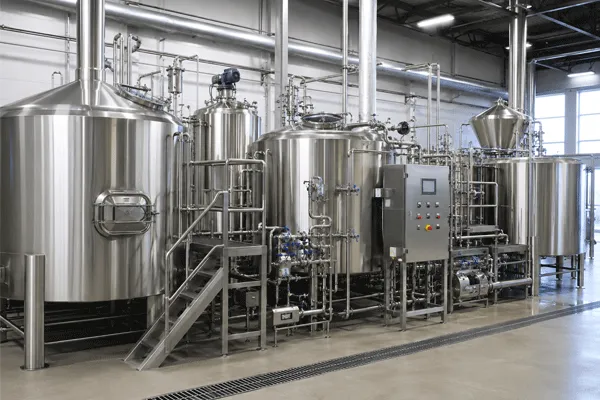
brouwhuislay-out — 2-vessel, 3-vessel, or 4-vessel — decides more than brew day speed: it sets your floor footprint, batch cycle time, and how easily you can add capacity later. MICET’s published used brewhouse package covers a 3-vessel configuration from 2–10 BBL. Here’s how vessel count actually changes cost and expansion.
Vessel Count at a Glance
| 2 ketels | 3-Vessel | 4-Vessel | |
| Typical role | Maisch/filter gecombineerd + kook/whirlpool gecombineerd | Aparte maischkuip, kookketel en HLT (of aparte filterkuip) | Separate mash tun, lauter tun, kettle, and whirlpool |
| Common capacity range | Nano- tot kleine pilotsystemen | Van nano- tot middelgrote craftbrouwerijen (MICET's gebruikte pakket: 2–10 BBL) | Middelgrote craft tot grotere productie |
| Floor footprint | Kleinst — minder tanks, minder aansluitingen | Gemiddeld | Grootst — nog een extra ketel plus bijbehorend leidingwerk |
| Indicatie batchcyclustijd | Trager per batch, aangezien één ketel dubbel werk doet (maischen/klaren, vervolgens gereinigd voor koken/whirlpool) | Faster than 2-vessel, since mash and boil steps don’t compete for the same tank | Fastest cycle time of the three, since whirlpool separation frees the kettle sooner |
| Best fit for | Startups minimizing capex and footprint over throughput | Craftbrouwerijen die vloeroppervlak afwegen tegen productiesnelheid | Brouwerijen die recepten met veel hop brouwen of mikken op een hogere batchfrequentie |
2-ketelsystemen: de standaard voor nano- en proefbrouwerijen
A 2-ketelbrouwhuis combineert maisch- en filterfuncties in één ketel en kook-/whirlpoolfuncties in een tweede. Het is de lay-out waar de meeste nano- en proefbrouwerijen mee beginnen, omdat deze het minste vloeroppervlak vereist en het minste aantal leidingverbindingen om te installeren en te onderhouden.
Het compromis openbaart zich op de brouwdag, niet op het prijskaartje. Omdat hetzelfde vat twee opeenvolgende stappen uitvoert, moet die tank tussen het uitmaischen en koken worden gereinigd en opnieuw worden klaargezet. Dit verlengt de totale brouwdag vergeleken met een opstelling waarin die functies parallel in afzonderlijke vaten kunnen draaien. Voor een brouwer die één of twee batches per week brouwt, maakt die extra cyclustijd zelden uit. Voor een brouwerij die dagelijks batches wil draaien, wordt dit echter het knelpunt.
3-Vessel Systems: Where MICET’s Standard Used Brewhouse Package Lands
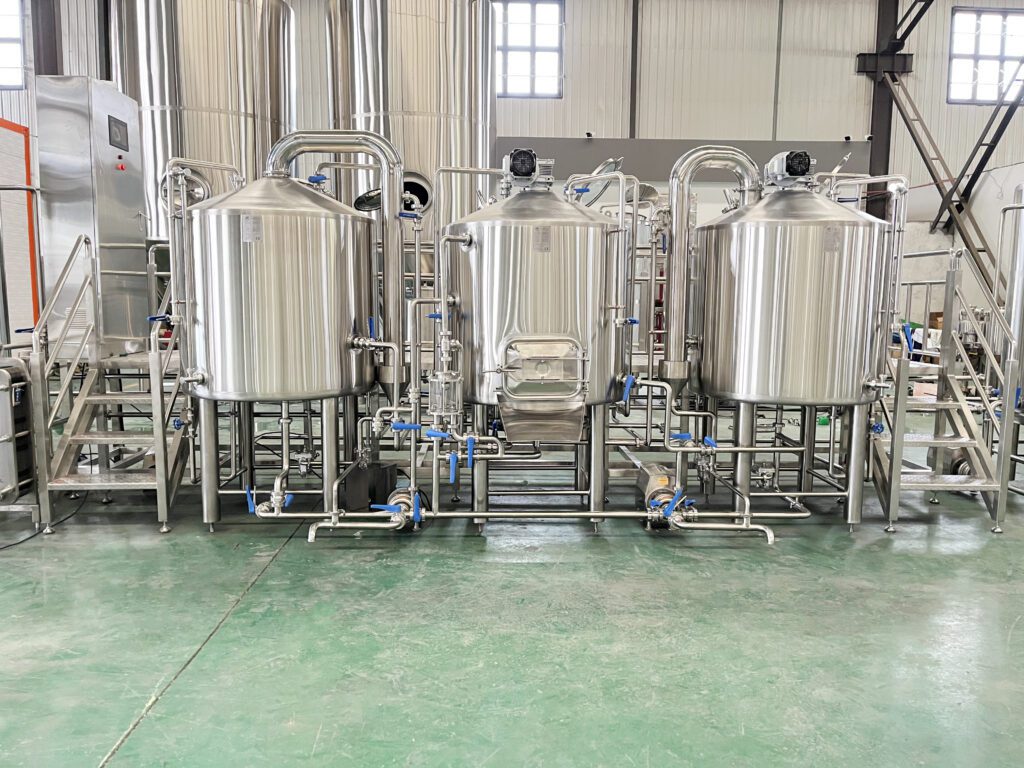
MICET's gepubliceerde gebruikte brouwerijapparatuur line is a 2–10 BBL compact brewhouse configuration built around a mash tun, kettle, and hot liquor tank (HLT) as a set — a 3-vessel arrangement — with pumps, a heat exchanger, and a control panel included in the package.
Splitting mash and kettle functions into separate vessels means mash-out on one tank doesn’t hold up the boil on another; the HLT keeps hot water staged and ready rather than competing for space with the mash process. That’s the main reason 3-vessel layouts dominate the craft segment between nano and mid-size production — the footprint increase over a 2-vessel system is real, but modest compared to the cycle-time gain.
What MICET’s current used inventory listing doesn’t itemize is a separate lauter tun as a fourth vessel option within this package — the published configuration is fixed at mash tun, kettle, and HLT. A brewery wanting a dedicated lauter tun on top of this base package should confirm whether that’s available as an add-on or requires a different configuration entirely.
4-Vessel Systems: wanneer een aparte whirlpool zijn benodigde vloeroppervlak rechtvaardigt
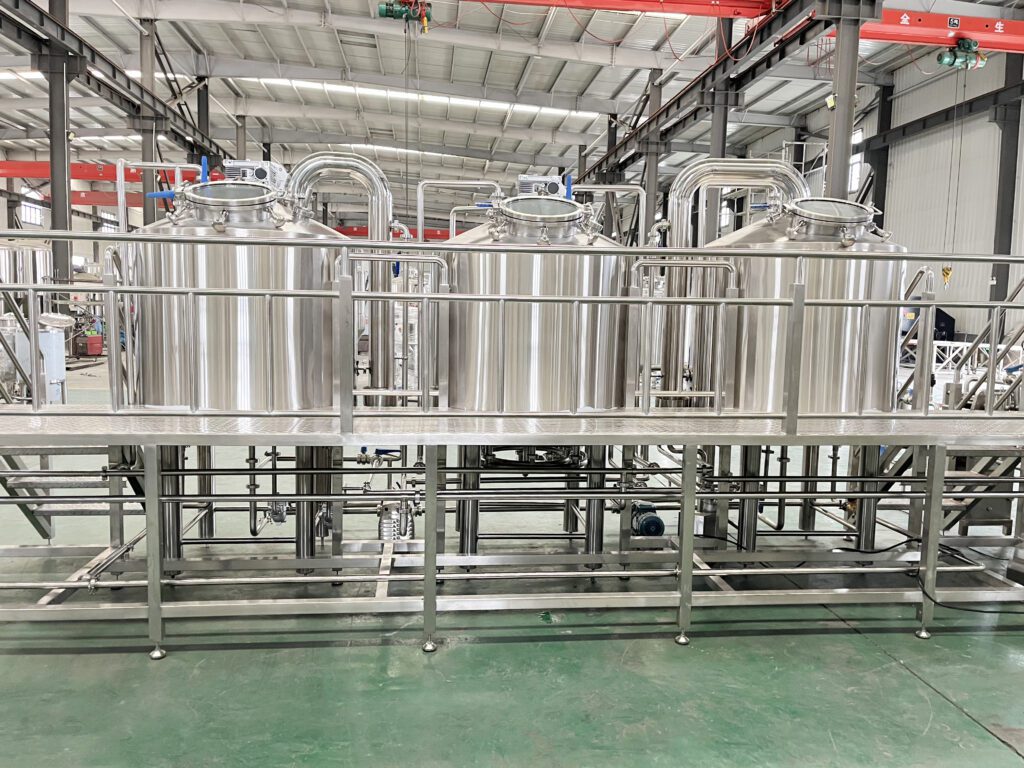
Een 4-ketellay-out voegt een speciale whirlpool toe aan de maischketel, filterkuip en kookketel. De taak van de whirlpool is het scheiden van hop- en eiwittrub uit het wort na het koken. Door dit in een aparte ketel te doen, is de kookketel sneller leeg en weer gereed dan wanneer het whirlpoolen in de kookketel zelf zou plaatsvinden.
That speed advantage matters most for hop-heavy styles — IPAs and other recipes with large late-addition hop charges generate more trub, and a combined kettle/whirlpool vessel takes longer to settle and clear between batches. For a brewery running a hop-forward lineup at higher batch frequency, the extra vessel and floor space typically pay for themselves in throughput. For a brewery with a lighter, less hop-intensive recipe book, the fourth vessel adds cost and footprint without a matching return.
Footprint and Ceiling Height: The Constraint Vessel Count Doesn’t Solve Alone
Het aantal ketels beantwoordt de vraag 'hoeveel tanks', maar twee brouwhuizen met hetzelfde aantal ketels kunnen toch heel verschillende ruimtes vereisen. De plafondhoogte is net zo belangrijk als het vloeroppervlak, aangezien kookketels en whirlpools daarboven vrije ruimte nodig hebben voor ontluchting en toegang, en een op zwaartekracht werkende lay-out (waarbij het wort tussen ketels omlaag stroomt door hoogteverschil in plaats van uitsluitend via pompen) meer verticale vrije ruimte nodig heeft dan een volledig verpompt systeem op één niveau.
Een brouwerij die een winkelpand of bestaande magazijnruimte ombouwt, heeft vaak al te maken met een vaste plafondhoogte voordat het aantal ketels überhaupt ter sprake komt. In dat scenario kan de beperkte plafondhoogte een op zwaartekracht werkende 3- of 4-ketellay-out uitsluiten, ongeacht hoeveel vloeroppervlak er beschikbaar is, waardoor de keuze eerder valt op een configuratie met pompen.
Capex-signalen versus gepubliceerde prijsklassen: wat de cijfers van MICET werkelijk dekken
| Tier | Published Price Range | Wat het omvat |
| Microbrouwerij-apparatuur | 30.000–80.000 USD | System-level bundle; vessel count not broken out separately |
| Commercial brewery equipment (10 BBL minimum) | 50,000–80,000 USD | System-level bundle; vessel count not broken out separately |
| Vergistings-, afvul- en overige aanvullende apparatuur | Niet gepubliceerd | Offerte vereist |
Beide gepubliceerde prijsklassen zijn bedragen op bundelniveau, geen uitsplitsingen per ketel. Dit betekent dat het prijsverschil tussen een 2-ketel- en een 3-ketelsysteem met dezelfde capaciteit niet apart vermeld staat in de beschikbare prijsinformatie van MICET. Een brouwerij die opstellingen op basis van kosten vergelijkt, moet voor elke specifieke configuratie een offerte aanvragen in plaats van uit te gaan van een vast bedrag per ketel over de gehele gepubliceerde prijsklasse.
Het misverstand: meer ketels betekent niet automatisch meer capaciteit
A common assumption is that adding vessels increases batch size. It doesn’t — vessel count changes cycle time and workflow, not the volume of a single batch. A 4-vessel 10 BBL system still produces 10 BBL per batch, the same as a 2-vessel 10 BBL system. What changes is how many batches that brewhouse can realistically run in a week, since separating functions into dedicated vessels reduces the downtime between batches.
Breweries chasing higher output sometimes add vessels expecting bigger batches and end up with the same batch size run more frequently instead. That’s not a bad outcome if throughput was the actual goal, but it’s worth naming the difference before committing capex to a layout change.
Uitbreidingstraject: retrofitten versus starten met overcapaciteit
A brewery starting on a 2-vessel system can generally retrofit toward a 3-vessel layout later by adding a dedicated kettle or HLT, provided the original room has space and utility connections for it. Going from 3-vessel to 4-vessel by adding a whirlpool is usually a smaller retrofit, since it typically fits into existing piping runs more easily than a full mash/lauter split does.
The harder retrofit is capacity, not vessel count — swapping a 5 BBL mash tun for a 10 BBL one usually means replumbing connections sized for the smaller vessel, not just dropping in a bigger tank. Breweries planning to double capacity within a few years often find it cheaper to start with larger vessels running under-filled than to retrofit capacity later, even though the upfront footprint and price are higher.
Certification Note
MICET holds a PED Verification (certificate 3N231110.SICS093, issued by Ente Certificazione Macchine Srl, valid through November 9, 2028) covering brewing equipment, beer equipment, brewery equipment, and pressure vessels under the EU’s Pressure Equipment Directive 2014/68/EU, tested to EN 1626:2008. That verification sits at the organization and product-line level. On the used brewhouse product page specifically, certification is referenced only generically as “ASME/CE” craftsmanship, without a registration number or issuing body — buyers who need documentation for their own jurisdiction should request the specific unit’s paperwork before purchase rather than relying on the general reference.
Before You Commit to a Layout: 4 Questions to Answer
- What’s your target batch frequency, not just batch size — weekly, daily, or somewhere between?
- What does your recipe lineup actually demand — is trub load from hop-heavy styles significant enough to justify a dedicated whirlpool?
- Wat zijn uw plafondhoogte en vloeroppervlak, bevestigd met daadwerkelijke metingen in plaats van uit te gaan van een veronderstelde 'standaardruimte'?
- What’s your 3-year capacity plan — is it cheaper to size vessels for future volume now, or to plan a defined retrofit path later?
FAQ
Q: Does adding a vessel to a brewhouse increase batch size?
A: No. Vessel count affects cycle time and workflow speed, not the volume of a single batch. A 10 BBL system produces 10 BBL per batch whether it’s a 2-vessel or 4-vessel layout — more vessels mean the brewhouse can typically run more batches per week, not bigger ones.
V: Welke ketelconfiguratie omvat het pakket met gebruikte brouwzaalapparatuur van MICET?
A: The published 2–10 BBL used brewery equipment package is a 3-vessel configuration — mash tun, kettle, and hot liquor tank — with pumps, a heat exchanger, and a control panel included.
Q: Is a 4-vessel system worth the extra footprint?
A: Dat hangt af van het receptengamma en de beoogde batchfrequentie. Bij hoprijke bierstijlen met een aanzienlijke trubbelasting en voor brouwerijen die streven naar een hogere batchfrequentie, levert een aparte whirlpool meestal het duidelijkste rendement op. Voor een lichter, minder hopintensief assortiment is dit vaak niet nodig.
V: Dekt de certificering van MICET de conformiteit voor drukvaten van gebruikte brouwzaalapparatuur?
A: MICET’s PED Verification (3N231110.SICS093) covers brewing and pressure vessel equipment at the organization and product-line level. The used brewhouse product page itself references certification only generically as “ASME/CE” without a specific registration number, so individual-unit documentation should be confirmed directly before purchase.