










Nancy Shang | Founder & CEO | Published July 30, 2026
SUS304 handles standard beer fermentation and bright tank duty; SUS316L earns its higher price when the batch is acidic, chloride-heavy, or the tank sees aggressive CIP chemicals daily. Below are the actual dimensions, pressure ratings, and inspection points that separate the two on paper and in a used tank yard.

What SUS304 and SUS316L Actually Differ On
SUS304 is an 18% chromium, 8% nickel austenitic stainless. It resists standard fermentation acids, wort, and routine caustic CIP cycles without issue, which is why most craft brewhouses, fermenters, and bright beer tanks ship in 304. SUS316L adds molybdenum to the alloy and lowers carbon content — the “L” — which cuts down on carbide precipitation at weld seams. Practically, that means less pitting risk where the shell was TIG-welded, and better tolerance for chloride exposure (coastal water supplies, brine-based glycol systems, or high-salt cleaning agents).
Neither grade is “better” in a vacuum. A brewery running standard ale or lager batches on a municipal water supply gets no measurable benefit from paying the 316L premium on a fermenter shell. A winery or kombucha operation running higher-acid, higher-chloride product through the same vessel week after week is a different case — weld-seam corrosion shows up faster there, and it shows up first at the exact spots a rushed pre-purchase inspection skips.
Fermentation Tank Spec Sheet: Capacity, Shell, Insulation
Used and new fermentation tanks in the current product range run across two sizing conventions — barrel-based for craft brewhouses, and tonnage-based for larger installations:
| Sizing | Capaciteit | Shell Material | Jacket | Isolatie | Ontwerpdruk | Test Pressure |
| Barrel (bbl) | 3–5 bbl / 10 bbl / 20 bbl / 40 bbl | SUS304 | Glycol jacket | Polyurethane | 0.2 MPa | 0.3 MPa |
| Tonnage | 2T / 4T / 6T (2,000L / 4,000L / 6,000L total; 1,800L / 3,600L / 5,400L working) | SUS304 | Glycol jacket | Polyurethane | 0.2 MPa | 0.3 MPa |
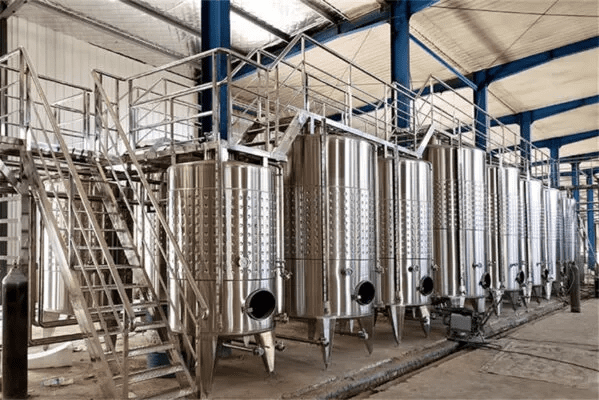
| Wine fermentation | 5,000L / 10,000L | SUS304 or SUS316L | — | Polyurethane, 80–100mm | — | — |
Two things worth flagging in that table. First, total capacity and working capacity aren’t the same number — a 2,000L tank holds roughly 1,800L of actual product once you leave headspace for krausen and CO2, and buyers sizing a fermentation cellar off total capacity alone routinely undersize their cooling load. Second, the wine fermentation line is the one place SUS316L shows up as a standard shell option rather than an upgrade, with inner shell around 3.0mm and outer shell around 2.0mm — thicker than most beer-only fermenters, because wine tanks are built to also handle must with skins and seeds moving through pumps and valves.
SUS304 vs SUS316L: Side-by-Side
| Factor | SUS304 | SUS316L |
| Chromium / Nickel | 18% / 8% | Similar, plus molybdenum |
| Chloride resistance | Adequate for municipal water, standard CIP | Better under brine, coastal water, aggressive acids |
| Weld-seam corrosion risk | Standard | Lower, due to reduced carbon content |
| Typical use in this product line | Beer fermenters, bright tanks | Wine fermentation tanks, high-acid or high-chloride runs |
| Relative cost | Baseline | Higher — expect a premium over an equivalent 304 tank |
| Where it’s overkill | High-chloride, high-acid, marine environments | Standard ale/lager fermentation on municipal water |
Compared to painted carbon-steel or plastic-lined vessels still found in some entry-level home-to-commercial upgrade setups, both stainless grades solve the corrosion problem outright — the 304-vs-316L decision only matters once carbon steel is already off the table.
The Misconception That Costs Buyers Money
The most common mistake isn’t picking the wrong grade — it’s assuming a tank is fully one grade when only part of it is. A conical bottom or a set of tri-clamp fittings can be 316L while the cylindrical shell above it is 304, and a spec sheet that just says “SUS304/316L available” doesn’t tell you which component got which grade. On a new build, MICET’s spec sheet resolves this per line item. On a used tank sourced secondhand, the mill certificate is often missing entirely, and the seller’s word is the only documentation available.
If a mill certificate isn’t available, three checks narrow the uncertainty:
- Run a magnet test on the shell, the jacket, and every fitting separately — austenitic 304 and 316L are both weakly magnetic to non-magnetic, but a strongly magnetic patch anywhere signals carbon steel or a repaired weld using the wrong filler rod.
- Inspect weld seams under strong light for surface pitting or a rainbow discoloration — a sign of inadequate post-weld passivation, which shortens service life regardless of the base grade.
- Ask for the tank’s cleaning chemical history — a tank that’s run high-chlorine sanitizer for years on 304 will show more surface degradation than the same age tank in 316L, even if both look clean at a glance.
Buying a Tweedehands Fermentatietank: What to Check Beyond the Grade
A used tank’s real condition depends on more than the alloy stamped on the nameplate. Before signing off on a secondhand fermenter or bright tank:
- Confirm the design pressure and test pressure match what the original build sheet states (0.2 MPa design / 0.3 MPa test is standard for this tank class) — a tank re-rated downward after a repair should be priced and used accordingly.
- Check the glycol jacket for weld cracks at the jacket-to-shell transition, the most common failure point on tanks that have been through multiple relocations.
- Verify the polyurethane insulation hasn’t compressed or delaminated, since that directly affects glycol consumption and temperature stability, not just cosmetic condition.
- Ask whether the tank was decommissioned for a production reason (contamination, valve failure) or simply because the previous owner upgraded capacity — the two carry very different risk profiles.
Certification: What’s Actually on Paper
Beer and wine tank pressure vessels in this category can carry third-party PED verification rather than a manufacturer’s self-declaration alone. One documented example: a Pressure Equipment Verification (certificate 3N231110.SICS093) issued by Ente Certificazione Macchine Srl covers brewing equipment, beer equipment, and pressure vessels against the EU’s 2014/68/EU Pressure Equipment Directive, tested to EN 1626:2008, valid through November 2028. That kind of third-party sign-off is worth asking for specifically — a generic “CE compliant” line on a spec sheet doesn’t tell you whether an independent body actually tested the pressure rating or whether the manufacturer simply declared it.
For fermentation tanks specifically, no separate certificate numbers are published beyond that pressure-directive coverage, so if a supplier claims additional certifications for the tank line itself, ask them to produce the document rather than take the claim at face value.
Pricing: What’s Published, What Requires a Quote
Standalone fermentation tank pricing isn’t published as its own line item. What is published: microbrewery equipment packages run 30,000–80,000 USD, and commercial brewery systems starting at 10bbl run 50,000–80,000 USD — but those figures cover full brewing systems, not an isolated tank purchase. A single 2T or 4T fermentation tank, new or used, needs a direct quote, and pricing will move with grade (304 vs 316L), wall thickness, and whether it ships with a full glycol jacket or a partial one.
The tradeoff worth stating plainly: 316L costs more up front, and on a standard beer-only production line that premium buys corrosion margin you may never use. It’s the right spend when the product or the water supply demands it, not as a default upgrade.
FAQ
Q: Can a SUS304 fermentation tank be used for wine or kombucha?
A: Yes, for lower-acid runs and standard cleaning cycles. Higher-acid, higher-chloride production is where 316L’s corrosion margin starts to matter — check your specific water and cleaning chemical profile rather than assuming based on product category alone.
Q: Does a thicker shell always mean a better tank?
A: Not by itself. The wine fermentation line’s 3.0mm inner / 2.0mm outer shell reflects the mechanical demands of handling must with skins and seeds, not a general corrosion or pressure advantage — a thinner 304 beer fermenter built to spec for its actual duty isn’t undersized.
Q: How do I know if a used tank still meets its original pressure rating?
A: Ask for the original test certificate showing the 0.2 MPa design / 0.3 MPa test figures, and have any repaired welds re-inspected before relying on the original rating — a repair that wasn’t re-tested is an unknown, not a pass.
Q: Is SUS316L worth it for a standard 10bbl craft brewery on municipal water?
A: Generally no. The corrosion cases where 316L pays for itself involve chloride or acid exposure beyond what standard tap water and routine CIP produce.