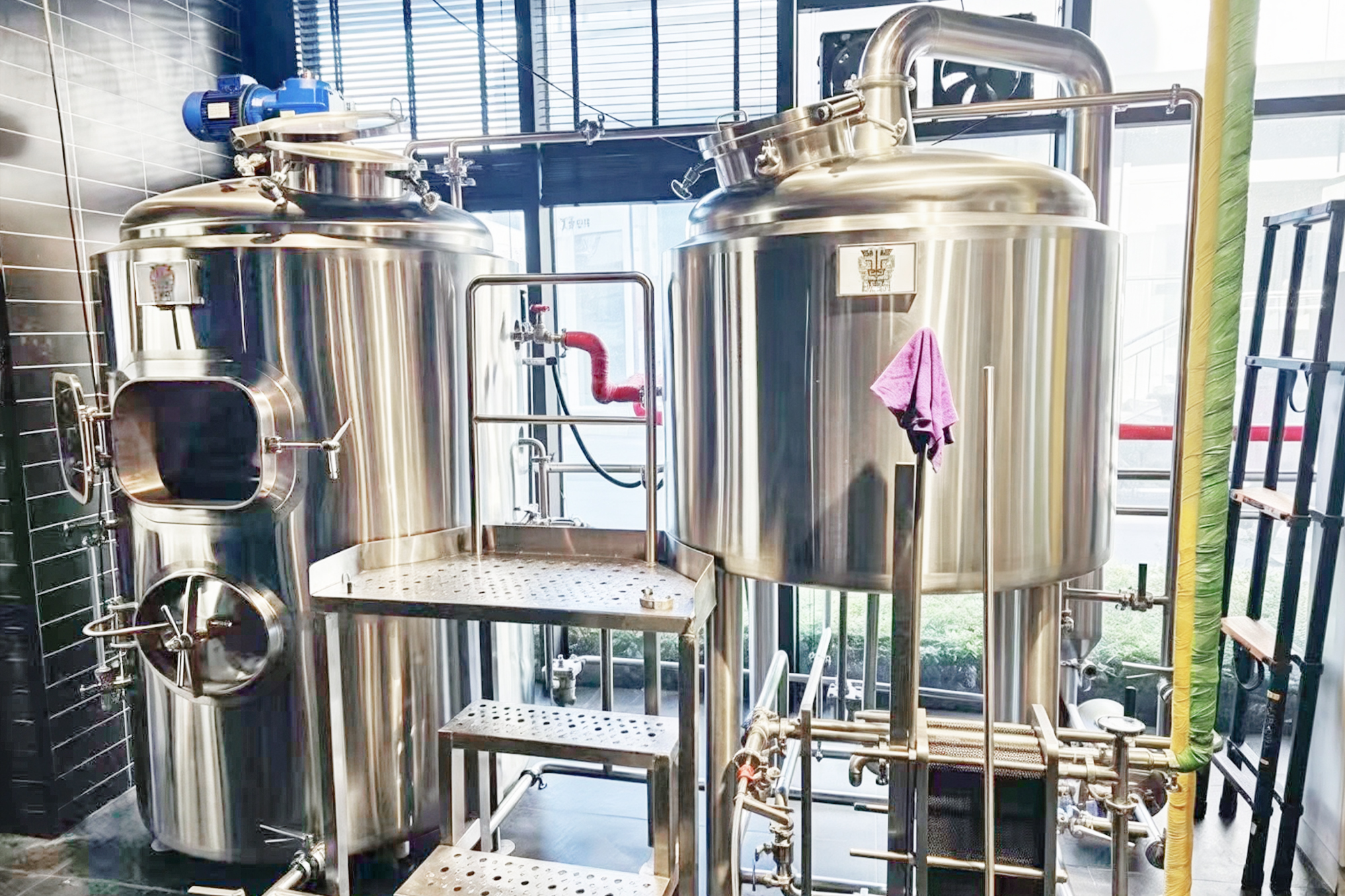
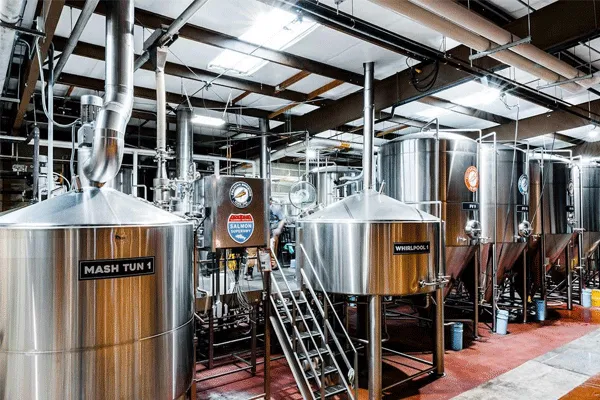
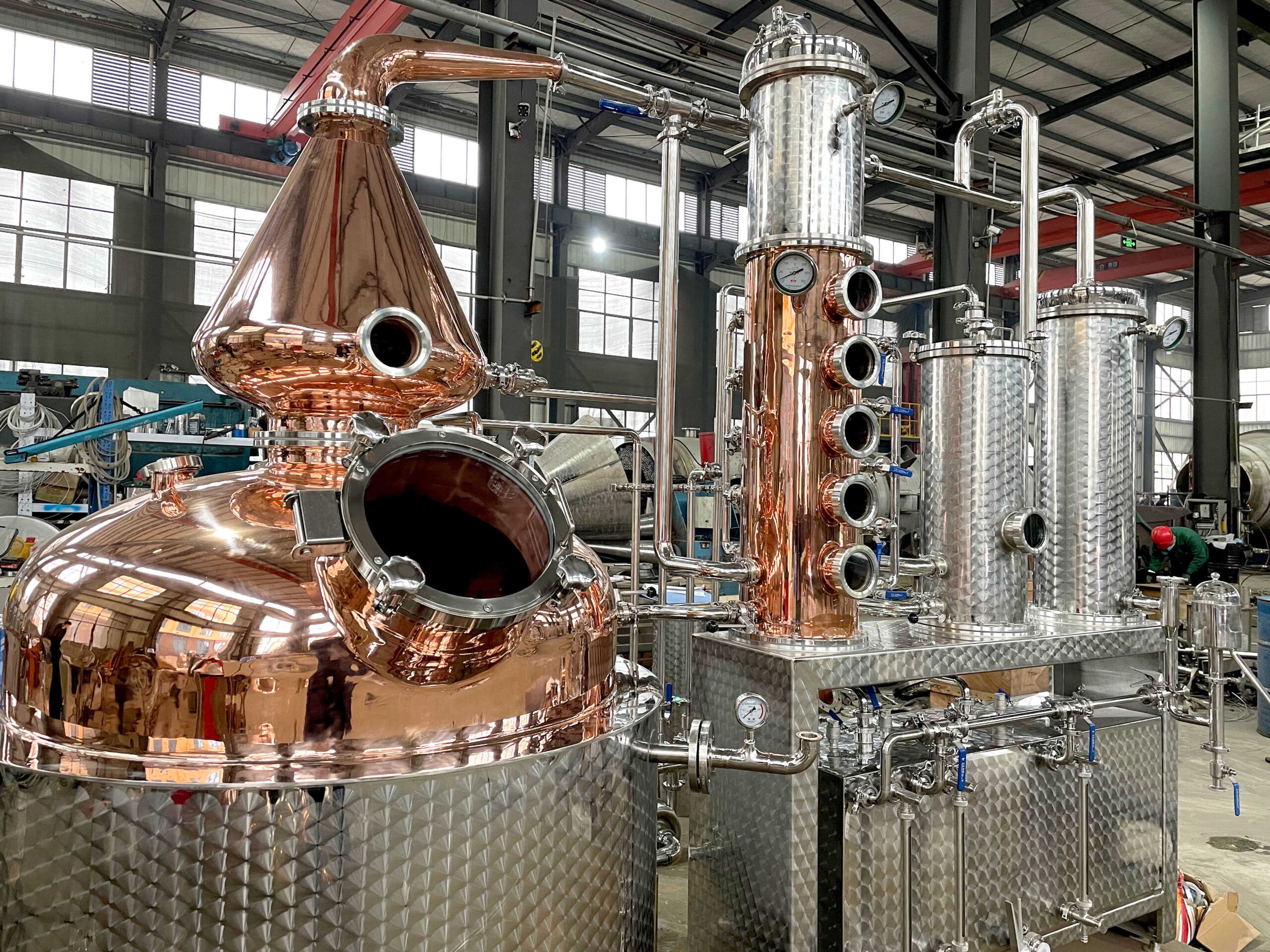
Проверка компании по производству пивоваренного оборудования означает разграничение трёх бизнес-моделей (прямой производитель, брокер, реселлер), проверку сертификатов по фактическому номеру сертификата, а не по логотипу, и личную оценку инженерной компетенции завода до подписания договора. Всё остальное вытекает из этих трёх проверок.
Три типа компаний, продающих вам пивоваренное оборудование
Результаты поиска по запросу «компании по производству пивоваренного оборудования» выдают сотни англоязычных сайтов, звучащих совершенно одинаково: комплексные решения, сертификация ISO, десятилетия опыта, более 1000 установок по всему миру. За этими главными страницами скрываются три совершенно разные бизнес-модели, и ваши расходы будут выглядеть по-разному в зависимости от того, у кого вы в действительности купили оборудование.
Прямой производитель. Владеет производственным предприятием. Имеет собственных сварщиков, инженеров по панелям управления и сотрудников отдела контроля качества. Отдел продаж и производственный цех находятся на одной площадке или в рамках одной компании. Цена включает только производственную маржу. Вопросы после продажи решают люди, изготовившие оборудование.
Брокер или торговая компания. Не имеет собственного производства. Закупает продукцию у сети заводов-партнёров, добавляет наценку 15–30% и проводит ребрендинг. На публичном сайте её часто невозможно отличить от производителя, поскольку сайт создан так, чтобы выглядеть идентично. Проблемы после продажи направляются через брокера обратно на тот завод-партнёр, который изготовил именно ваше оборудование, а скорость ответа зависит от того, насколько важным для этого завода был ваш заказ.
Местный реселлер. Дистрибьютор в вашем регионе, который импортирует контейнеры от одного или нескольких китайских производителей или брокеров, а затем перепродаёт их с местной поддержкой. Цены включают наценку брокера, маржу реселлера и внутреннюю логистику. Преимущество — местные специалисты и местное оформление документов. Недостаток — два дополнительных звена между вами и производственным цехом.
Ни один из этих трёх вариантов не является автоматически неправильным. Местный реселлер с настоящими техническими специалистами решает проблемы, которые прямой производитель из Шаньдуна не сможет решить во вторник днём в Сан-Паулу. Брокер с действительно глубокими возможностями поиска поставщиков может предложить конфигурации, которых нет ни у одного отдельного завода. Но вы не сможете принять такое решение, пока не поймёте, с кем именно разговариваете, — а большинство брокеров не станут сами сообщать об этом различии.
Сравнение вкратце
| Параметр | Прямой производитель | Broker / Trading Company | Local Reseller |
| Owns fabrication | Да | No | No |
| Price markup layers | 0 | 1–2 | 2–3 |
| Certificate numbers on file | Usually verifiable | Depends on partner factory | Depends on chain of custody |
| Deep customization | Wide range | Limited to partner factory’s standards | Very limited |
| Real factory tour possible | Yes, at own facility | No, or arranged theater tour | No |
| Refurb / used inventory access | Case-by-case | Rare | Rare |
| Lead-time control | Direct | One extra decision layer | Two extra layers |
| After-sales response | Direct engineering | Broker → factory → engineer | Reseller → broker → factory |
| Cheapest for standard configs | Not always | Sometimes | Rarely |
| Best for regulated markets | Yes, if certs are traceable | Risky | Depends |
The compressed version: cheaper up-front is not always cheaper over five years, and shorter response chains matter far more than the buyer thinks until something breaks.
Certifications: What to Ask For, and What “CE Compliant” Isn’t
The single most abused phrase in this industry is “CE certified.” CE is a self-declaration mechanism under EU directives, not a certificate issued by a single body. When a supplier’s site says “CE certified” with no directive, no standard, and no verification body listed, that phrase is doing zero work.
A defensible certification claim for brewing equipment names three things: the directive, the standard, and either the verifying body plus a certificate number, or the manufacturer’s own Declaration of Conformity with a technical file reference. For brewing equipment specifically, expect to see:
- Pressure Equipment Directive 2014/68/EU (PED)— required for any pressurized vessel (fermenters, bright tanks, kettle with pressure rating), with standard EN 1626:2008 referenced for cryogenic valves and related components.
- Machinery Directive 2006/42/EC— required for the mechanical assembly and safety of the equipment, with standards including EN ISO 12100:2010 (safety of machinery — general principles) and EN 60204-1:2018 (electrical equipment of machines).
- EMC Directive 2014/30/EU— required for the electrical control system’s electromagnetic compatibility, with standards EN IEC 61000-6-2:2019 and EN IEC 61000-6-4:2019.
- For packaging lines specifically, add EN 415-3:2021and EN 415-10:2014 for filling and packaging machinery safety.
A working example of what real disclosure looks like — this is a set actually issued to a China-based brewing equipment manufacturer:
| Document Type | Certificate Number | Issuing Body | Validity |
| PED Verification | 3N231110.SICS093 | Ente Certificazione Macchine Srl | 2023-11-10 to 2028-11-09 |
| Machinery + EMC Attestation | M.2025.206.C131636 | UDEM (Turkey) | Valid to 2030-12-15 |
| CE PED Report | UAC231101SIC01PED | UAC Quality Technology Service Limited | Dated 2023-10-20 |
| Voluntary Verification of Conformity | ICR/VC/HM2507146 | ICR Co., Ltd. | 2025-07-16 to 2030-07-15 |
| CE MD Test Report | XDH40255041120802FAR | BST Testing (Shenzhen) Co., Ltd. | 2025-11-25 to 2025-12-08 |
You do not need the supplier to have exactly this list. You need any list at all, with numbers you can look up on the issuing body’s site. A supplier who cannot produce a certificate number when you ask has told you the certificate does not meaningfully exist.
Ask ISO 9001 separately. ISO 9001 is a quality management system certification, not a product certification, and many brewing equipment companies conflate the two. If the supplier says “ISO 9001,” ask which body issued it, when, and for which specific facility. A group ISO 9001 issued at head office does not cover fabrication done at a partner factory 800 km away.
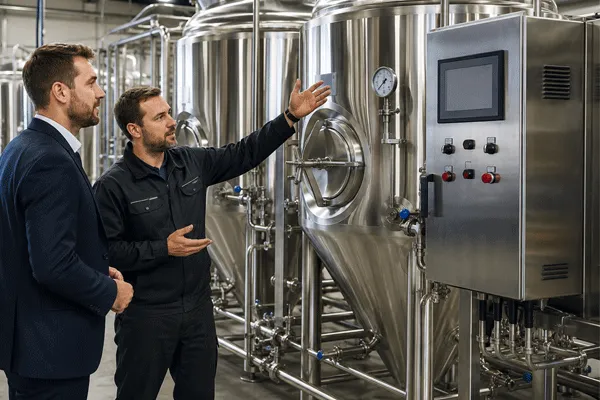
Сайт Factory Tour Checklist
If you are placing an order above USD 200,000, you visit the factory. If your travel budget cannot cover that, send a third-party inspection service (SGS, Bureau Veritas, TÜV) to do it for you. This is not optional at that dollar figure.
What to look at, in order:
- The address matches the entity on the pro forma invoice.Sounds obvious. It is the single most common misalignment. If the sales entity is registered in Hong Kong or Shenzhen but the factory is in a completely different province with a different owner, you have a broker relationship you were not told about.
- Raw material storage and traceability.Ask to see the stainless steel storage area. Coils and sheets should carry mill certificates (EN 10204 3.1 or better) that document the material grade and heat number. SUS304 and SUS316L look identical to the eye; the mill cert is the only way to verify. A factory that cannot produce mill certs on demand cannot guarantee what your vessels are actually made of.
- Welding station: TIG or MIG, and are welders qualified.For food-contact brewing vessels, TIG welding on interior seams is standard practice. Watch a weld being made if possible. Ask about welder qualification records — reputable factories maintain welder-performance-qualification files tied to specific procedures. This is dry paperwork that separates real fabrication shops from assembly operations that source shells from elsewhere.
- Passivation and surface finish process.Interior surface finish on fermentation vessels should be #4 sanitary polish or better (Ra ≤ 0.8μm typical for craft brewing, tighter for pharma-grade). Ask how they measure and document polish quality. A factory that cannot show you a profilometer reading is polishing by eye, which is fine for aesthetics but not for CIP effectiveness.
- Pressure testing area.Every pressure vessel should be hydrostatically tested at 1.5× the design pressure per PED requirements. Look for the test rig. Ask to see test records for vessels currently in production. If the test rig looks unused or the records look freshly printed, be skeptical.
- Control panel assembly area.PLC panels wired on-site vs bought pre-built from a subcontractor is a real distinction. Ask which PLC brand (Siemens, Allen-Bradley, and Schneider are the three you want to see; unbranded Chinese PLCs run fine but have thinner overseas support). Ask whether the HMI programming is done in-house or outsourced. Outsourced programming means a third party has to fix it when it breaks.
- Shipping and packing area.How they crate finished equipment tells you how long it will survive ocean freight. Look for foam corners, stretch wrap on stainless surfaces, and separately crated fittings and small parts. Loose parts thrown in with the main vessel means damage claims when the container arrives.
Refurbishment Capability as a Vetting Signal
Most brewing equipment companies sell new equipment only. A smaller subset also handles refurbished and used equipment as a distinct product line. This is worth paying attention to for two reasons: it signals the factory has the fabrication capability to rework existing vessels rather than only assemble new components, and it opens a lower-CAPEX path for buyers whose budget does not clear a new-line quote.
For reference, a подержанное пивоваренное оборудование package that a manufacturer with refurb capability can typically offer looks like this:
| Компонент | Configuration |
| Brewhouse size range | 2–10 BBL compact |
| Vessel package | Mash tun + kettle + HLT |
| Auxiliary included | Pumps, heat exchanger, control panel |
| Typical remediation before resale | Passivation refresh, seal replacement, PLC reprogramming, PED re-verification |
Asking whether a supplier offers refurbished configurations is a fast diagnostic. Brokers rarely can, because they do not own the reconditioning workshop. Local resellers almost never can. Factory-direct manufacturers vary: those with mechanical fabrication depth can, those who effectively assemble from bought-in shells cannot. This is not a moral distinction, but it changes what happens when your existing tanks need re-jacketing five years from now.
Pricing note. Used brewery equipment configurations are not published pricing on most manufacturer sites — refurb scope, source unit condition, and remediation depth vary too much for a rate card. Expect any quote to require a project-specific inquiry. For reference, new microbrewery equipment (small commercial systems) sits roughly at USD 30,000–80,000, and small commercial breweries (10 BBL and up) at USD 50,000–80,000; refurbished configurations typically fall meaningfully below these ranges but require case-by-case scoping.
After-Sales Structure: What Actually Matters at Year 3
The sales conversation talks about warranty length. The service conversation, which you will have three years later, is about response time and parts availability. These are different metrics, and warranty length correlates with neither.
Real questions to ask about after-sales:
- Where is the nearest service technician who can be dispatched to your site, and what is the standard travel window for a critical failure?
- Are common wear parts (gaskets, seals, sight glasses, sensor probes, PLC I/O modules) held in stock in your region, or shipped from origin factory on demand?
- Is remote HMI access supported for diagnostics, and if yes, on what protocol (VNC, VPN into the local network, cloud-based platform)?
- What is the escalation path if a first-line service response fails to solve the issue?
- Are technical manuals bilingual, and are they specific to your delivered configuration or generic to the product line?
A supplier that can answer these questions specifically — with names, cities, part numbers, response-time commitments in hours — has real service infrastructure. A supplier that answers in generic reassurances has a sales team.
Compared with the standard broker-sourced approach, where after-sales runs through a chain of custody with unclear ownership, direct-to-factory service has one fewer handoff. That does not automatically make it faster; it makes it more diagnosable when it slows down. Traceability of a problem is worth as much as speed of response.
Red Flags That Should End the Conversation
A short list of things that, in isolation, may be defensible, but combined mean you are looking at a company that will disappear if the project goes wrong:
- Website with no physical address, only a WhatsApp number and an @gmail or @yahoo sales email.
- “CE certified” claim with no directive, no standard, no certificate number, and no willingness to provide one when asked.
- Factory tour offered by video only, with the sales rep controlling the camera and refusing to show specific stations.
- Reference customers listed on the site but no customer contact provided on request (real breweries generally take a reference call if the supplier asked in advance).
- Aggressive discounting from the first quote — the first quote should be defensible; a 30% drop on the second email means the first number was fictional.
- Payment terms that require 100% before shipment with no letter of credit option or no inspection clause.
- Refusal to name the specific factory for fabrication when you ask, or answers that shift between visits (“normally we make it here, but this order will be at our other facility”).
None of these is fatal alone. Two of them stacked is a warning. Three is your answer.
FAQ
Q: How many brewing equipment companies should I shortlist and RFQ?
A: For orders above USD 200,000, three to five is a reasonable balance. Fewer than three and you have no basis for price and configuration comparison. More than five and evaluation time outpaces the marginal information you get from another quote.
Q: What documentation should a supplier provide with the pro forma invoice?
A: Detailed spec sheet (materials, dimensions, capacities), P&ID or equipment layout drawing, list of included and excluded scope, certification list with numbers, warranty terms with specific coverage boundaries, and delivery schedule with milestone dates. Vague pro forma invoices become vague final invoices.
Q: Can I trust a supplier who won’t share other customers’ contact information?
A: Not fully. Suppliers should protect customer privacy, but a supplier who cannot arrange any reference call, on any project, in any market, is signaling that either the references do not exist or the reference customers are not confident recommenders. Ask for two references in your region or industry. Follow up if they materialize.
Q: What is the realistic lead time for a 30 BBL brewery from order to arrival at my facility?
A: For a China-based factory-direct manufacturer, typical production lead time is 60–90 days for standard configurations, plus 30–45 days ocean freight to major North American, European, or South American ports, plus customs clearance. Total 100–140 days is realistic; anything under 60 days total is a red flag.
Q: Should I require a factory inspection before shipment?
A: Yes, either in person or via a third-party inspection service. This is standard practice for orders above USD 100,000 and non-negotiable above USD 300,000. Inspection catches material, weld, and dimension deviations before the container ships, which is when they are cheapest to fix.
Q: What questions best distinguish a real manufacturer from a rebranded broker?
A: Ask for photos of the fabrication facility with today’s date on a whiteboard. Ask for the welder qualification records for one specific project you can look up later. Ask for the ISO 9001 certificate PDF, not the logo — the PDF names the scope and the certified site. Any of these will feel routine to a real factory and awkward to a broker.