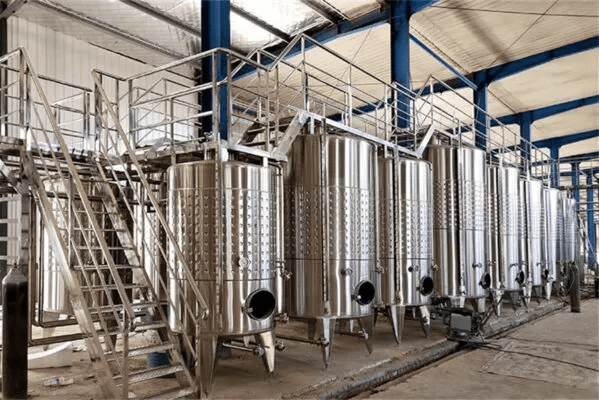











Buying tanks before planning your process can create low output, poor workflow, and costly building changes. These problems become harder to fix after installation. A successful project starts with a clear production plan, then matches every tank, utility, and package line to that plan.
A microbrewery needs grain-handling equipment, a brewhouse, fermentation vessels, cooling and cleaning systems, and packaging equipment. The main equipment usually includes a malt mill, hot liquor tank, mash tun, lauter tun, kettle, whirlpool, heat exchanger, fermenters, brite tank, glycol chiller, CIP unit, pumps, sanitary piping, and a keg, can, or bottle filling line.
This guide explains the brewing equipment you need, what each machine does, and how to choose a practical system for your production goals. It is designed for startup brewery owners, experienced brewers, brewpub chains, beverage producers, project investors, agents, and engineering contractors.
Исполнительное резюме
- A complete microbrewery requires more than a brewhouse. Fermentation capacity, utilities, cleaning, packaging, drainage, and material flow often determine real output.
- The best tank size depends on annual sales, product mix, fermentation time, daily brew cycles, labor, and available floor space.
- Fermentation vessels commonly become the first capacity bottleneck because one brew day may occupy a tank for several weeks.
- Hygienic design should prioritize cleanable product-contact surfaces, full drainage, accessible components, suitable materials, and reliable CIP coverage.
- Kegging usually offers the simplest startup packaging route, while a can or bottle line requires more space, utilities, oxygen control, and operating labor.
- Used systems can reduce capital cost, but buyers should verify tank pressure ratings, jacket condition, controls, dimensions, documentation, and replacement-part availability.
Конспект статьи
- What main equipment does a microbrewery need?
- How do malt handling and milling affect beer quality?
- Which brewhouse vessels are required to brew?
- Why are heat exchangers and hot liquor tanks important?
- How many fermentation vessels does a brewery need?
- What are brite tanks and serving tanks used for?
- Why does a microbrewery need glycol and utility systems?
- How does a CIP system protect product quality?
- Which kegging, canning, and bottling equipment should you choose?
- How should you compare new and used microbrewery equipment?
1. What Main Equipment Does a Microbrewery Need?
A working microbrewery contains several connected production areas. The brewhouse creates wort. Fermentation tanks turn that wort into beer. Utility systems provide heat, cooling, water, gas, and electricity. Cleaning equipment keeps product-contact surfaces sanitary. Finally, the package line prepares the finished beer for sale.
The most important mistake to avoid is treating each machine as a separate purchase. A 10-barrel kettle, for example, cannot reach its planned output if the building lacks enough steam, electrical power, cold water, drainage, or fermentation capacity. The entire brewery system must work as one process.
Essential microbrewery equipment list
| Production area | Main equipment | Primary function |
|---|---|---|
| Malt handling | Malt storage, conveyor, mill | Prepare grain before mashing |
| Brewhouse | HLT, mash tun, lauter tun, kettle, whirlpool | Produce clear, stable wort |
| Wort cooling | Plate heat exchanger, pumps | Cool the wort before yeast is added |
| Cellar | Fermenter, brite tank, yeast collection | Ferment, condition, clarify, and carbonate |
| Контроль температуры | Glycol chiller, pumps, piping | Maintain tank temperatures |
| Очистка | CIP cart or skid | Clean tanks, pumps, and pipelines |
| Упаковка | Keg washer/filler, canner, bottle filler | Package finished beer |
| Draft service | Kegs, cooler, gas system, beer line | Store and serve beer |
| Quality control | Hydrometer, pH meter, thermometer | Check process consistency |
| Material handling | Platforms, hoses, racks, floor drains | Support safe daily operation |
The exact equipment you need depends on the business model. A taproom-focused brewery may prioritize serving tanks and kegging. A retail brand may need a can or bottle line from the start. A brewpub may need a compact layout with visible tanks, while a contract producer may require larger equipment and faster package changeovers.
2. How Do Malt Handling and Milling Affect the Brewing Process?
Malt is the main source of fermentable sugar in most beer recipes. Before mashing, a roller mill cracks the grain and exposes its inner material. The goal is to open the kernel while keeping much of the husk intact.
A crush that is too fine may compact the grain bed and slow filtration. A crush that is too coarse may reduce extraction. The ideal setting depends on malt type, roller design, brewhouse configuration, and the brewer’s process.
Small systems may use a manually fed mill. Larger craft breweries often add:
- Malt storage bins
- Dust-control equipment
- Flexible screw conveyors
- Bucket elevators
- Load cells
- Grist cases
- Automated feed controls
The mill should match the brewhouse output. An undersized mill slows the production day, while an oversized unit may add cost without improving beer.
Dust also deserves careful planning. The milling area should follow local building, fire, electrical, ventilation, and workplace rules. These requirements vary by country and facility, so they should be confirmed with qualified local professionals before installation.
From our manufacturing experience, buyers often focus on brewhouse capacity but give little attention to grain movement. Yet lifting malt bags, feeding the mill, and moving grist can consume significant labor during every brew. A simple conveyor can improve workflow more than an expensive control feature that the brewer rarely uses.
3. Which Brewhouse Vessels Are Required to Brew?
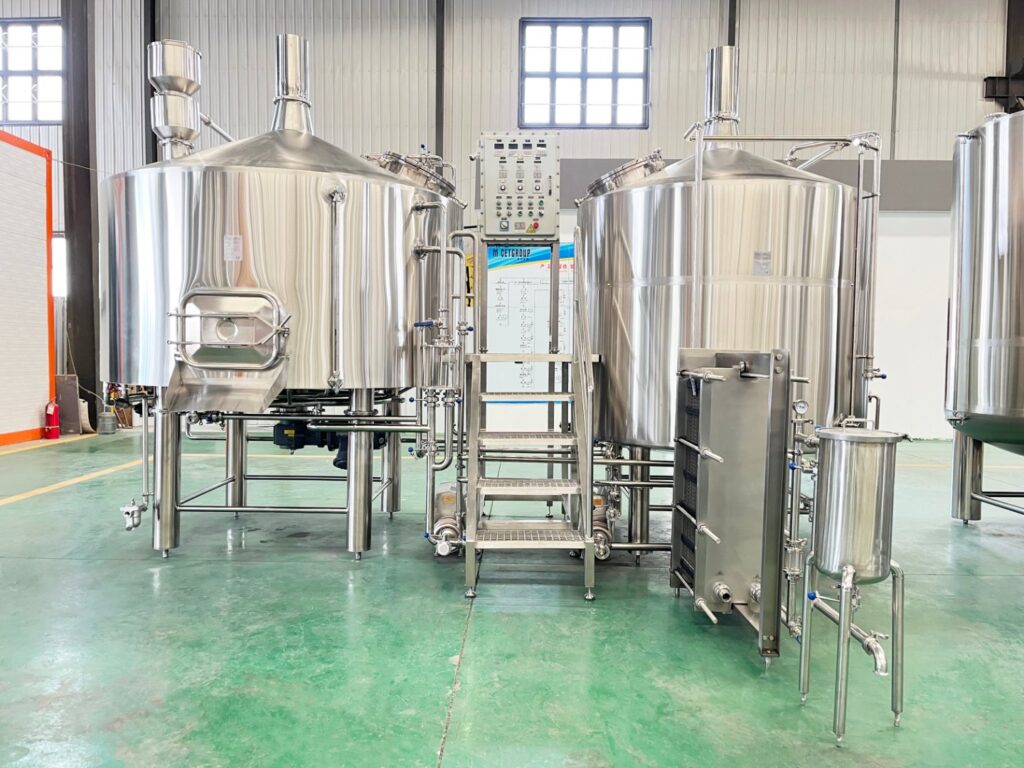
The brewhouse converts crushed malt, water, and hops into wort. A basic commercial setup includes a hot liquor tank, mash vessel, filtration function, brew kettle, and whirlpool function.
These functions may be arranged in two, three, four, or more separate vessels.
Common brewhouse configurations
| Configuration | Typical arrangement | Main advantage | Main trade-off |
|---|---|---|---|
| Two-vessel | Mash/lauter + kettle/whirlpool | Compact and cost-effective | Longer cycle time |
| Three-vessel | Mash tun + lauter tun + kettle/whirlpool | Better workflow | More floor space |
| Four-vessel | Mash + lauter + kettle + whirlpool | Faster production turns | Higher investment |
| Five-vessel | HLT or specialty vessel added | High scheduling flexibility | Greater complexity |
What happens in the mash tun?
In the mash tun, milled malt mixes with controlled brewing water. Heat activates natural enzymes that convert starch into fermentable sugar. Temperature stability matters because different temperature ranges influence body, fermentability, and the final beer style.
A well-designed vessel provides even mixing, suitable heating area, accurate temperature sensing, and easy cleaning. Depending on the process, it may use steam jackets, electric heating elements, or another approved heat source.
What does a lauter tun do?
The lauter tun separates liquid wort from spent grain. A false bottom supports the grain bed while the liquid drains below it. During recirculation, the first cloudy runoff returns to the top until the brewer obtains clearer wort.
Warm water then rinses remaining sugars from the grain. This step is called sparging. Flow must remain controlled. Pulling too quickly can compress the bed, while uneven flow may reduce extraction.
Small systems often combine mash and lauter functions in one tun. Larger systems use separate vessels to shorten the production cycle.
Why does the brew kettle matter?
The brew kettle brings wort to a controlled boil. Boiling stabilizes the liquid, concentrates the recipe, drives off selected volatile compounds, and extracts bitterness from hop additions.
The brewer may add hops at different times to influence bitterness, flavor, and aroma. Kettle geometry, heating power, evaporation rate, and control accuracy can all affect consistency.
After boiling, the wort enters a whirlpool or uses a combined kettle-whirlpool function. The rotating liquid helps collect hop matter and protein solids toward the center, reducing the amount of sediment transferred downstream.
4. Why Are a Hot Liquor Tank and Heat Exchanger Important?
A hot liquor tank stores heated process water. Despite its name, it does not contain alcohol. The water supports mashing, sparging, rinsing, and selected cleaning operations.
A correctly sized HLT can hold enough hot water for the current brew while preparing water for the next cycle. A vessel that is too small may delay production. A vessel that is too large increases capital cost, heating demand, and floor-space use.
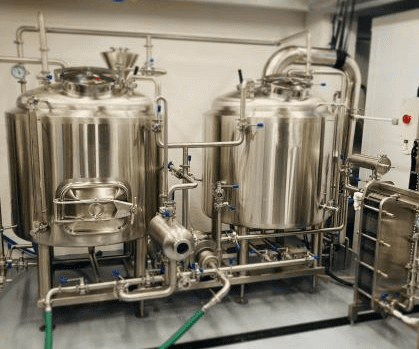
After the kettle, the plate heat exchanger quickly reduces wort temperature before fermentation. Hot wort moves through one side of thin metal plates while cold water or chilled water moves through the other side. The fluids transfer heat without mixing.
A useful recovery loop looks like this:
Cold brewing water → Heat exchanger → Warm recovered water → Hot liquor tank

Hot wort → Heat exchanger → Cooled wort → Fermentation vessel
Recovering warm water can reduce the next heating load when the water quality and production plan allow reuse. However, this recommendation does not apply in every facility. Water chemistry, storage time, local hygiene rules, tank capacity, and the next recipe must all be considered.
The plate cooler must match:
- Wort flow rate
- Incoming wort temperature
- Target fermentation temperature
- Cold-water temperature
- Available water pressure
- Cooling-medium capacity
- Product viscosity
- Cleaning flow requirements
An ale and a lager may require different outlet temperatures. In a warm climate, groundwater alone may not cool the wort enough, so the system may need a two-stage exchanger using both water and glycol.
5. How Many Fermentation Vessels Does a Microbrewery Need?
Fermentation converts wort into beer. After cooled wort enters a fermenter, yeast consumes fermentable sugar and creates alcohol, carbon dioxide, heat, and flavor compounds.
Most modern microbreweries use jacketed cylindroconical tanks. The cone collects yeast and sediment, while cooling jackets help control fermentation temperature. Pressure-rated tanks may also support conditioning, carbonation, dry hopping, and closed product transfer.
The required number of tanks depends on more than brewhouse size.
Basic cellar-capacity formula
Required fermentation capacity
= Average weekly wort production
× Average tank occupancy in weeks
÷ Expected usable yield
For example, a brewery that produces several batches each week but holds each beer for three weeks needs much more cellar volume than a simple brewhouse-to-tank ratio suggests.
The calculation should account for:
- Primary fermentation time
- Cold-conditioning time
- Dry-hop residence time
- Cleaning turnaround
- Tank losses
- Seasonal sales
- Recipe variety
- Package schedule
- Tank maintenance
- Future growth
A brewer making quick-turn ales will need a different tank plan from one producing long-conditioned lager. Likewise, a kombucha producer may require different temperature, pressure, agitation, and holding-time assumptions.
In our project reviews, we frequently find that the brewhouse is not the true production limit. The fermentation vessel stays occupied for days or weeks, while the brewhouse completes its work in hours. Adding cellar tanks may therefore increase annual output more effectively than installing larger brewhouse vessels.
Should every fermenter match the brewhouse size?
Not always. A 10-barrel brewhouse may fill a 20-barrel beer tank with two brew cycles. This arrangement can improve cellar-volume economics but requires scheduling discipline and process consistency.
Larger tanks also create risks. A failed recipe affects more product, and slower filling can lengthen the time between the first and second batch. The right choice depends on the brewery’s recipes, staffing, sales volume, and quality controls.
6. What Are Brite Tanks and Serving Tanks Used For?
A brite tank, also called a bright beer tank, holds conditioned beer after fermentation. It can support clarification, carbonation, package-line feeding, and short-term storage.
The beer may enter the tank after cooling, settling, filtration, or centrifugation. A carbonation stone introduces small CO₂ bubbles, helping the gas dissolve into the liquid. The tank must have appropriate pressure controls and fittings for its intended use.
A brite tank can improve packaging efficiency because the package line draws from one prepared source while a fermenter becomes available for the next brew. However, it also adds a transfer step, cleaning work, floor-space demand, and possible oxygen exposure.
A brewery does not always need a separate brite tank. A pressure-rated unitank may ferment, condition, carbonate, and feed packaging from one vessel. This approach can suit startups with limited space and low packaging volume.
Choose a brite tank when:
- Packaging occupies many hours each week.
- Several fermenters need to feed one package line.
- The brewery wants a dedicated carbonation and holding vessel.
- Clear beer must be staged before filling.
- The taproom serves directly from tanks.
Consider unitank-only production when:
- Floor space is limited.
- Production volume remains modest.
- The team wants fewer product transfers.
- The package line can connect directly to each fermenter.
- Capital cost must remain low.
Serving tanks are common in a brewpub or taproom. Some use removable internal bags so the beer does not contact incoming gas. Others operate like standard pressure tanks. Local regulations, dispense design, cleaning procedures, and the intended sales model should guide the choice.
7. Why Does a Microbrewery Need Glycol and Utility Systems?
A microbrewery cannot operate on tanks alone. Its utilities control heating, cooling, transfer, pressure, cleaning, and packaging.
The glycol system removes heat from jacketed fermentation and conditioning tanks. It typically includes a chiller, reservoir, circulation pumps, insulated piping, control valves, and individual tank temperature controls.
The glycol unit should be sized for the facility’s peak load, not its average load. Peak demand may occur when the team must cool a full fermenter, maintain several other tanks, and support wort cooling at the same time.
Other important utilities include:
- Steam boiler or electric heating supply
- Process and potable water
- Chilled water
- Compressed air
- Carbon dioxide or nitrogen
- Electrical distribution
- Ventilation
- Floor drainage
- Wastewater handling
- Hot-water generation
Facility utility checklist
| Utility question | Why it matters |
|---|---|
| What voltage and frequency are available? | Motors and controls must match local power |
| What is the cold-water temperature? | It affects wort-cooling capacity |
| How hard is the incoming water? | Treatment may be needed for process and cleaning |
| How much steam or electrical heat is available? | It controls kettle heating time |
| Where will CO₂ be stored? | Gas use requires suitable planning and local compliance |
| Can drains handle peak discharge? | Cleaning creates high short-term wastewater flow |
| Is the ceiling high enough? | Tanks require installation and service clearance |
| Can equipment pass through the doors? | Tank diameter may exceed access width |
| Is expansion space available? | Future tanks need floor area and utility branches |
CAD and 3D layout work help identify these issues before fabrication. We normally review door dimensions, tank heights, platform access, drain positions, operator routes, package flow, chemical storage, and maintenance space before confirming the final equipment arrangement.
A visually attractive layout is not enough. It must also reduce unnecessary movement. Malt should move toward the brewhouse, wort toward fermentation, and finished beer toward packaging without repeated crossing of dirty and clean work zones.
8. How Does a CIP System Protect Product Quality?
CIP means clean-in-place. A CIP unit circulates water and cleaning solutions through tanks, piping, pumps, and selected equipment without requiring full disassembly.
A typical cycle may include:
- Initial water rinse
- Heated alkaline cleaning
- Intermediate rinse
- Acid cleaning when required
- Final rinse
- Sanitation before production
The correct process depends on product soil, water quality, chemical supplier guidance, tank design, temperature, flow, and local requirements.
The U.S. Food and Drug Administration explains that food CGMPs address plant equipment, sanitary operations, facility sanitation, and production controls. FDA hygienic-design guidance also highlights cleanability, compatible materials, access for inspection and maintenance, drainage, and the reduction of niches where contamination can develop. These principles are relevant when evaluating brewery tanks and piping, although applicable regulations differ by country and product.
ASME BPE provides requirements for equipment used in industries with high hygienic demands, covering materials, design, fabrication, inspection, testing, and certification. A normal craft brewery may not require full ASME BPE compliance, but its cleanability principles can still provide a useful reference when buyers evaluate sanitary components and fabrication quality.
Features to check on a CIP-compatible system
- Smooth, cleanable product-contact surfaces
- Sanitary weld treatment
- Suitable spray-ball coverage
- Full vessel drainage
- Correct cleaning-flow velocity
- Accessible pumps and valves
- Minimal dead spaces
- Chemical-compatible gaskets
- Safe chemical concentration control
- Return-temperature monitoring
A small brewery may use a mobile CIP cart with one or two tanks. A larger facility may use a multi-tank, semi-automatic skid that recovers water and chemical solution.
More automation does not always mean better cleaning. A simple system with correct flow, temperature, chemical concentration, contact time, and trained operators can outperform a costly skid that was poorly sized or programmed.
9. Which Kegging, Canning, and Bottling Equipment Should You Choose?
Packaging connects production with revenue. The right choice depends on where and how the brewery will distribute beer.
Kegging equipment
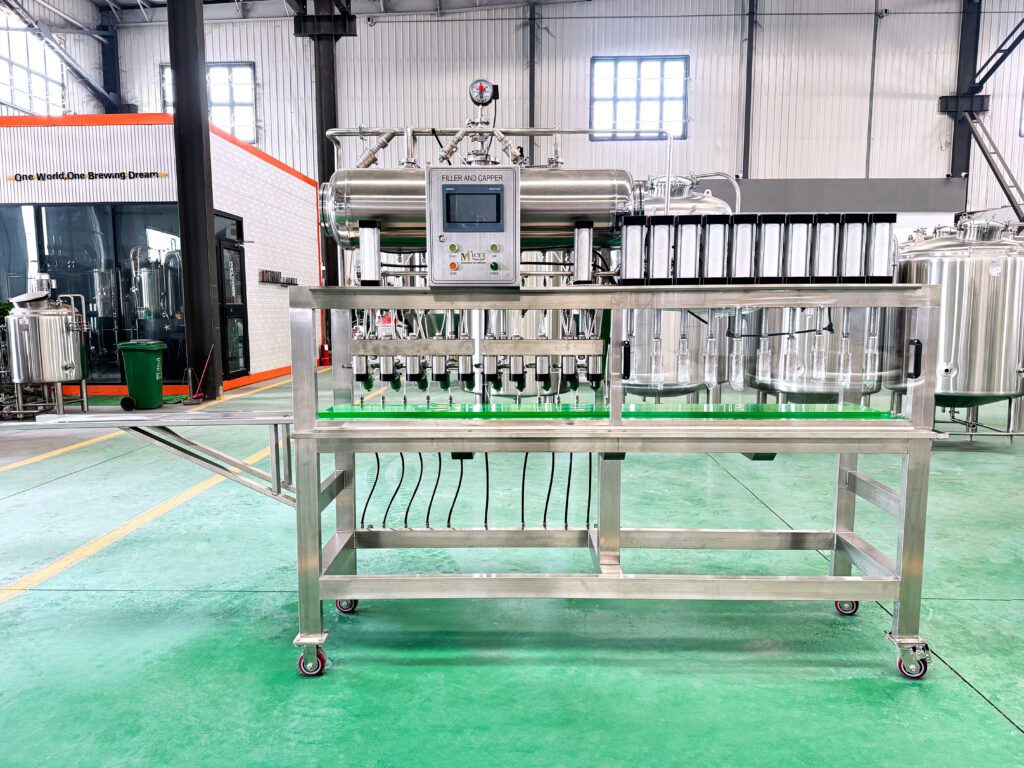
Kegging is often the simplest option for a startup that sells through its own taproom, restaurants, or local bars. A basic system may include a keg washer, filler, gas controls, transfer hoses, and cold storage.
An automatic or semi-automatic washer may perform:
- External rinse
- Internal rinse
- Alkaline cleaning
- Intermediate rinse
- Sanitation
- CO₂ purging
- Pressure testing
- Наполнение
A draft system also needs a suitable cooler, regulator, couplers, taps, and beer line. The Brewers Association’s Draught Beer Quality Manual covers draught-system components, gas balance, sanitation, pouring, and line cleaning.
Canning and bottling equipment
A can or bottle line may include:
- Empty-container loading
- Rinsing
- CO₂ purging
- Наполнение
- Seaming or capping
- Date coding
- Labeling
- Inspection
- Case packing
- Conveyors
Bottling equipment and canning systems require stable product temperature, consistent pressure, compressed air, gas supply, drainage, and enough staff to manage containers and finished packages.
A compact manual filler may suit early retail testing. A faster filling machine becomes useful when packaging labor or missed delivery deadlines create a bottleneck.
Packaging comparison
| Package format | Best suited to | Main advantages | Main trade-offs |
|---|---|---|---|
| Keg | Taproom and local draft sales | Low container handling and fast filling | Return logistics and draft-system care |
| Can | Retail and outdoor markets | Lightweight and strong light protection | Seamer control and container supply |
| Bottle | Retail, specialty, and premium products | Familiar format and varied presentation | Weight, breakage, and light exposure |
| Serving tank | On-site sales | Low package waste and direct service | Limited distribution flexibility |
A startup should not automatically buy all three package formats. Each one requires different equipment, spare parts, materials, labor, storage, and quality checks.
Begin with the package that supports the main sales channel. Add different equipment when demand justifies the added complexity.
10. How Should You Compare New and Used Microbrewery Equipment?
New professional microbrewery equipment can be designed around the building, recipes, utility supply, control preference, and future capacity. It usually offers clearer documentation, warranty support, and easier integration.
Used equipment may reduce the opening investment and shorten procurement time. It can work well when its size, condition, connections, and control system fit the new project.
However, a lower purchase price does not always mean a lower installed cost.
New vs. used brewery equipment
| Decision factor | New equipment | Used equipment |
|---|---|---|
| Tank dimensions | Customized to the building | Fixed |
| Вместимость | Matched to production plan | Limited to available inventory |
| Controls | Current and configurable | May be outdated |
| Гарантия | Normally available | Often limited |
| Documentation | Can be supplied with project | May be incomplete |
| Installation | Designed as one system | Adaptation may be required |
| Lead time | Manufacturing time required | Potentially faster |
| Initial price | Usually higher | Often lower |
| Hidden cost risk | More predictable | Potentially higher |
| Expansion planning | Easier to integrate | Depends on design |
Used equipment inspection checklist
Before buying, verify:
- Manufacturer and model
- Production year
- Working and test pressure
- Tank wall condition
- Cooling-jacket integrity
- Internal surface condition
- Weld repairs
- Spray-device coverage
- Agitator and gearbox condition
- Sensor availability
- Control-panel condition
- Electrical compatibility
- Valve and gasket availability
- Tank height and diameter
- Shipping method
- Installation access
- Replacement-part support
- Drawings and pressure documentation
As both a manufacturer and used brewing system supplier, we advise buyers to calculate the full project cost:
Installed cost
= Purchase price
+ Inspection
+ Repair
+ Shipping
+ Modification
+ Controls
+ Piping
+ Installation
+ Commissioning
A used tank that requires new jackets, controls, valves, and electrical work may cost more than a new customized tank. On the other hand, a well-maintained used system with complete records can offer strong value.
How Should You Size a Microbrewery Before Requesting a Quote?
Before opening a brewery, define the expected sales model and work backward.
A basic planning sequence is:
Annual sales target
        ↓
Weekly package demand
        ↓
Required finished beer volume
        ↓
Fermentation and conditioning capacity
        ↓
Weekly brewhouse cycles
        ↓
Brewhouse size and utility load
Useful questions include:
- How much beer will you sell in year one?
- Which beer style will occupy tanks longest?
- How many days each week will the team brew?
- Will one brewer operate the system?
- Will most sales be keg, can, bottle, or on-site draft beer?
- How much cold storage is available?
- Can the building support future tanks?
- Is the planned output based on realistic sales?
- Which tasks will be manual?
- How will finished beer move to packaging?
Illustrative microbrewery case study
Consider a startup planning a taproom with moderate restaurant distribution. The founders initially request a large four-vessel brewhouse because they assume larger equipment will create faster growth.
After reviewing the plan, the larger risk becomes clear: limited cellar space and low first-year package demand.
A more balanced solution may include:
- A smaller two- or three-vessel brewhouse
- Enough fermenters for the expected product cycle
- One flexible brite tank
- A compact keg washer and filler
- Space and glycol connections for future tanks
- CAD placement that protects packaging and cold-room access
This plan directs capital toward the capacity that earns revenue. It also leaves a practical expansion path.
The recommendation would change for a regional commercial brewery with retail contracts. That project may need a faster brewhouse, larger bright-beer staging, automated package handling, higher utility capacity, and more advanced process controls.
There is no universal micro brewing equipment package. The correct design depends on the production and business assumptions behind it.
How Can a Turnkey Manufacturer Reduce Project Risk?
Starting a microbrewery involves more than selecting pieces of equipment from a catalog. Tanks, piping, controls, utilities, cleaning, packaging, and the building must connect properly.
A turnkey supplier can coordinate:
- Capacity calculations
- Process-flow planning
- CAD and 3D layouts
- Customized tank design
- Brewhouse manufacturing
- Fermentation and storage vessels
- Glycol cooling
- CIP equipment
- Sanitary piping
- Control systems
- Packaging integration
- Factory testing
- Shipping plans
- Installation guidance
- Commissioning support
- Operator training
- Spare parts
- Long-term technical service
Our role as a brewery, distillery, winery, kombucha, and beverage equipment manufacturer is to evaluate the complete production route. We also source and assess used brewing systems when they offer a practical financial advantage.
We do not assume that new, larger, or more automated equipment is always better. We compare output, labor, utility use, facility restrictions, maintenance ability, package demand, and project budget before recommending the right equipment.
Regulatory and Planning Considerations
Licensing, building approval, pressure equipment, food sanitation, alcohol production, fire protection, wastewater, and electrical requirements differ by country and region. Equipment selection should not begin before the project team understands the local approval process.
In the United States, a business intending to produce beer for sale must obtain approval of a Brewer’s Notice from the Alcohol and Tobacco Tax and Trade Bureau before operating. State and local requirements also apply.
This U.S. requirement does not apply directly to projects in other countries. Each buyer should work with local authorities, qualified engineers, and compliance advisers.
Early regulatory review may affect:
- Facility location
- Drain design
- Tank spacing
- Production records
- Tax measurement
- Package labels
- Pressure certification
- Wastewater treatment
- Gas storage
- Пожарная безопасность
A layout should therefore remain flexible until the main local requirements are confirmed.
Frequently Asked Questions
What is the minimum equipment needed to start a microbrewery?
At minimum, most projects need a malt mill, mash and lauter functions, kettle and whirlpool functions, a hot-water tank, heat exchanger, fermentation tanks, glycol cooling, pumps, cleaning equipment, sanitary hoses or piping, and a package method. The final list depends on production scale and sales channels.
What size brewhouse should a startup choose?
The correct size depends on weekly sales, daily brew cycles, labor, tank capacity, and growth plans. A smaller system used several times per week may be safer than larger equipment that remains idle. Cellar capacity should be calculated at the same time.
Is a brite tank essential for a small brewery?
No. A pressure-rated unitank can ferment, condition, carbonate, and feed packaging. A brite tank becomes useful when package scheduling, tank turnover, clarification, or taproom service justifies the extra transfer and cleaning step.
Can used brewery equipment be reliable?
Yes, provided it has been inspected and fits the new project. Buyers should verify pressure ratings, jacket condition, internal surfaces, controls, dimensions, electrical compatibility, and documentation before purchase.
How much space should be left around brewery tanks?
The exact clearance depends on tank size, local rules, piping, platforms, cleaning access, and maintenance needs. Allow room for valves, manways, pumps, instrumentation, operator movement, and future service. A CAD layout should confirm clearance before production.
Should a microbrewery start with kegging or bottling?
Kegging is often simpler for a taproom or local draft business. A bottle or can line may be necessary for retail distribution, but it adds container handling, labeling, oxygen-control, storage, and labor requirements. The package choice should follow the sales plan.
Key Points to Remember
- A microbrewery needs grain handling, brewhouse, fermentation, utility, CIP, and packaging systems.
- The brewhouse is only one part of the investment.
- Fermentation capacity often controls annual output.
- Malt milling, heating power, cooling, drainage, and packaging can become hidden bottlenecks.
- A two-vessel brewhouse is economical, while separate vessels support faster production.
- The heat exchanger should match local water temperature and target beer temperature.
- Glycol capacity should be based on peak cooling demand.
- Cleanability, drainage, access, and suitable materials are core equipment-selection factors.
- Keg, can, and bottle systems suit different sales channels.
- New equipment offers customization and predictable integration.
- Used equipment can reduce cost when its condition and dimensions are properly verified.
- CAD and 3D planning help prevent layout, access, and workflow problems.
- Local regulatory requirements should be reviewed before final equipment design.
- Factory-direct engineering, installation guidance, and long-term service can reduce project risk.
Conclusion: Plan the Brewery Before Buying the Tanks
The main equipment used in a microbrewery includes the malt mill, brewhouse vessels, heat exchanger, fermenters, brite or serving tanks, glycol cooling, CIP system, sanitary pumps and piping, and the selected packaging line.
But a useful equipment list is only the beginning.
The quality of your beer and the strength of your brewing business depend on how well those components work together. Capacity, recipes, utilities, labor, cleaning, packaging, building access, and future growth must all support the same plan.
As a factory-direct brewery and beverage equipment manufacturer, we review these factors before recommending new or used equipment. A practical next step is to evaluate your target annual output, building dimensions, preferred package format, fermentation schedule, and available utilities. That review can show whether the proposed system is balanced—or where changes may reduce cost and project risk.