










Nancy Shang | Founder and CEO, MICET Brewing | Published September 11, 2026
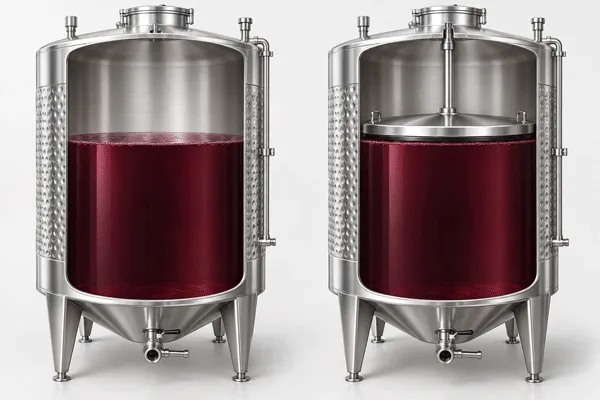
A variable-capacity wine tank uses a floating lid that drops as wine volume falls, keeping headspace minimal without racking to a smaller vessel. A fixed tank holds one nominal volume with a set headspace instead. For wineries running several small lots at once, the real tradeoff is upfront cost against fewer transfers and lower oxidation exposure.
What Is a Variable-Capacity Wine Tank?
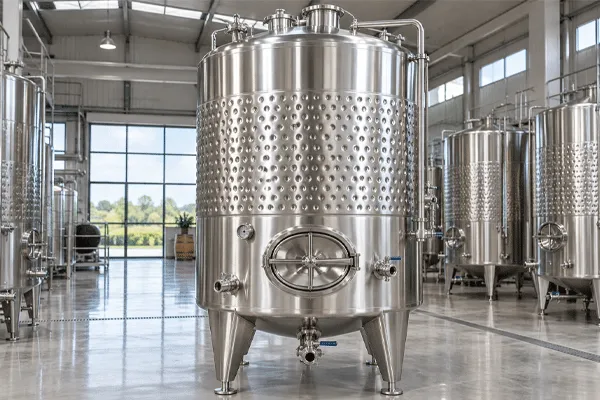
The core mechanism is a lid — a disc, piston, or telescoping shell section — that rests directly on the surface of the wine and is sealed against the tank wall with a gasket. As wine is drawn off during racking, blending, or topping losses, the lid rides down with the liquid level instead of leaving a growing pocket of air above the wine.
Three formats show up across the market:
- Floating disc lid: a flat plate on a center post or side guides, sealed with an O-ring or wiper gasket against the tank wall.
- Telescoping shell: the tank itself is built from two or more nested cylindrical sections that collapse into each other as volume drops.
- Inflatable bladder lid: a flexible membrane inflated to press against the wine surface, adjusted by adding or releasing gas.
All three exist to solve the same problem: oxygen exposure in a partially full tank. A fixed tank at half capacity has a headspace equal to half its volume; a variable-capacity tank at the same fill level has almost none.
Variable Capacity vs. Fixed-Volume Tanks: The Practical Difference
| Factor | Fixed-Volume Tank | Variable-Capacity Tank |
| Headspace at partial fill | Grows as volume drops | Stays minimal by design |
| Typical use case | Full-batch fermentation, single-lot storage | Multi-racking cycles, blending, topping-sensitive aging |
| Upfront cost premium | Baseline | Typically 20–40% higher for equivalent nominal capacity (industry-general range; confirm current pricing with the manufacturer) |
| Cleaning complexity | Standard CIP pass | Added seal/gasket and lid-track cleaning |
| Sizing flexibility across vintages | Fixed nominal volume only | Usable across a volume range within one vessel |
Compared with typical single-SKU retailer listings — where each product page shows one fixed nominal volume per model — the sizing question for a small winery is rarely “how big is the tank” and more often “how much of the vintage’s volume range does this one vessel actually need to cover.”
When Variable Capacity Actually Matters
The common assumption is that any winery bottling multiple small lots should default to variable-capacity tanks across the board. That’s not always the cheaper or more practical call.
Variable capacity earns its premium when a lot sits in the same vessel through several partial-volume stages — primary fermentation, then racking off lees, then topping during aging, then blending trials — without being moved to a smaller tank at each step. If a winery instead presses to barrel or moves to a bottling tank shortly after fermentation finishes, a fixed tank sized close to the batch volume does the same job for less money.
One limitation worth flagging before ordering: most floating-lid designs only adjust within a defined range of the tank’s total height, generally somewhere in the range of a fifth to a third of nominal volume, not the full 0–100% span. A tank rated for 5,000L variable capacity is not necessarily usable down to a few hundred liters — that detail lives in the manufacturer’s mechanical drawing, not the marketing copy, so it has to be confirmed per model rather than assumed.

Sizing Tradeoffs for Wineries Producing Multiple Varietals
A winery running four or five small varietal lots at once is really solving an inventory problem, not just a tank-capacity problem. Two sizing approaches show up in practice:
- One tank per lot, sized to the largest expected volume for that varietal— simple to manage, but tanks sit under-filled for most of the season if yields vary year to year.
- Fewer, larger variable-capacity tanks shared across lots at different stages— reduces total vessel count, but requires more careful scheduling since two lots can’t occupy the same tank simultaneously.
The second approach is where variable capacity pays for itself fastest: a single tank can hold a 3,000L Cabernet lot through fermentation, drop with it through racking, then be cleaned and refilled with a 4,500L Chardonnay lot from the next block — all within one vessel’s adjustment range, rather than owning two separate fixed tanks sized for each lot’s peak volume.
MICET’s Documented Wine Tank Specifications — and Where the Catalog Falls Short of This Format
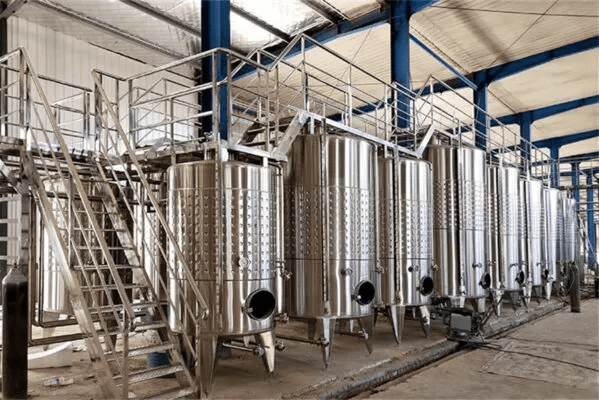
MICET’s published wine fermentation tank line lists two reference capacity points: 5,000L and 10,000L, built in SUS304 or SUS316L stainless steel, with an inner shell around 3.0mm and outer shell around 2.0mm, insulated with 80–100mm of polyurethane.
| Documented Spec | Value |
| Reference capacities | 5,000L / 10,000L (example sizes cited) |
| Shell material | SUS304 or SUS316L |
| Inner shell thickness | ~3.0mm |
| Outer shell thickness | ~2.0mm |
| 절연 | 80–100mm polyurethane |
| Certification (product-line level) | Not disclosed for wine tanks specifically |
Here is the gap that matters for this topic: MICET’s public wine tank line does not itemize a floating-lid or telescoping variable-capacity configuration. The two capacity points on file are fixed-volume reference examples. If a floating-lid version is available, it would fall under custom engineering rather than a standard catalog SKU — and that has to be confirmed directly with MICET’s sales team before assuming it’s an off-the-shelf option. Wineries evaluating this format against MICET should ask for a mechanical drawing showing the lid’s adjustment range in liters, not just a maximum nominal capacity.
On certification: MICET holds a Verification of Conformity under the Pressure Equipment Directive (PED 2014/68/EU), certificate number ICR/VC/HM2507146, issued by ICR Co., Ltd., valid through July 15, 2030. That verification covers brewing, brewing-adjacent, and fermentation equipment as pressure vessels at an organization/product-line level — it is not itemized against wine tanks by name, and it does not by itself confirm certification status for a specific floating-lid or variable-capacity unit. Ask for the exact scope document if PED coverage for a wine tank purchase is a requirement.
What to Ask Before You Buy
- Request the lid’s actual adjustment range in liters, not just the tank’s maximum nominal capacity — a 5,000L tank might only float down to 3,500L.
- Ask whether the gasket and seal material are wine-contact rated, since some floating-lid designs are adapted from beer or industrial tank lines.
- Confirm whether the configuration is a standard catalog item or custom engineering, since lead time and pricing differ substantially between the two.
- Get pricing in writing for the specific capacity and material grade, since neither format has a published price band for wine tanks in MICET’s public materials — commercial brewery 그리고 microbrewery equipment ranges are published, but wine tank pricing is quote-only.
- Ask which certifications, if any, apply to the specific unit being quoted, rather than assuming an organization-level PED verification transfers automatically to that model..
FAQ
Q: Does a variable-capacity wine tank replace the need for a separate small-lot tank?
A: Sometimes. If the lid’s adjustment range covers the full volume swing a lot goes through — from fermentation peak down to final topped volume — one tank can do the work of two fixed vessels. If the swing exceeds the lid’s rated range, a second smaller tank is still needed.
Q: Is variable capacity worth it for a winery producing one or two varietals only?
A: Less often. The cost premium is easiest to justify when the same vessel cycles through multiple volume-reduction stages across several lots in a season. A single-varietal operation moving straight to barrel after fermentation gets less benefit from the format.
Q: Can an existing fixed tank be retrofitted with a floating lid?
A: This depends entirely on the tank’s shell diameter tolerance and whether a matching lid and seal system exists for that diameter — it is a case-by-case mechanical question for the manufacturer, not a standard aftermarket part.
Q: Are MICET’s wine tanks certified under a specific pressure equipment standard?
A: MICET holds an organization-level PED Verification of Conformity (ICR/VC/HM2507146, issued by ICR Co., Ltd., valid to July 2030) covering fermentation and pressure vessel equipment broadly. No wine-tank-specific certificate number is published, so confirm scope for the exact unit being quoted.