










Nancy Shang | Founder & CEO, MICET Brewing | Published: July 11, 2026
Brewery manufacturers cluster into five distinct archetypes on the equipment side: turnkey factory, component-only fabricator, refurb-focused seller, broker, and downstream distributor. Each covers a different slice of the buyer’s project. For a distributor or integrator building a multi-country roster, the archetype determines margin structure, white-label options, and long-term supply stability.
What “Brewery Manufacturers” Actually Refers To
The phrase has two meanings in commercial use, and search results routinely blend them:
Beer-side. Companies producing beer as their final product — Sierra Nevada, Yuengling, Boston Beer, and the roughly 9,500 US craft breweries tracked by the Brewers Association. Rankings and directories in this category focus on production volume, market share, and brand identity.
Equipment-side. Companies fabricating or supplying the stainless-steel vessels, control systems, and packaging lines those breweries use. This side of the market is what a procurement lead, distributor, or project integrator is sourcing from.
This guide covers the equipment side, and specifically the five supplier archetypes an overseas distributor or integrator meets when building a multi-market roster. The archetypes overlap at the edges. A single company can operate under two of them for different product lines. But the archetype determines what a partnership with that company can actually deliver — margin room, white-label flexibility, project support depth, long-term supply reliability — and getting this classification wrong at the roster-building stage compounds through every project that follows.
The Five Supplier Archetypes
1. Turnkey Factory
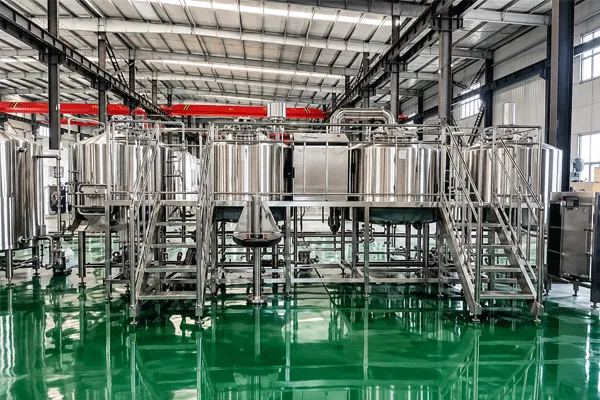
A single-entity manufacturer that designs, fabricates, and delivers complete brewing systems: brewhouse, fermentation, cellar, CIP, control, and often filling and packaging. Everything under one project number, one point of contact, one shipping crate.
What they do well. Full-system design coherence. Piping, control logic, and CIP paths get engineered as one, rather than integrated after the fact. Delivery arrives sized to install as a package, with layout drawings and P&IDs matched to the delivered configuration. For a distributor selling into markets where the buyer wants “one supplier, one warranty, one contact,” this archetype is the natural fit.
What they don’t do well. Configuration compromise. A turnkey factory’s engineering strength is in delivering their standard designs at scale; deep customization outside those standards adds calendar time and cost. Sourcing individual components from a turnkey factory (just fermenters, just a filling line) usually costs more per unit than buying from a component specialist, because their pricing assumes the systems-level margin.
What partnering means for a distributor. Best fit when you sell into markets where the end buyer values single-source accountability more than piecewise price optimization. Distributors representing turnkey factories typically get regional exclusivity on defined territories in exchange for volume commitments. Margins compress on the equipment itself but expand on installation, commissioning, and long-term service.
Typical pricing reference. Complete microbrewery packages (2–15 BBL) land in the USD 30,000–80,000 range; small commercial turnkey systems (10–30 BBL) at USD 50,000–80,000; larger commercial builds move into higher six figures depending on automation scope and packaging inclusion.
Typical lead time. 100–140 days landed for Asian-sourced turnkey; 100–200 days for European or US-sourced.
2. Component-Only Fabricator
A fabrication specialist focused on one or a narrow set of vessel or component types: fermentation tanks, bright tanks, hot liquor tanks, mash tuns. Paul Mueller Company is a well-known example on the North American side, with a long history in stainless-steel process vessels beyond just brewing. Regional fabricators in Germany, Slovakia, and China occupy similar positions in their local markets.
What they do well. Vessel-level engineering depth. Deeper material sourcing, tighter dimensional tolerances, and more thorough documentation on the specific components they specialize in. Component-only fabricators often hold better mill certificate traceability and pressure-vessel documentation than turnkey factories, because vessels are their business, not one line item in a larger project.
What they don’t do well. System integration. If you buy fermenters from a component fabricator and a brewhouse from a different supplier, you own the integration work: control panel wiring across systems, piping specification, CIP path design. This is real engineering effort, not a formality.
What partnering means for a distributor. Best fit if your target markets include end buyers with in-house engineering teams — larger commercial breweries, contract manufacturers, existing multi-vessel operations expanding capacity. Distributor margins on components are typically thinner than on turnkey, offset by higher order frequency (buyers return repeatedly for capacity additions rather than once every ten years for a full system).
Typical pricing. Not published on most component fabricator sites. Custom quoted per project. Fermenter and bright tank pricing scales roughly linearly with capacity, non-linearly with material grade (SUS304 vs SUS316L for wine-side applications) and jacket specification.
Typical lead time. Individual component fabrication runs 30–60 days; freight adds regional variance.
3. Refurb-Focused Seller
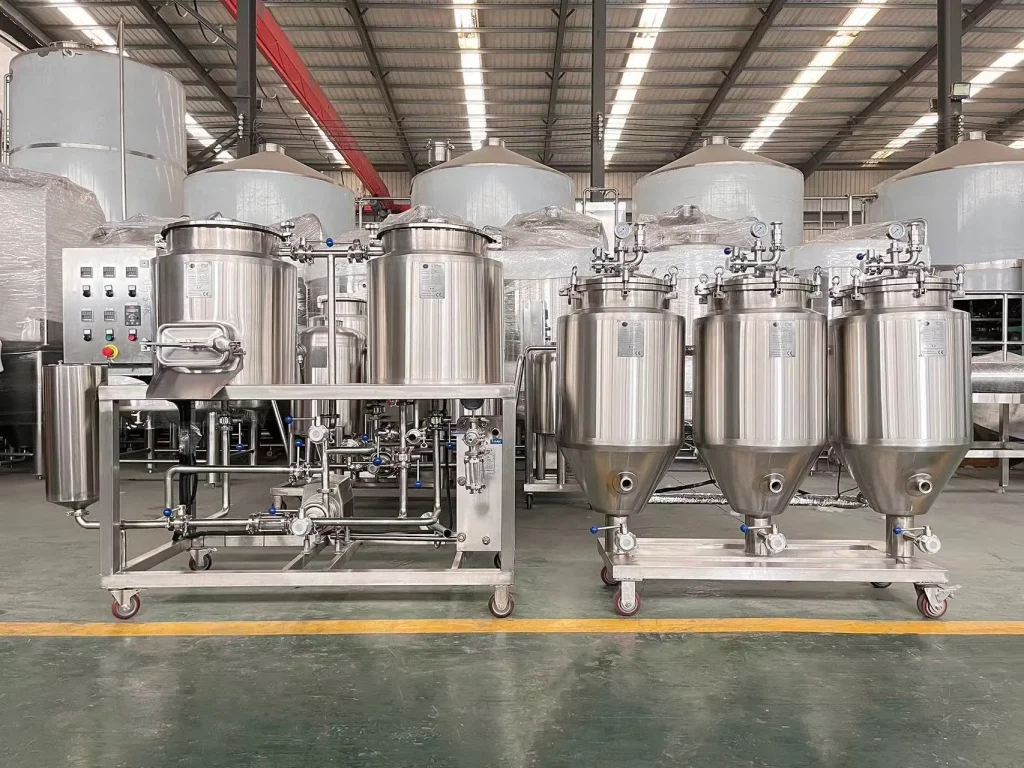
A specialized subset of manufacturer that operates a distinct workflow for used and refurbished brewery equipment, alongside or instead of new-build production. Source-unit acquisition, inspection, structural reworking, wear-part replacement, and re-certification are treated as their own capability rather than an afterthought.
For the specific product category relevant here — used brewery equipment configurations — the commonly available refurbished package typically presents like this:
| Компонент | Configuration Detail |
| Brewhouse size range | 2, 3, 5, 7, 10 BBL compact |
| Vessel package | Mash tun + kettle + HLT |
| Насосы | Included |
| Heat exchanger | Included |
| Control panel | Included, typically reprogrammed |
| Interior surface | Passivation refreshed before shipment |
| Pressure vessel documentation | Refreshed against current standards |
Documentation refresh for pressure vessels references directives including PED 2014/68/EU (Pressure Equipment Directive) and standard EN 1626:2008 for cryogenic valves; the control panel refresh references Machinery Directive 2006/42/EC with standard EN ISO 12100:2010 for machinery safety, and EMC Directive 2014/30/EU with EN IEC 61000-6-2:2019 for immunity. A refurb-focused seller who cannot point to specific directive references on the paperwork they deliver is not actually operating a compliance-grade refurbishment workflow.
What they do well. Lower-CAPEX path for buyers with commercial-grade requirements but tight budgets. Documentation clarity on what was reconditioned and against which standard. Hybrid configurations that pair a refurbished brewhouse with new fermenters, or the reverse, depending on which components most benefit from refurb economics.
What they don’t do well. Predictable volume. No two refurbished units are identical; refurb availability follows source-unit supply, not a production calendar. A distributor cannot commit to “ten of the same package by December” unless the seller happens to have matching source units in inventory when the order arrives.
What partnering means for a distributor. Best fit for markets where the end buyer values capital efficiency over equipment novelty — startup breweries, second-facility expansions, contract manufacturing on a validation timeline. Refurb inventory rotates, which means distributor communication has to be fast: units listed today may be gone next week.
Typical pricing. Not published on most refurb-focused sellers’ sites — refurb scope, source-unit condition, and certification refresh cost vary too much for a rate card. Refurbished configurations typically run meaningfully below equivalent new-build; expect any specific quote to require project-specific scoping.
Typical lead time. 45–75 days refurbishment plus freight, once matching source units are confirmed. Source-unit sourcing itself may add 30–60 days if a match is not already on hand.
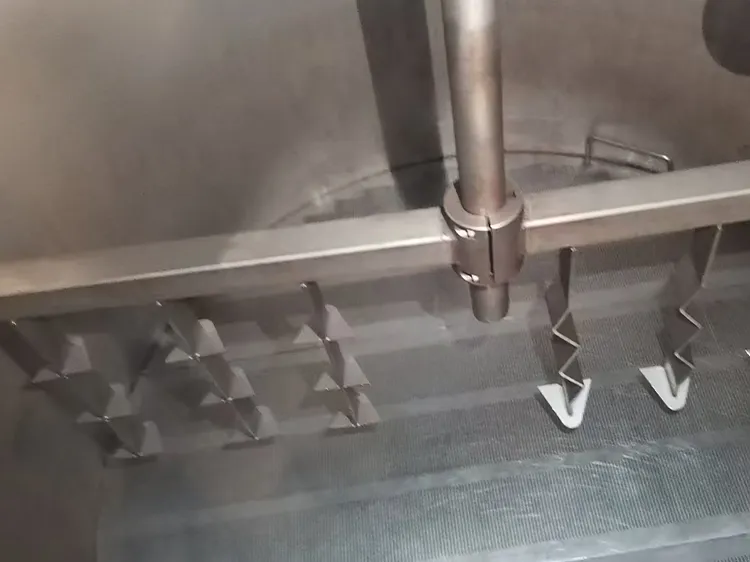
4. Broker
A trading operation that maintains rotating inventory of used and decommissioned brewery equipment, sourced from brewery closures, upgrades, and receivership sales. Sells as-is or with light shop reconditioning done externally. Common in the US market as specialty resale dealerships and auction platforms; also present in European markets under similar structures.
What they do well. Immediate availability of physical inventory. The buyer can inspect the exact unit before wiring funds. Domestic freight only (no ocean logistics, no customs, no L/C financing). Time-to-production measured in weeks rather than months. Provenance information on unique or hard-to-find pieces.
What they don’t do well. Configuration flexibility is zero — you buy what they have. Wear-part replacement and remediation typically fall on the buyer’s account after purchase. Original certifications may not transfer cleanly to a different regulatory environment if the unit was sourced from a mismatched market.
What partnering means for a distributor. Limited. Broker inventory is opportunistic and geographically local; a distributor in Southeast Asia cannot practically sell from a broker’s warehouse in Michigan. The exception is when a distributor operates as a re-broker in their own market — sourcing containers of used equipment from origin brokers, marking up, and reselling locally. This works, but the margin structure resembles resale trading more than manufacturer partnership.
Typical pricing. Wide spread based on unit condition and market timing. Auction-pull prices for small used brewhouses run roughly USD 40,000–120,000. Fully reconditioned lines approach new-build pricing at the top of the range.
Typical lead time. 1–4 weeks from purchase to on-site, domestic freight.
5. Distributor (Downstream Reseller)
A regional company that imports, holds inventory, and resells brewing equipment sourced from one or more manufacturers upstream. Adds local hands, local paperwork, local language, and local warranty support. The category most likely to be confused with a manufacturer on a first-impression basis, because the distributor’s website usually looks and reads like a manufacturer’s.
What they do well. Reducing friction for end buyers in their region: language-matched documentation, in-country service dispatch, faster response on parts and small components, familiarity with local regulatory expectations and utility standards. For an end buyer who does not want to manage overseas procurement themselves, a competent distributor is genuinely valuable.
What they don’t do well. Custom engineering. Distributors resell what their upstream manufacturer produces; they rarely have the engineering depth to modify or extensively customize. Certification paperwork traceability depends on the manufacturer they source from. Post-sale service for complex issues eventually escalates back to the upstream factory, with all the timezone and language delay that implies.
What partnering means for a distributor. This category is the mirror of the question you’re asking as a reader of this guide. If you are a distributor considering which upstream manufacturer to represent, the framing above applies to the upstream factory you are evaluating. If you are an end buyer considering whether to source through a distributor or go direct to the upstream factory, the trade-off is speed and local support versus margin and configuration flexibility.
Typical pricing. Manufacturer’s price plus 15–35% distributor margin, depending on services included (installation, commissioning, warranty administration, spare parts).
Typical lead time. Depends on whether the specific unit is in local inventory (weeks) or needs to be ordered from upstream (added to upstream manufacturer’s lead time).
Where Each Archetype Sits on a Distributor Partnership Framework
For a distributor or integrator building a multi-country roster, five variables matter more than the pricing headline: white-label / OEM flexibility, pre-sale project support, long-term supply reliability, training and technical documentation depth, and geographic exclusivity terms.
| Переменная | Turnkey Factory | Component Fabricator | Refurb-Focused Seller | Broker | Upstream Manufacturer |
| White-label / OEM branding | Often available | Sometimes | Rarely | Not applicable | Depends on upstream |
| Bid and proposal support | Usually strong | Component-level only | Case-by-case | Minimal | Depends on upstream |
| Layout drawings / P&IDs | Included | Component only | For specific unit | No | Depends on upstream |
| Long-term supply reliability | High (build-to-order) | High | Variable (source-dependent) | Opportunistic | Depends on upstream |
| Training packages available | Often | Rarely | Sometimes | No | Depends on upstream |
| Technical manuals bilingual | Factory-dependent | Factory-dependent | Factory-dependent | English-native | Local-language |
| Regional exclusivity offered | Common on distributor deals | Rare | Rare | Not applicable | Not applicable |
| Freight consolidation | Full-system container | Individual vessel | Full-unit or piece | Domestic only | Local |
Two rows deserve extra distributor attention.
White-label / OEM branding. For an integrator serving regional markets where their own brand carries weight, the ability to sell equipment under their brand — with the upstream factory as the invisible fabricator — changes the commercial conversation entirely. This is standard practice with turnkey factories at meaningful order volumes; less common with component fabricators; effectively absent from brokers.
Long-term supply reliability. Distributors building multi-year roadmaps need to know that the upstream supplier will still exist, still fabricate the same designs, and still support the equipment installed three years ago. Turnkey factories and component fabricators with production continuity offer this; refurb sellers cannot commit to it structurally, because their supply is opportunistic; brokers cannot at all.
The Common Traps When Building a Multi-Country Supplier Roster
Three patterns cost distributors more money than any single wrong-supplier decision:
Trap 1: Treating all five archetypes as substitutes. They cover overlapping territory, but they are not interchangeable. A distributor who slots a refurb-focused seller into a turnkey-factory slot in their roster ends up with unpredictable supply against fixed sales commitments. Conversely, a distributor who uses a turnkey factory for opportunistic used-unit resales pays for engineering they do not need. Match archetype to sales channel.
Trap 2: Signing regional exclusivity without volume math that supports it. Regional exclusivity looks attractive on paper. It also means you are the only channel accountable for regional sales performance. If your volume falls below the manufacturer’s expectations, exclusivity gets revoked, and the customer relationships you built land with the next distributor. Structure exclusivity terms around achievable volume tiers, not aspirational ones.
Trap 3: Underestimating the training and documentation gap. For a distributor to service equipment locally, technical staff need training that goes beyond a sales-side product overview. Ask upstream manufacturers about specific training packages: hours, format (on-site vs remote), documentation depth (installation manuals for the exact configuration, not generic product-line manuals), and refresher availability as personnel changes. Manufacturers who cannot answer these specifically will not solve your service problem later.
Compared with the common industry approach of ranking manufacturers by aggregate scale claims, a distributor-side evaluation framework that classifies by supply archetype produces better roster decisions. Scale claims (installations worldwide, years in business, factory square footage) reveal little about whether a specific supplier fits a specific channel. Archetype-based classification does.

When Each Archetype Is the Wrong Answer
Naming when each archetype is not the right fit is often more useful than restating when it is.
Turnkey factory is the wrong answer when your end buyers want piecewise sourcing — buying a fermenter this year, a bright tank next year, a canning line the year after. Turnkey pricing assumes systems-level integration, which the piecewise buyer pays for and does not use.
Component fabricator is the wrong answer when your target market’s end buyers want single-supplier accountability. First-time craft brewery founders rarely want to coordinate three fabricators; they want one contract.
Refurb-focused seller is the wrong answer when you need predictable volume commitments to your own downstream customers. Refurb supply is opportunistic; predictable volume is not the same thing.
Broker is the wrong answer for cross-border distributor relationships. The economics of moving used equipment across ocean freight, with unclear certification transfer, rarely justify the price advantage.
Upstream manufacturer (as an alternative to distributing) is the wrong answer when you lack the regional service infrastructure to substitute for what a distributor would otherwise provide. Going direct saves distributor margin but transfers the service burden to the upstream factory, which may not have the regional depth to handle it well.
FAQ
Q: Can a single company operate under more than one of these five archetypes?
A: Yes, and many do. A turnkey factory may also operate a refurb line as a distinct product category. A component fabricator may resell as a broker for certain used inventory. When evaluating a supplier, evaluate archetype by product line rather than by company as a whole — the fermenter you’re buying may come out of a different workflow than the packaging line from the same vendor.
Q: For an overseas distributor entering the brewery equipment category, which archetype is easiest to start with?
A: A turnkey factory offering white-label OEM terms is typically the fastest ramp. Single supplier, single-source accountability, sales conversation simplified for end buyers, and margin structure that supports investment in local service capability. Component fabricators and refurb sellers work better once the distributor has established sales channels and can absorb the more complex sourcing conversation.
Q: How do you evaluate whether a manufacturer’s OEM/white-label offer is real or just marketing?
A: Ask for specific examples of white-label projects (project descriptions, not customer names — those are typically confidential). Ask what documentation gets rebranded (control panel labeling, technical manuals, warranty certificates) and what does not. Ask about minimum order volumes required to trigger white-label service. Vague answers on any of these mean the OEM offer is a talking point rather than a workflow.
Q: Is regional exclusivity worth negotiating for as a distributor?
A: It depends on volume commitments and channel investment. Exclusivity that comes with high volume floors and requires exclusive-brand marketing effort is a real commitment — worth pursuing if the regional market supports the volume. Exclusivity without volume commitments favors the distributor but the manufacturer will typically claw back over time. Exclusivity with mismatched volume expectations turns into a canceled contract and lost customer relationships within three years.
Q: How much training should an upstream manufacturer provide to a new distributor?
A: Minimum standard for a serious partnership includes: initial technical training (typically 5–10 days on-site at the factory or in a regional training center), delivered documentation covering commissioning and service procedures for specific configurations sold, remote support access for troubleshooting during the first two years, and refresher training as new product lines are added or distributor personnel changes. Anything less than this pushes support burden back to the upstream factory later.
Q: What is the biggest mistake integrators make when selecting refurbished equipment for a project?
A: Assuming the refurbishment scope is standardized. It is not — different refurb-focused sellers do different work at different depths. Get the refurb scope in writing, per unit, before purchase: what was inspected, what was replaced, what documentation was refreshed against which directives, and what warranty coverage applies to the reconditioning work. Vague refurb scope leads to warranty disputes at year two.