










Nancy Shang | Founder and CEO, MICET | Published August 28, 2026
Micro winery equipment covers fermentation tanks, must and wine pumps, pressing, and storage vessels sized for annual production between roughly 500 and 2,000 litres. At this scale, tank type and count matter more than total capacity, because variety separation and cap management drive vessel decisions rather than volume alone.
What 500L to 2000L means in bottles, cases, and fruit
Volume figures on a tank quote translate poorly into business planning, so start with the conversions.
| Вместимость | 750 ml bottles | 12-bottle cases | Approx. fruit intake |
| 500 L | ~666 | ~55 | ~0.75–0.85 tonnes |
| 1,000 L | ~1,333 | ~111 | ~1.5–1.7 tonnes |
| 1,500 L | ~2,000 | ~166 | ~2.2–2.5 tonnes |
| 2,000 L | ~2,666 | ~222 | ~3.0–3.4 tonnes |
Fruit intake figures are planning approximations. Actual yield per tonne varies substantially by variety, press regime, and how hard you press — your winemaker’s own numbers should override these.
Two things follow from this table. First, a 2,000 L operation is producing roughly 220 cases, which is a cellar-door and local-restaurant business rather than a distribution one. Second, and more consequentially for equipment: if you make three varieties, a single 2,000 L tank is useless to you. You need three smaller vessels, or one vessel and three vintages’ worth of patience.
Tank count beats tank capacity
The most common specification error at micro scale is buying total capacity as a single large vessel because the price per litre looks better.
Consider a 2,000 L annual target across two reds and one white. A single 2,000 L tank forces you to ferment sequentially, which is impossible when both reds ripen in the same three-week window. Four 500 L vessels handle the same volume with variety separation, staggered picking, and the option to run a small experimental lot.
The trade-offs are real in both directions. More vessels means more surface area to clean, more temperature control points, more floor space, and a higher total price for the same litres. Fewer vessels means lower cost and simpler cleaning but no flexibility on variety, picking date, or experimentation. At 500–2,000 L, flexibility usually wins, because a micro winery’s commercial argument is typically distinctiveness rather than volume.
A working rule: size your largest vessel to your largest single-variety pick, not to your annual total.
Tank types and which problem each solves
| Tank type | Best suited to | Key characteristic | Main limitation |
| Variable capacity (floating lid) | Small lots, partial fills, storage between rackings | Lid descends to sit on the wine surface, eliminating headspace | Seal maintenance; not pressure-rated |
| Closed jacketed cylindrical | White fermentation, cold settling, temperature-controlled ageing | Glycol jacket allows precise temperature holds | Cap management difficult if used for reds |
| Open-top fermenter | Red fermentation with cap management | Access for punch-down or pump-over | Oxygen exposure; needs cover or inert gas discipline |
| Storage / holding tank | Post-fermentation ageing and blending | Simple construction, no jacket needed | No temperature control |
Red and white workflows diverge sharply at micro scale. Whites want closed, jacketed, temperature-controlled vessels with the ability to cold-settle juice before fermentation. Reds ferment on skins and need physical access to the cap, which favours open-top vessels or wide-manway designs.
A winery making both from one tank set is compromising on one of them. Deciding which compromise you can live with is a winemaking decision that should precede the equipment quote, not follow it.
Construction specification: what is published
MICET’s wine fermentation tank line has published construction parameters, though the size examples cited sit above the range this article covers:
| Параметр | Published value |
| Shell material | SUS304 / SUS316L stainless steel |
| Inner shell thickness | ~3.0 mm |
| Outer shell thickness | 2.0 мм |
| Изоляция | Polyurethane, 80–100 mm |
| Size examples published | 5,000 L and 10,000 L |
| Certificate numbers | Not disclosed for this product line |
| Jacket zone count | Not published |
| Manway type and dimensions | Not published |
| Lid type (fixed / variable capacity) | Not published |
| Valve and fitting specification | Not published |
| Leg height and floor clearance | Not published |
Two points of honesty here. The published size examples for the wine fermentation tank line are 5,000 L and 10,000 L — both above the 500–2,000 L range. Tanks at micro scale are within manufacturing capability, but no specific 500–2,000 L wine tank specification is published on the site, so dimensions, lid type, and fittings for that range have to be confirmed at quotation rather than read off a page.
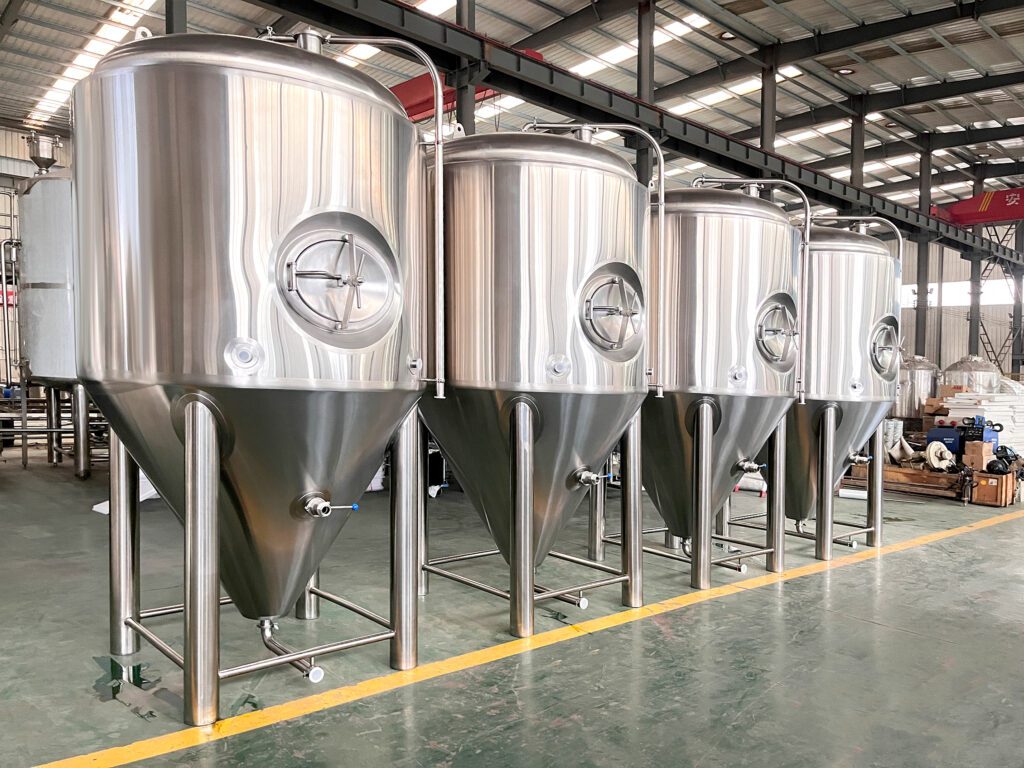
The material and construction figures above are the transferable part. SUS316L versus SUS304 is a genuine decision rather than a marketing upgrade: 316L’s molybdenum content gives better resistance to chloride attack, which matters if your wash water is high in chlorides or you produce wines with aggressive acid profiles. 304 is adequate for many operations and costs less. Ask which grade your quote is based on, because the two are visually identical.
The 80–100 mm polyurethane insulation figure is worth attention at micro scale for a reason that is easy to miss: small tanks have a high surface-area-to-volume ratio, so they gain and lose heat faster than large ones. Insulation matters proportionally more on a 1,000 L vessel than on a 10,000 L one, not less.
Pumps and transfer at micro scale
Pump selection at this size is dominated by gentleness rather than throughput. Must with skins, whole berries, and lees all handle differently from clear wine, and a pump that shears fruit or oxidises wine during racking will undo careful fermentation work.
The questions to put to a supplier: can it handle must with skins or only clear liquid, is it self-priming, can it run in reverse, and how is it cleaned. Detailed pump specifications are not published for MICET’s winery line, so flow rate, inlet size, and motor rating need to be requested for the specific unit.
At 500–2,000 L, gravity flow is a genuine alternative worth designing for. A mezzanine or tank stand that lets you rack by gravity rather than pump reduces both equipment cost and oxygen pickup. It costs floor-to-ceiling height, which is why it has to be decided during site layout rather than added later.
Compared with the compact all-in-one fermentation units commonly marketed to home and hobby winemakers stepping up, commercial micro winery equipment is modular by design — separate vessels, separate transfer equipment, separate temperature control. That modularity is what lets you add a tank next vintage instead of replacing the system.
Where refurbished tanks fit a first-year budget
Refurbished stainless can genuinely reduce first-year capital cost. It fits best where the vessel does simple work: storage and holding tanks, blending vessels, and non-jacketed capacity that does not need precise temperature control.
Refurbished fits less well where the vessel does complicated work. A jacketed fermentation tank with temperature control has more to go wrong — jacket integrity, glycol circuit condition, probe accuracy, valve seat wear. The cost of a failed jacket weld discovered mid-vintage is not measured in the price difference.
Honest scope note: MICET’s published used equipment listings cover brewing equipment — compact brewhouse configurations from 2 to 10 BBL, and used fermentation tanks listed at 3–5 BBL, 10 BBL, 20 BBL, 40 BBL, plus metric sizes of 2T, 4T, and 6T (2,000 L, 4,000 L, and 6,000 L total capacity; 1,800 L, 3,600 L, and 5,400 L working capacity), in SUS304 with glycol jacket and polyurethane insulation, at 0.2 MPa design and 0.3 MPa test pressure.
Those are beer fermentation vessels. The 2T unit at 2,000 L total and 1,800 L working capacity lands within this article’s range on volume, but beer and wine fermenters differ in cone angle, manway placement, cap-management access, and fitting configuration. A beer fermenter can serve as wine storage or as a closed white-fermentation vessel in many cases; it is a poor open-top red fermenter. There is no separately listed refurbished wine tank inventory on the site, so availability for a wine-specific used vessel is a question for quotation.
If you are evaluating a refurbished tank from any source, inspect for: pitting on the interior shell, weld condition at the cone-to-cylinder transition, jacket pressure integrity, valve and fitting condition, and whether the interior finish has been repolished or merely cleaned. Ask what was replaced during refurbishment and what was left as-is.
Certification: check the scope wording, not the logo
This is where winery buyers should read more carefully than brewery buyers, because certificate scope language does not always name wine equipment.
MICET holds a PED Verification, certificate 3N231110.SICS093, issued by Ente Certificazione Macchine Srl under Directive 2014/68/EU with verification to EN 1626:2008, issued November 10, 2023 and valid to November 9, 2028. Its scope wording names brewing equipment, beer equipment, brewery equipment, and pressure vessels.
A second document, the voluntary Verification of Conformity ICR/VC/HM2507146, issued by ICR Co., Ltd., covers brewery equipment, brewing equipment, fermentation equipment, and pressure vessels under PED 2014/68/EU with reference to EN 1626:2008 and EN 10204:2004, issued July 16, 2025 and valid to July 15, 2030. The broader “fermentation equipment” and “pressure vessel” wording is the more relevant of the two for a winery buyer.
Both are organization-level verifications held by the manufacturer. No certificate numbers are disclosed for the wine fermentation tank line specifically, and none are disclosed for the used product lines. If a particular vessel needs documented status for your installation, establish it for that vessel in writing.
One technical point that saves unnecessary worry: many wine fermentation tanks at 500–2,000 L are atmospheric or variable-capacity vessels operating at ambient pressure, which places them outside pressure equipment directive scope entirely. Pressure equipment documentation becomes relevant when a vessel is pressure-rated. Confirm which category your tanks fall into before assuming you need a certificate, or assuming you do not.
Budget: what is published and what is not
No price range is published for winery equipment. The disclosed ranges — microbrewery equipment at 30,000–80,000 USD and commercial brewery equipment from 10 BBL at 50,000–80,000 USD — apply to brewing systems and should not be read across to winery projects. Wine equipment pricing requires a quotation.
I would rather state that than publish an inferred figure. Tank count, stainless grade, jacketing, lid type, and freight vary enough between two micro wineries at the same nominal capacity that a headline range would mislead more than it helps.
What moves a micro winery quote most: number of vessels (usually the largest factor), whether tanks are jacketed, SUS304 versus SUS316L, variable-capacity lids versus fixed, and freight terms. Ask explicitly whether the quote includes a glycol chiller, tank stands, valves and fittings, and installation — these are frequently excluded and frequently assumed.
The misstep: buying tanks before deciding the temperature strategy
Most micro winery equipment errors trace back to treating temperature control as an accessory rather than a design decision made first.
There are three routes at this scale, and they lead to different tank purchases. A jacketed tank with a glycol chiller gives precise per-vessel control and costs the most. A temperature-controlled room gives adequate control across all vessels and lets you buy unjacketed tanks, which are cheaper, but every vessel is held at the same temperature. Passive control — a well-insulated cellar with thermal mass — costs least in equipment and most in vintage variability.
Choosing jacketed tanks and then discovering the glycol chiller was not in the quote is a common and expensive sequence. So is buying unjacketed tanks to save money, then finding the cellar cannot hold fermentation temperature during a warm harvest and losing aromatic character on a white.
Decide the strategy, price the chiller if the strategy needs one, then specify the tanks. Not the reverse.
A specification sequence for a micro winery build
- Fix your variety plan and lot structure, not just the annual litre target. The number of distinct lots determines vessel count.
- Size the largest vessel to the largest single-variety pick, then fill remaining capacity with smaller vessels.
- Choose your temperature control strategy— jacketed plus chiller, controlled room, or passive — and price it as part of the tank decision.
- Split the tank list by function: fermentation vessels, storage and blending vessels, and any dedicated red open-top capacity.
- Decide stainless gradebased on your water chemistry and wine style, and confirm which grade each quoted vessel uses.
- Request the unpublished fieldsfor the specific tanks quoted: diameter, height with legs, manway type and dimensions, lid type, valve specification, jacket zone count.
- Measure the delivery route and cellar— doorway clearance, ceiling height, floor drainage, and whether gravity racking is feasible.
- For any refurbished vessel, request its inspection and refurbishment record, plus documentation of what was replaced.
- Confirm exclusions in writing: chiller, stands, fittings, freight terms, installation.
Step 1 is the one that determines whether the rest of the list produces a workable cellar or an expensive set of tanks that do not match your fruit.
What to do next
If you are specifying this vintage, the immediate action is writing your lot structure down — variety by variety, expected tonnage, expected pick window — and taking that document to a supplier rather than a total litre figure. A quote built from a lot structure will look different from one built from “2,000 litres,” and it will be the one that works in October.
The subject this article has not covered is pressing and destemming, which sits upstream of everything here and has its own scale thresholds. Press capacity determines how fast you can process a pick, and a mismatch between press throughput and tank availability creates a bottleneck on the one day of the year you cannot afford one.
FAQ
Q: How much wine does a 2,000 L micro winery produce?
A: Roughly 2,666 bottles at 750 ml, or about 222 twelve-bottle cases, before accounting for losses during racking and filtration. Fruit intake is typically in the region of 3.0–3.4 tonnes, though yield per tonne varies considerably by variety and press regime.
Q: Can I use beer fermentation tanks for wine?
A: Sometimes. A closed jacketed beer fermenter can work for white fermentation or wine storage, and MICET’s used listings include a 2T unit at 2,000 L total and 1,800 L working capacity. Beer fermenters make poor open-top red fermenters, as cone angle, manway placement, and cap-management access differ. No wine-specific refurbished inventory is separately listed.
Q: SUS304 or SUS316L for wine tanks?
A: Both are published for MICET’s wine fermentation tank line. 316L resists chloride attack better, which matters with high-chloride wash water or aggressive acid profiles. 304 costs less and is adequate for many operations. The two look identical, so confirm which grade a quote is based on.
Q: What does micro winery equipment cost?
A: No price range is published for winery equipment; it requires a quotation. The published microbrewery and commercial brewery ranges apply to brewing systems and should not be read across. Vessel count, jacketing, stainless grade, and lid type are the largest cost drivers.