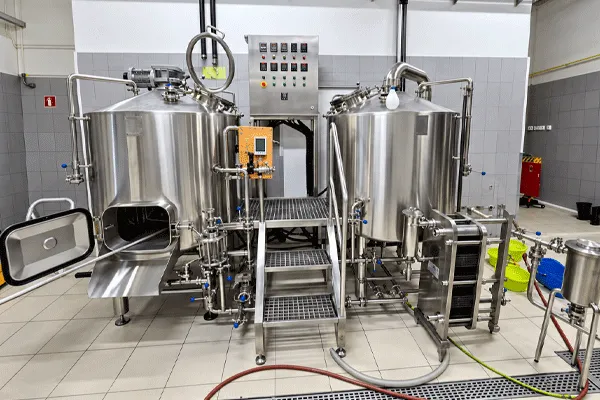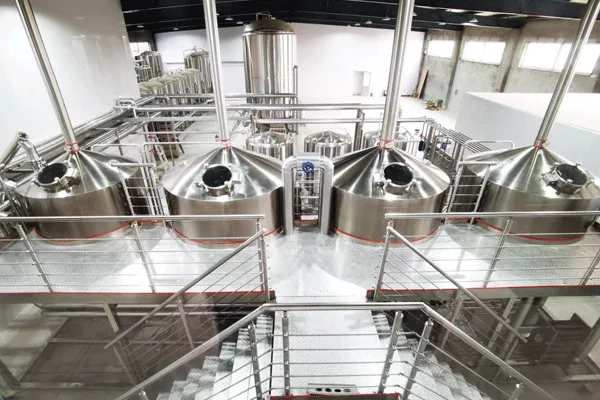


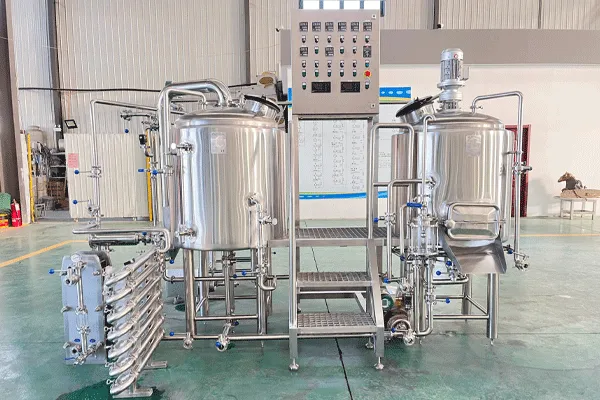
A shiny tank can still hide poor welds, hard-to-clean corners, weak cooling, or the wrong fittings. Those problems become costly once production starts. The safer approach is to evaluate stainless steel beer brewing equipment by material, sanitary design, fabrication quality, cooling, cleanability, and real production needs.
Good stainless steel brewing equipment should use the right material grade, smooth product-contact surfaces, sanitary welds and fittings, effective drainage, reliable temperature control, and CIP-friendly construction. For commercial brewing, buyers should inspect these details together with tank capacity, pressure requirements, utilities, controls, and future expansion before approving a system.
Resumen del artículo
- Why is stainless steel the standard choice for commercial brewing equipment?
- Should your brewery choose 304 stainless steel or 316L?
- How should buyers inspect welds and internal surface finish?
- Which tri-clamp fittings, valves, hoses, and sanitary parts matter?
- What should you check in a brew kettle and brewhouse?
- How should stainless steel fermenters be designed?
- Why do glycol chillers and precise temperature control matter?
- How does CIP-friendly design improve brewery sanitation?
- How should equipment change from 1 BBL to 15 BBL and beyond?
- What should be included in your brewery equipment RFQ and FAT?
- Frequently asked questions
Why Is Stainless Steel the Standard Choice for Commercial Brewing Equipment?
Modern breweries depend heavily on stainless steel because it combines strength, corrosion resistance, cleanability, and durability. The same material can be used across hot-side vessels, fermentation tanks, bright tanks, piping, pumps, and many other pieces of production equipment.
For a professional brewer, however, the material name is only the beginning.
A tank may look polished from the outside yet still have poor internal welds, difficult drainage, badly positioned fittings, or areas that are hard to sanitize. Those details can influence cleaning time, product loss, maintenance, and beer quality for years.
A commercial brewing line may contain:
- Malt handling equipment
- Mash tuns
- Caldera de cocción
- Lauter vessel
- Whirlpool
- Intercambiador de calor
- Bombas
- Process piping
- Fermenter tanks
- Bright beer tanks
- Glycol system
- CIP equipment
- Control system
The goal is not to buy the most polished-looking tank. It is to build a brewing system in which every surface touching water, wort, beer, yeast, or cleaning solution supports reliable daily production.
That difference separates professional beer brewing equipment from a simple collection of tanks.
Should Your Brewery Choose 304 Stainless Steel or 316L?
For many brewery applications, 304 stainless steel is widely used because it provides good corrosion resistance, fabrication performance, and long service life.
The Brewers Association’s process-piping guidance notes that 304 SS tubing is commonly used in breweries. It also emphasizes sanitary fittings, qualified welding, inspection, and hygienic installation rather than treating material grade as the only quality factor.
MICET also uses SUS304 across many published brewery and beverage tank designs, while SUS316L can be specified for applications where the product chemistry, cleaning chemicals, water conditions, or corrosion environment justify it.
304 vs. 316L at a Glance
| Factor | SUS304 | SUS316L |
|---|---|---|
| General beer production | Common choice | Suitable |
| Standard brewery tanks | Widely used | Available |
| Corrosion resistance | Good | Higher in some aggressive conditions |
| Chloride resistance | Lower than 316L | Better |
| Fabrication cost | Baja | Más alto |
| Typical use | Brewhouse, fermenters, BBTs, piping | More demanding chemical/process conditions |
Do not automatically assume 316L makes every brew better.
Material selection should follow process conditions. The Brewers Association’s current CIP guidance also points out that water hardness, chlorides, cleaning chemistry, equipment material, surface finish, and plant environment all affect cleaning performance and corrosion risk.
For most buyers, the better question is:
What material should be used on each product-contact surface, and why?
That gives your supplier something measurable to design around.
How Should Buyers Inspect Welds and Internal Surface Finish?
This is one of the most important parts of a commercial equipment inspection.
A good weld should not create pits, cracks, rough edges, burn marks, or difficult-to-clean crevices on product-contact surfaces. Poor welding can turn a high-quality sheet of SS into a difficult sanitary surface.
The Brewers Association recommends that sanitary tubing welds be TIG welded and properly purged. It also recommends inspecting OEM piping and weld quality before final completion and shipment.
3-A sanitary guidance likewise stresses smooth product-contact surfaces free from imperfections such as pits, folds, and crevices.
What Should You Inspect?
Ask the manufacturer to show:
- Internal weld seams
- Circumferential welds
- Nozzle welds
- Manway welding
- Cooling-jacket fabrication
- Internal polishing
- Drain areas
- Tank bottom
- Pipe welds
- Pressure-test records
MICET’s published commercial tanks commonly use TIG-welded construction and polished sanitary internal surfaces. Some published systems specify internal finishes around Ra 0.4 μm, depending on equipment and project design.
But do not copy one number blindly into every RFQ.
Ask what finish is needed for your process and request a measurable specification.
Which Tri-Clamp Fittings, Valves, Hoses, and Sanitary Parts Matter?
Small components can create large operating problems.
A well-made tank connected with badly selected valves, long dead legs, poor hose routing, or difficult-to-clean fittings is no longer a well-designed sanitary system.
Commercial breweries commonly use tri-clamp connections because they allow hygienic equipment sections to be connected and serviced efficiently.
A typical system may include:
- Butterfly valves
- Sampling valves
- Check valves
- Pressure/vacuum relief devices
- Tri-clamp elbows and tees
- Sight glass
- Sanitary pumps
- Flexible hoses
- Temperature sensors
- Pressure gauges
The correct fitting size also matters.
An undersized transfer line can slow a brew day. An oversized line may increase cost and product hold-up without improving the process.
Look Beyond the Valve Brand
During procurement, buyers sometimes focus heavily on component brands.
Brand quality matters, but the full design matters more.
Ask:
- Can the valve be cleaned in place?
- Is it easy to replace locally?
- Is its seal material suitable for the process?
- Can operators reach it?
- Does the piping drain?
- Are there unnecessary dead legs?
The best sanitary component cannot fix a poorly designed process line.
What Should You Check in a Brew Kettle and Brewhouse?
The hot side exposes equipment to heat, grain solids, water, cleaning chemicals, and repeated production cycles.
A commercial brew kettle therefore needs more than a strong shell.
Buyers should evaluate:
- Capacidad de trabajo
- Total tank volume
- Método de calentamiento
- Aislamiento
- Steam jacket or heating elements
- Agitation
- Outlet position
- Internal finish
- Cleaning coverage
- Vent design
- Temperature measurement
- Pump capacity
The same approach applies to the mash vessel.
During all-grain brewing, the mash must achieve stable temperature conditions and good mixing. Grain handling, lautering, wort transfer, and the kettle should work as one process instead of separate machines.
A home brewer may use an 8 gal kettle, a propane burner, a simple wort chiller, or an immersion cooling coil. Those tools can be useful when learning to brew, but the design priorities change once you enter commercial production.
A professional brewhouse needs repeatability.
The brewer should be able to make the same recipe again tomorrow, next week, and next month without fighting the equipment.
How Should Stainless Steel Fermenters Be Designed?
The fermenter is where good hot-side work can either develop into good beer or run into trouble.
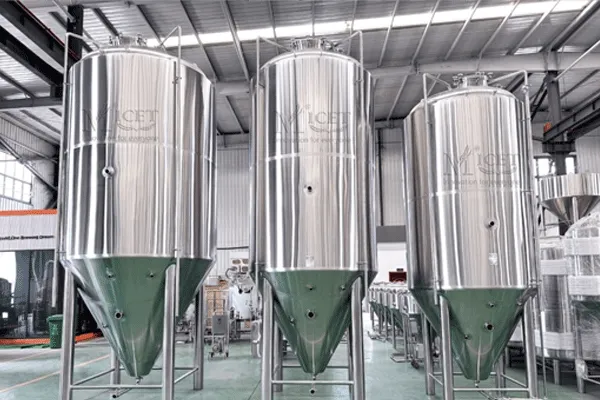
Commercial stainless steel fermenters often use a cylindrical body with a conical bottom. The geometry supports yeast collection, sediment removal, cleaning, and product transfer.
A commercial conical tank may include:
- Cooling jackets
- Aislamiento
- Temperature sensor
- Válvula de muestreo
- Pressure gauge
- Válvula de seguridad
- CIP spray device
- Entrada de hombre
- Brazo de estantería
- Carbonation stone where required
- Adjustable legs
For example, a published MICET 4000L brewery fermenter uses SUS304 construction, polyurethane insulation, a 60° cone, and multiple glycol cooling zones to support stable fermentation.
Why Cone Design Matters
During the fermentation process, yeast and solids settle toward the bottom of the tank.
A proper cone allows the brewer to remove sediment and harvest or discharge yeast more easily while reducing unnecessary product disturbance.
This is one major difference between commercial conical fermenters and simple carboys or small hobby containers.
A Brew Bucket, for example, may make sense in a pilot or home brew environment. Products associated with brands such as SS Brewtech or Blichmann also appear frequently in small-scale and enthusiast brewing discussions.
Commercial buyers should not judge industrial tanks by the same criteria used to choose a hobby fermentation vessel.
Scale changes everything.
Why Do Glycol Chillers and Precise Temperature Control Matter?
Good fermentation requires more than a good tank.
Yeast produces heat while it works. If the cooling system cannot remove that heat, the tank temp can move away from the brewer’s target.
A commercial fermentation system may therefore combine:
Fermenter → temperature sensor → controller → cooling valve → glycol jacket → chiller
That loop enables precise temperature control.
Cooling Capacity Must Match the Cellar
One chiller may serve several tanks, but it must be sized for the actual load.
Consider:
- Number of fermenters
- Tank capacity
- Fermentation heat
- Cold crashing
- Bright tanks
- Ambient conditions
- Future tank additions
A small brewery may start with several tanks and later double cellar capacity. If the original glycol system has no spare capacity, adding tanks may also require replacing the cooling system.
That is why we often plan utilities together with vessels.
A good controller and valve cannot compensate for an undersized chiller.
Likewise, a large chiller cannot solve poor jacket coverage.
The entire cooling loop has to work together.
How Does CIP-Friendly Design Improve Brewery Sanitation?
You cannot judge cleanability by looking at the outside of a tank.
A brewery must clean internal vessel surfaces, piping, pumps, valves, heat exchangers, and other product-contact areas repeatedly.
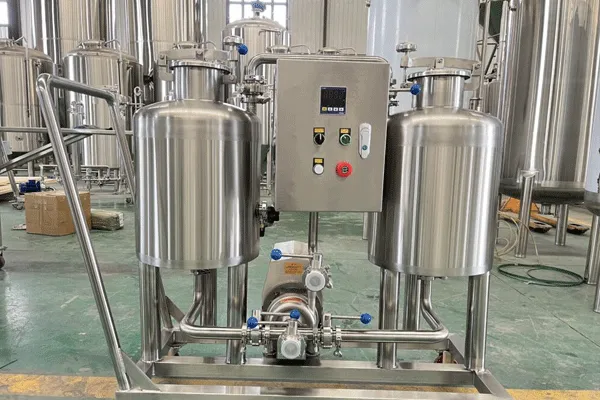
A CIP system helps circulate water and cleaning solutions through this equipment without dismantling every component.
The Brewers Association emphasizes four interacting cleaning variables—chemistry, mechanical action, temperature, and time—and also points out that equipment design and water quality can limit how well a cleaning program performs.
In other words:
You cannot clean away a bad equipment design.
CIP-Friendly Equipment Should Consider
- Drainability
- Spray coverage
- Smooth product-contact surfaces
- Válvulas accesibles
- Suitable pump flow
- Cleanable fittings
- Short sanitary pipe runs
- Correct return paths
- Minimal dead spaces
MICET’s commercial systems can be configured with CIP spray balls, sanitary fittings, pumps, valves, and dedicated cleaning units depending on plant scale.
Good sanitation starts during design and build, not after the first contaminated batch.
Some purchase specifications use broad terms such as food grade or even “USDA.” Those words alone are not enough to evaluate a tank. Ask suppliers to define measurable material, surface, welding, pressure, electrical, cleaning, and applicable sanitary requirements.
How Should Equipment Change From 1 BBL to 15 BBL and Beyond?
Scaling a brewery is not as simple as multiplying every dimension.
A 1BBL pilot system and a 15 BBL production system may perform similar process steps, but their engineering needs can be very different.
| Design Factor | Smaller Pilot System | Larger Commercial System |
|---|---|---|
| Transfers | More manual | More pump-driven |
| Calefacción | Electric may be practical | Steam often considered |
| Refrigeración | Lower load | Larger centralized glycol load |
| Controls | Simple PID | More integrated controls |
| Tuberías | Limitado | More permanent sanitary piping |
| PIC | Basic/mobile | Larger or dedicated CIP |
| Labor | Hands-on | Automation becomes more valuable |
| Tank handling | Few vessels | Cellar scheduling becomes critical |
As capacity grows, pipe sizing, pump selection, heat exchange area, jacket coverage, utility demand, floor loading, tank access, and control logic become more important.
That is why copying a “successful” small system and simply making it larger can create problems.
An Illustrative 15 BBL Example
Imagine a brewery that plans to brew twice per day.
The real purchasing question is not only:
“Can the kettle hold 15 BBL?”
It is also:
- Can the heat source reach boil on schedule?
- Can the heat exchanger cool the wort fast enough?
- Is there a fermenter ready?
- Can glycol handle peak load?
- Can the CIP unit turn tanks around quickly?
- Can pumps transfer product without delaying the next brew?
Commercial brewing solutions should answer all of these questions together.
What Should Be Included in Your Brewery Equipment RFQ and FAT?
A professional RFQ should make comparison easier.
If one supplier quotes a bare tank while another quotes a complete system, the lower price tells you very little.
Include These Items in Your RFQ
Process
- Target batch size
- Brews per day
- Beer styles
- Fermentation schedule
- Annual production target
Tank
- Working volume
- Volumen total
- Calidad del material
- Shell thickness
- Cone geometry
- Aislamiento
- Jacket configuration
- Working pressure
Sanitary Design
- Internal finish
- Welding method
- Drainability
- CIP arrangement
- Valve types
- Tri-clamp sizes
Servicios
- Electrical supply
- Steam
- Water
- Glicol
- Compressed air
- CO₂
Controls
- Control de la temperatura
- Pump controls
- Heating controls
- PLC/PID preference
- Alarm requirements
Do Not Skip FAT
A Factory Acceptance Test gives the buyer an opportunity to verify equipment before shipment.
The Brewers Association recommends inspecting OEM welds and piping before final completion and suggests including weld inspection in the equipment contract.
A practical FAT may check:
| Inspection Item | What to Verify |
|---|---|
| Material | Matches approved specification |
| Welding | Smooth and complete |
| Finish | Matches required internal surface |
| Tank dimensions | Match approved drawings |
| Accesorios | Correct quantity and location |
| Jackets | Pressure/leak testing |
| Tank | Pressure testing where applicable |
| Controls | Basic functional test |
| Bombas | Rotation and operation |
| Documentation | Drawings, manuals, component list |
This is where a manufacturer should prove that the delivered equipment matches the agreed design.
Home Brewing Equipment vs Commercial Stainless Steel Brewing Equipment
The keyword brewing equipment covers a very wide market.
A hobby brewer may shop for a brewing kit, 8 gal kettle, brew bucket, small beer keg, spigot, rack, immersion chiller, or other brewing supplies.
That is a valid market. It is simply not the same market as a commercial brewery.
| Home Brewers | Commercial Brewers |
|---|---|
| Small batches | Repeated production |
| Portable equipment | Fixed process system |
| Manual transfers | Pumps and sanitary piping |
| Basic temp control | Engineered cooling |
| Hobby cleaning | Documented sanitation |
| Small fittings | Integrated sanitary network |
| Simple kettle | Engineered brewhouse |
| Limited output | Commercial capacity |
Brands such as SS Brewtech and Blichmann may appear when buyers research pilot or enthusiast-level equipment.
But a brewery investing in commercial stainless steel beer production should compare fabrication quality, sanitation, cooling performance, serviceability, engineering support, and plant integration—not just familiar retail product names.
Preguntas Frecuentes
Is 304 stainless steel suitable for beer brewing equipment?
Yes. SUS304 is widely used in commercial brewery tanks, piping, brewhouses, and fermenters because it offers good corrosion resistance and sanitary performance when properly fabricated and maintained.
More demanding product chemistry or cleaning conditions may justify SUS316L.
What internal finish should a brewery fermenter have?
The required finish depends on the process and sanitary specification.
Commercial buyers should request a measurable surface-finish requirement and verify that welds, fittings, and product-contact areas do not introduce pits, crevices, or hard-to-clean zones.
Are thicker stainless steel tanks always better?
No.
Tank design depends on diameter, height, pressure, head geometry, jacket construction, structural loads, and applicable design requirements.
A thicker sheet does not automatically mean a better fermenter.
What should I inspect before buying a stainless steel fermenter?
Check material, welds, internal finish, cone design, cooling jackets, insulation, temperature sensor, pressure protection, sanitary valves, CIP coverage, working pressure, and tank dimensions.
Also confirm whether it fits your building and cooling system.
Does every craft brewery need a fully automated brewing system?
No.
A small craft beer brewery may prefer semi-automatic controls, while a larger operation with frequent batches may benefit from more automation.
Choose automation based on labor, repeatability, output, recipe complexity, and maintenance resources.
Can one manufacturer design both tanks and the complete brewery system?
Yes.
A professional brewery equipment manufacturer can combine stainless steel fabrication, brewhouse vessels, fermenters, cooling, controls, CIP, piping, and installation planning into one project.
This often makes system integration easier because each component can be designed around the same process requirements.
Key Things to Remember
- 304 stainless steel is widely used in commercial brewery applications, while 316L may suit more demanding corrosion conditions.
- Material grade alone does not determine equipment quality.
- Inspect internal welds, polishing, fittings, drainability, and sanitary design.
- TIG welding, proper fabrication, and weld inspection matter on product-contact surfaces.
- A good fermenter needs effective cooling, sanitary fittings, and reliable temperature control.
- Glycol capacity should be calculated around the complete cellar, not one tank.
- CIP performance depends partly on equipment design.
- Avoid vague terms such as “food grade” without measurable specifications.
- Small home-brew hardware and commercial brewing equipment serve very different operating needs.
- Scaling from 1 BBL to 15 BBL requires changes in utilities, pumps, cooling, controls, and workflow—not just larger tanks.
- Include material, finish, welding, pressure, fittings, controls, and testing requirements in your RFQ.
- Carry out a FAT before equipment ships whenever possible.
- The best commercial system combines good stainless steel fabrication with process engineering, sanitation, cooling, and long-term serviceability.
For craft breweries, brewpubs, beverage producers, investors, and engineering contractors, buying stainless equipment should never be reduced to comparing tank prices.
We recommend starting with the product, production target, building, utilities, and operating plan. From there, the brewhouse, fermenter cellar, chiller, CIP, controls, and piping can be designed as one system.
That approach helps a brewery brew consistently today while keeping enough flexibility to grow tomorrow.