Desechar demasiado alcohol reduce el rendimiento y los beneficios. Conservar la fracción incorrecta puede perjudicar el sabor, la consistencia y la seguridad. La respuesta no es un número fijo de onzas ni un porcentaje universal. Un destilador profesional realiza cortes controlados en función del mosto, el diseño del alambique, el ABV, el análisis sensorial y un proceso de producción validado.
No existe una cantidad universal de alcohol que deba desecharse durante la destilación. Los destiladores comerciales separan las puntas, las cabezas, los corazones y las colas según la materia prima, la fermentación, el diseño del alambique, el estilo de la bebida espirituosa, la concentración alcohólica y los objetivos de calidad. La fracción del corazón se convierte en el producto principal, mientras que las cabezas y las colas pueden separarse, redestilarse, reciclarse cuando sea oportuno o gestionarse de acuerdo con los procedimientos operativos de la destilería y la normativa local.
Para una destilería profesional, preguntarse «¿cuánto debo desechar?» es menos útil que preguntarse «¿dónde debo hacer los cortes?».
Esa diferencia importa.
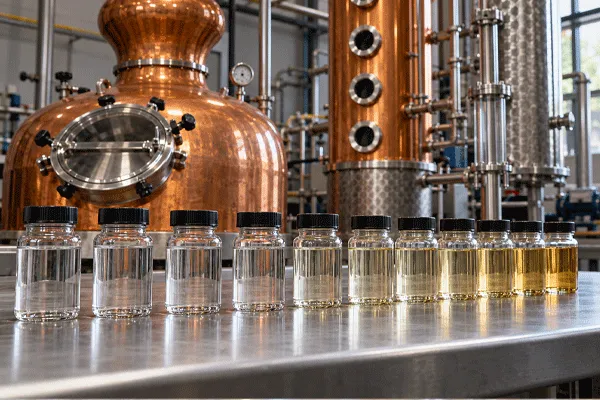
Una regla fija como «descartar X onzas por cada tanda de 5 galones» ignora la cantidad de etanol en el mosto fermentado, la materia prima, la calidad de la fermentación, la geometría del alambique, el reflujo, la velocidad de calentamiento y el destilado deseado. El enfoque correcto consiste en comprender cómo cambia cada fracción a lo largo de la destilación y, a partir de ahí, establecer procedimientos operativos reproducibles.
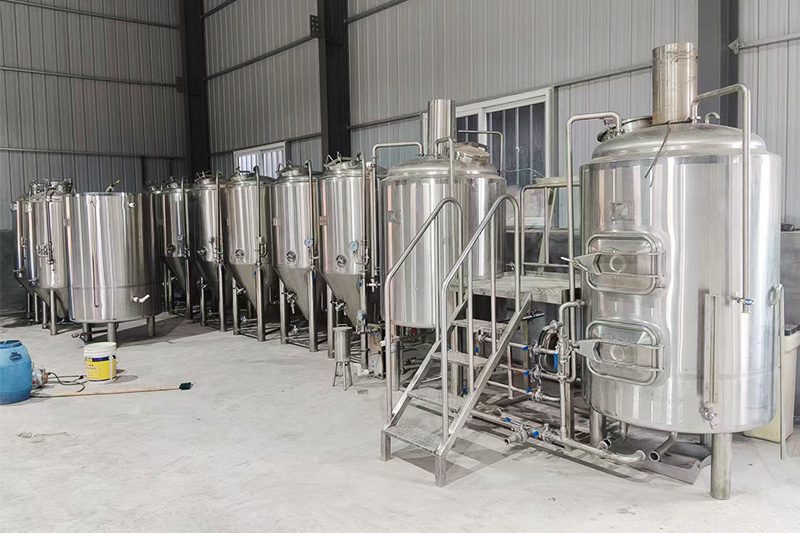
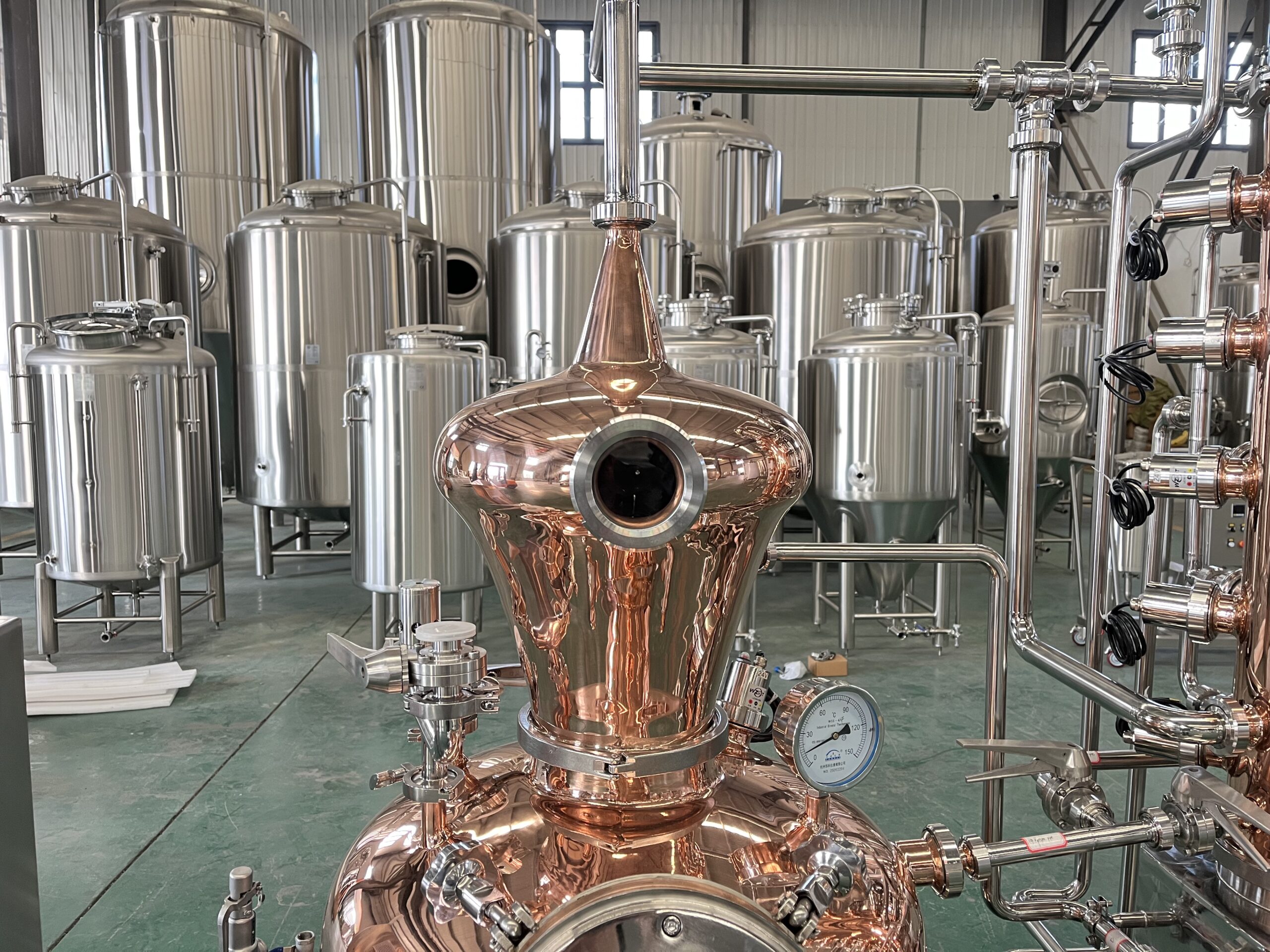
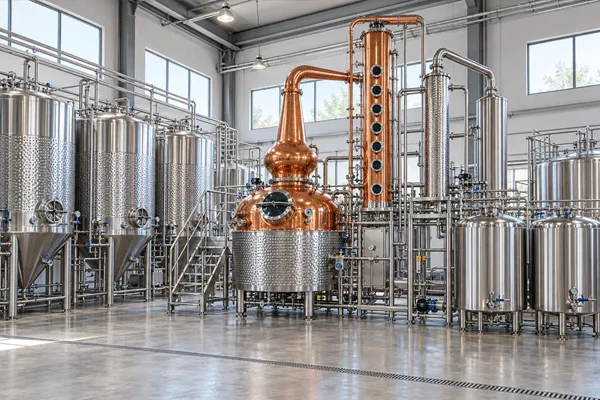
En Micet, nuestros sistemas de destilería están diseñados en torno a la producción integral de bebidas espirituosas y no solo al alambique. Los alambiques pot still, los alambiques híbridos, los sistemas de columnas, los fermentadores, los condensadores, los depósitos de destilado, los sistemas de control, el CIP, la refrigeración y las tuberías de proceso pueden adaptarse al destilado requerido y a la capacidad de producción.
¿Qué sucede durante el proceso de destilación?
Antes de poder destilar una bebida espirituosa, primero se necesita alcohol.
Durante la fermentación, la levadura transforma los azúcares fermentables del mosto en etanol, dióxido de carbono y muchos otros compuestos aromáticos secundarios. Cuando ese mosto fermentado entra en el alambique, contiene agua, etanol, ácidos, ésteres, alcoholes superiores y otros compuestos volátiles.
El proceso de destilación separa esos compuestos en función de su volatilidad y de su interacción con la mezcla líquida total.
En pocas palabras:
Fermented Wash → Heat → Vapor → Condensation → Distillate
As the still heats, the composition of the vapor changes over time. The composition of the collected distillate also changes.
That is why a distillation run is normally divided into broad fractions:
| Fraction | General Position | Typical Role |
|---|---|---|
| Foreshots / early heads | Beginning | Separated from the main product |
| Heads | Early run | Strong volatile character; usually separated |
| Hearts | Middle | Main desirable spirit fraction |
| Tails | Late run | Heavier compounds; separated or managed separately |
The boundaries are not sharp lines.
Compounds overlap across the run, so experienced operators make cuts based on process data and sensory evaluation rather than assuming that one compound appears at one exact temperature.
What Are Foreshots and Why Are They Separated?
Foreshots are the first portion collected from a spirit run and are normally kept separate from the heart product.
Early distillate can contain a relatively high concentration of very volatile compounds. Depending on the fermented raw material and process, early fractions may contain substances such as acetaldehyde, ethyl acetate, acetone-like aromas, and other compounds that can give sharp solvent-like notes.
This is one reason commercial distillers do not immediately start collecting everything that comes out of the still into the finished-spirit tank.
The early fraction requires controlled handling.
However, it is important not to oversimplify this into the common internet claim that “all methanol comes out first.”
It does not.
Research on some fruit and grape distillates shows that methanol can be present across several parts of the run and, under some conditions, may even remain significant in later fractions. Raw material composition is especially important in fruit spirits because pectin can contribute to methanol formation.
Methanol is toxic, and unsafe or improperly produced alcoholic beverages can present serious health risks. CDC and UK public-health guidance both warn about methanol exposure and contaminated or improperly produced spirits.
For a commercial plant, this means foreshots should not be managed by an arbitrary home-distilling formula. Producers should follow validated process controls, applicable regulations, product testing, and trained distilling procedures.
How Much Foreshots Should a Distiller Discard?
There is no reliable universal answer.
The amount depends on:
- Wash volume
- Alcohol content
- Raw material
- Fermentation quality
- Spirit style
- Pot geometry
- Nivel de reflujo
- Velocidad de calentamiento
- Whether it is a stripping or spirit run
- Distillation equipment
- Operating procedure
- Legal specifications
A 5 gallon run, for example, cannot be safely standardized by saying “throw away the first X ounces.” Two 5-gallon washes can contain different concentrations of ethanol and different volatile compounds.
A fruit mash and a grain wash are also chemically different.
So when people ask:
“How much should I throw away the first time liquid exits my still?”
our answer for commercial producers is: do not set your production procedure from a generic volume rule.
Instead, develop the cut points from controlled runs, instrumentation, laboratory analysis where required, product specifications, and experienced sensory assessment.
This gives you a repeatable system rather than a guess.
What Are Heads in Distillation?
After the earliest fraction, the distillate moves into what distillers broadly call the heads.
Heads contain a mix of ethanol and relatively volatile aroma compounds. Some may smell fruity or sweet. Others can smell like solvent, nail polish, glue, green apples, or sharp chemicals.
Acetaldehyde and some esters are often associated with early-run character.
The challenge is that heads typically do not suddenly stop at one point.
Instead, the aroma gradually changes.
This creates a transition into hearts.
Experienced distillers may monitor:
- Distillate aroma
- Taste where legally and safely appropriate
- ABV
- Product temperature
- Vapor temperature
- Flow rate
- Reflux behavior
- Batch history
This is why cuts is a skill, but in a commercial distillery it should not depend on skill alone.
A good production system combines the operator’s sensory judgment with repeatable process data.
Micet’s distillery equipment can be configured with temperature, pressure, and flow monitoring as well as process-control options for managing heads, hearts, and tails.
Why Are the Hearts the Sweet Spot?
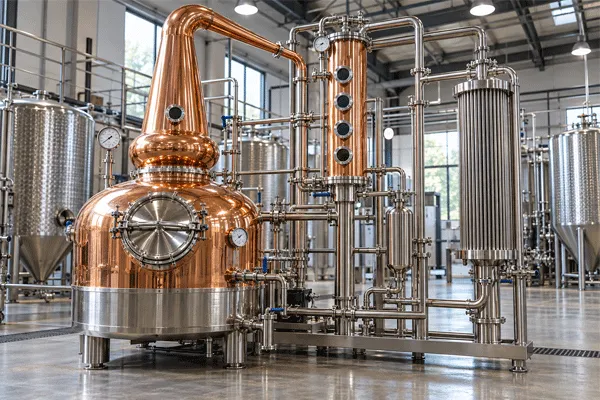
The hearts are the sweet spot of many batch spirit runs.
This is the fraction a distiller normally targets as the core of the final spirit.
The hearts contain a useful balance of ethanol and desirable flavor compounds while avoiding too much early-run harshness and excessive late-run heaviness.
For whisky, rum, brandy, fruit spirits, and similar products, the exact character of the heart can be part of the brand identity.
A wider heart cut may capture more flavor.
A narrower heart cut may create a cleaner spirit but reduce immediate yield.
There is no single correct answer because the desired taste and aroma varies by product.
For example:
- A flavor-forward whisky may retain more congeners.
- A clean vodka base may require greater rectification.
- A fruit spirit may aim to preserve delicate fruit aroma.
- Gin may use a different downstream botanical process.
- Brandy producers may manage cuts to retain characteristic grape or fruit notes.
This is where commercial distillation becomes both engineering and sensory work.
What Are Tails and Do You Throw Them Away?
Tails are the final part of the distillation run after the desirable heart fraction begins to fade.
As the run continues, ethanol concentration usually falls and heavier compounds become more noticeable.
Tails contain water, remaining ethanol, higher alcohols, fatty-acid-related compounds, and other congeners. Some can create oily, earthy, vegetal, wet-cardboard, or heavy aromas.
Higher alcohols are often grouped under the term fusel alcohols.
That does not mean the entire tail must automatically become waste.
Many commercial processes manage late fractions separately. Depending on the spirit, production method, regulations, and quality plan, portions of heads or tails may be recycled into a future distillation or processed separately rather than simply discarded.
Research on cider distillation, for example, describes systems in which selected separated fractions are recycled into later distillations.
This matters economically.
If a distiller treats every non-heart liter as waste, alcohol recovery may suffer. But if undesirable fractions are blended blindly back into the product, quality may suffer.
The goal is not:
“Throw away as little as possible.”
The goal is:
“Keep the right fraction in the finished spirit and manage the other fractions intelligently.”
What Is the Difference Between a Stripping Run and a Spirit Run?
Many traditional batch processes use more than one distillation.
A stripping run is generally the first faster distillation used to concentrate alcohol from the fermented wash.
The resulting intermediate product is often called low wines.
This material then goes through a second distillation, often called a spirit run.
The spirit run is where the distiller makes more careful fraction selections.
A simplified process looks like this:
Fermented Mash → Stripping Run → Low Wines → Spirit Run → Heads / Hearts / Tails
The purpose of the stripping run is mainly concentration and recovery.
The spirit run focuses more heavily on refinement and the final spirit profile.
This is especially relevant when using a pot still.
A column or hybrid system can behave differently because reflux and multiple separation stages can increase separation efficiency.
Micet currently offers pot still, column still, and hybrid still configurations for whisky, gin, vodka, rum, brandy, and other spirits, with systems ranging from small craft capacity to commercial production volumes.
Why Does Still Design Matter When Making Cuts?
Still design matters because it changes how vapor and liquid interact before the product reaches the condenser.
Consider two systems.
Traditional Pot Still
A pot still provides relatively limited rectification.
It tends to carry more raw-material and fermentation character into the distillate, which is why pot stills are widely associated with flavor-driven craft spirits.
Alambique de columna
A column creates repeated vapor-liquid contact.
This gives the distiller more separation stages and can produce higher alcohol concentration and a cleaner spirit.
Alambique híbrido
A hybrid combines elements of both.
A producer can retain pot-still character for one product while using additional plates or column sections when more separation is needed.
| Still Type | Typical Character | Cut Management |
|---|---|---|
| Alambique | Rich, flavor-forward | Strong operator influence |
| Columna fija | Cleaner, higher proof | More separation control |
| Híbrido todavía | Flexible | Adjustable for multiple products |
Micet specifically positions these three configurations for different spirit styles, production capacities, and automation needs.
The condenser, column height, number of plates, copper contact area, reflux level, heating system, and still geometry can all influence what comes out of the still and how quickly the fractions transition.
Does Still Temperature Tell You Exactly When to Make the Cuts?
No.
La temperatura del alambique es información útil sobre el proceso, pero no debe considerarse como un interruptor mágico para realizar los cortes.
Es posible que encuentre guías sencillas que afirman:
«El compuesto A hierve a una temperatura determinada, por lo que sale primero. El compuesto B hierve más tarde».
El mosto fermentado real es más complejo.
Contiene agua, etanol, ácidos, ésteres, aldehídos, alcoholes superiores y muchos otros compuestos que interactúan en una mezcla.
El punto de ebullición individual de un compuesto puro no significa que este salga del alambique únicamente cuando el termómetro alcance esa temperatura exacta.
La destilación depende del equilibrio vapor-líquido.
Los compuestos tienen diferentes puntos de ebullición, pero su comportamiento dentro de una mezcla de etanol y agua también depende de la concentración y de la interacción con otras sustancias.
Por ello, un destilador profesional debe utilizar la temperatura como un parámetro de medición más, y no como el único criterio para realizar los cortes.
Otras señales útiles incluyen el ABV, el flujo, el aroma, el historial del proceso y los análisis de laboratorio.
¿Cómo influye la fermentación en las cabezas, el corazón y las colas?
Una buena destilación comienza antes del alambique.
Comienza durante la fermentación.
Las materias primas, la temperatura de fermentación, los niveles de nutrientes, la salud microbiana, la contaminación, el pH y la elección de la levadura pueden influir en los compuestos que posteriormente llegan al alambique.
Una fermentación limpia y controlada genera una destilación más predecible.
Una fermentación estresada puede generar más compuestos aromáticos indeseables y complicar las decisiones sobre los cortes.
Por eso, una destilería debe dimensionar sus tanques de fermentación en función de:
- Volumen de macerado
- Tiempo de fermentación
- Capacidad de destilación diaria
- Tipo de destilado
- Requisitos de enfriamiento
- Cronograma de producción
En Micet, la línea de destilería puede integrar maceradores, fermentadores de acero inoxidable, alambiques tradicionales o híbridos, columnas, condensadores, depósitos de almacenamiento para destilados, equipos de refrigeración, bombas, sistemas CIP, tuberías y controles en un único sistema de producción.
Esto es importante porque el alambique no puede corregir todos los problemas de las etapas previas.
Una mejor calidad del mosto fermentado suele facilitar la obtención de un mejor destilado.
¿El metanol solo se encuentra en las cabezas iniciales?
No, y este es uno de los conceptos erróneos más importantes que hay que corregir.
A menudo se suele escuchar:
«Deseche siempre las cabezas iniciales (foreshots), porque ahí es donde está todo el metanol».
The reality is more complex.
Methanol can occur naturally in fermented material, and its distribution during distillation depends heavily on raw material and process conditions.
Fruit-based fermentation deserves particular attention because fruit contains pectin. Research on apple and other fruit spirits shows that raw material and processing conditions can influence methanol concentration.
Studies of grape marc distillation have also reported methanol appearing throughout the distillation rather than existing only in one tiny early fraction.
So while early fractions are normally separated as part of producing quality spirits, simply discard the foreshots should not be presented as a complete methanol-control plan.
Commercial producers should use proper raw-material control, validated processing, legal specifications, qualified analysis where needed, and professional equipment.
Methanol exposure can cause serious poisoning, including visual damage and death.
How Much Alcohol Is Actually Lost During Making Perfect Cuts?
This is the business question behind the title.
The answer depends on what you call “lost.”
Imagine a distillation run produces several fractions:
Total Distillate
│
├── Early Fraction / Heads
│
├── Hearts → Finished Spirit
│
└── Tails
Only the hearts may go directly into the primary finished product.
But separated heads and tails do not necessarily represent 100% economic loss.
Depending on the production method, they may be:
- Held separately
- Reprocessed
- Added to another permitted distillation
- Used for a different non-finished-product stream
- Disposed of under the plant’s procedures
Therefore, making perfect cuts is really a balance between:
Yield + Flavor + Purity + Consistency + Compliance
If the cuts are too aggressive, the distiller loses useful ethanol.
If the cuts are too wide, the final spirit may gain harshness, heavy tail notes, or undesirable head character.
Experienced distillers develop cut specifications over repeated runs, then use equipment and process data to make the result more consistent.
How Can Commercial Distillers Make More Consistent Cuts?
For a professional distillery, consistency matters more than memorizing a fixed volume.
A practical production system should track relevant variables from batch to batch.
Record the Wash
Document:
- Batch size
- Raw material
- Starting gravity where applicable
- Tiempo de fermentación
- Final alcohol content
- Fermentation temperature
Record the Distillation
Track:
- Heating profile
- Distillate flow
- Vapor/process temperature
- Pressure where relevant
- ABV over time
- Fraction volume
- Sensory observations
Keep Fractions Separate
Do not rush the transition.
Collecting smaller intermediate fractions around the expected cut points can make later evaluation easier.
Build a Repeatable SOP
Once the desired product profile is established, document it.
That turns the distiller’s experience into a repeatable manufacturing process.
For expanding craft distilleries, automated monitoring can further reduce operator variation. Micet distillery systems can incorporate temperature, pressure, flow monitoring and process-control options depending on the project.
Why the Right Distillation Equipment Matters
Good cuts require more than a skilled nose.
The equipment must provide stable, controllable operation.
A well-designed distillery system should offer:
- Controlled heat input
- Stable vapor flow
- Effective condensation
- Appropriate copper contact where required
- Repeatable reflux behavior
- Accurate temperature monitoring
- Safe pressure management
- Hygienic piping
- Reliable spirit collection
- Easy cleaning
Micet’s current distillery range includes systems from 200L for small distilleries and pilot production up to 1000L and 1500L commercial systems, with larger capacities also available on its equipo de destilería platform.
For a new project, still capacity should not be selected alone.
We normally recommend matching:
Mash Capacity → Fermentation Capacity → Still Capacity → Condenser → Spirit Storage → CIP → Cooling → Packaging
If the fermenters are too small, the still waits.
If the condenser is undersized, the run slows.
If collection and storage tanks are poorly planned, production becomes inefficient.
A complete system protects both product quality and investment.
Frequently Asked Questions About Heads, Hearts and Tails
How much alcohol should be discarded when distilling?
There is no universal percentage or volume. The correct separation depends on raw material, wash ABV, still design, spirit type, run conditions, and production standards. Commercial distillers use validated cut points rather than a fixed “X ounces per gallon” rule.
Should you always discard foreshots?
The earliest fraction is normally kept separate from the heart product. How it is subsequently handled should follow the distillery’s operating procedures, applicable regulations, and safety requirements. It should not be added blindly to finished spirits.
Are foreshots pure methanol?
No. This is a common oversimplification. Early fractions contain various volatile compounds, and methanol can occur across multiple fractions depending on the raw material and process. Fruit distillation can require particular attention to methanol management.
What is the best part of a distillation run?
The heart fraction is normally the main desirable product in traditional batch spirit distillation. However, the exact sweet spot depends on the spirit style and the distiller’s desired flavor profile.
Can heads and tails be redistilled?
In some commercial production methods, selected heads and tails may be collected and recycled or redistilled. Whether this is appropriate depends on the spirit, process, product specification, and applicable regulations.
Does a reflux still make the same cuts as a pot still?
Not exactly. A reflux still or column system creates more vapor-liquid contact and typically provides greater separation than a basic alambique tradicional. The transition between fractions and target ABV can therefore behave differently.
Final Thoughts: How Much Alcohol Do You Really Throw Away?
Professional distillers should not think of a distillation run as:
Good alcohol vs. alcohol to throw away.
A better way to see it is:
different fractions with different purposes.
The earliest fraction is separated.
The heads are monitored.
The hearts form the core spirit.
The tail is separated as heavier compounds become more prominent.
Then each distillery decides how non-heart fractions should be managed according to its validated process, spirit style, regulations, quality targets, and economics.
The actual volume depends on the amount of ethanol present, fermentation, raw material, still design, heating rate, reflux, product style, and desired cut width.
For a commercial project, this is why we recommend designing the complete production line rather than selecting a still from capacity alone.
Micet is a brewery, distillery, winery, kombucha, and beverage equipment manufacturer that provides complete systems including mash equipment, fermenters, pot, column and hybrid stills, condensers, spirit tanks, CIP, cooling, process piping, controls, layout planning, and technical support. Its distillery equipment can be configured for whisky, gin, rum, vodka, brandy, and other craft spirits.
If you are planning a distillery, useful project information includes:
- Tipo de destilado
- Raw material
- Mash or wash volume
- Fermentation capacity
- Target daily output
- Target ABV
- Pot, column, or hybrid preference
- Método de calentamiento
- Cooling-water conditions
- Building dimensions
- Automation requirements
- Spirit storage requirements
- Expansion plan
With this information, the production line can be sized around the real process instead of relying on generic distillation rules.
Key Things to Remember
- There is no universal amount of alcohol that every distiller should throw away.
- Distillation normally separates the run into foreshots/early heads, heads, hearts, and tails.
- The hearts are generally the primary finished-spirit fraction.
- Heads and tails do not always have to become total waste; some processes manage or recycle them separately.
- A fixed rule for a 5 gallon run should not be applied to a commercial distillery.
- Methanol is not simply confined to the first few drops of every distillation.
- Fruit mash can require special attention because fruit pectin can contribute to methanol formation.
- Pot still, column, and hybrid still designs behave differently.
- Temperature alone does not determine where to make the cuts.
- Fermentation quality directly affects distillation quality.
- Stable heating, reflux, condensation, monitoring, and collection make repeatable cuts easier.
- Commercial producers should use validated SOPs, testing where required, applicable regulations, and trained operators.
- A successful distillery should match fermentation, distillation, cooling, storage, CIP, piping, and controls as one complete system.