Nancy Shang | Fundadora y directora ejecutiva | Publicado el 30 de julio de 2026
El SUS304 es adecuado para la fermentación estándar de cerveza y el uso en tanques de cerveza terminada; el SUS316L justifica su precio más alto cuando el lote es ácido, tiene un alto contenido de cloruros o el tanque se expone a diario a productos químicos agresivos de limpieza CIP. A continuación se detallan las dimensiones, las presiones nominales y los puntos de inspección que distinguen a ambos materiales sobre el papel y al examinar tanques usados.

En qué se diferencian realmente SUS304 y SUS316L
El SUS304 es un acero inoxidable austenítico con un 18 % de cromo y un 8 % de níquel. Resiste sin problemas los ácidos habituales de la fermentación, el mosto y los ciclos rutinarios de limpieza CIP con productos cáusticos, por lo que la mayoría de las salas de cocción artesanales, los fermentadores y los tanques de cerveza terminada se suministran en acero 304. El SUS316L incorpora molibdeno a la aleación y reduce el contenido de carbono —de ahí la «L»—, lo que disminuye la precipitación de carburos en los cordones de soldadura. En la práctica, esto supone un menor riesgo de corrosión por picaduras en las zonas de la envolvente soldadas mediante TIG y una mayor resistencia a la exposición a cloruros, como los presentes en el suministro de agua de zonas costeras, los sistemas de glicol con salmuera o los productos de limpieza con alto contenido en sales.
Ninguno de los dos grados es «mejor» de forma absoluta. Una cervecería que elabora lotes convencionales de ale o lager con agua de la red municipal no obtiene ningún beneficio apreciable al pagar el sobreprecio del 316L para el cuerpo de un fermentador. Distinto es el caso de una bodega o un productor de kombucha que utiliza el mismo tanque semana tras semana para productos con mayor acidez y contenido de cloruros: allí la corrosión de los cordones de soldadura aparece antes, y lo hace precisamente en los puntos que se pasan por alto en una inspección apresurada antes de la compra.
Ficha técnica del tanque de fermentación: capacidad, envolvente y aislamiento
Los tanques de fermentación usados y nuevos de la gama actual de productos se clasifican según dos convenciones de capacidad: en barriles para cervecerías artesanales y en toneladas para instalaciones más grandes:
| Dimensiones | Capacidad | Material de la envolvente | Camisa | Aislamiento | Presión de Diseño | Presión de prueba |
| Barril (bbl) | 3–5 bbl / 10 bbl / 20 bbl / 40 bbl | SUS304 | Camisa de glicol | Poliuretano | 0,2 MPa | 0.3 MPa |
| Tonelaje | 2 T / 4 T / 6 T (2.000 L / 4.000 L / 6.000 L de capacidad total; 1.800 L / 3.600 L / 5.400 L de capacidad útil) | SUS304 | Camisa de glicol | Poliuretano | 0,2 MPa | 0.3 MPa |
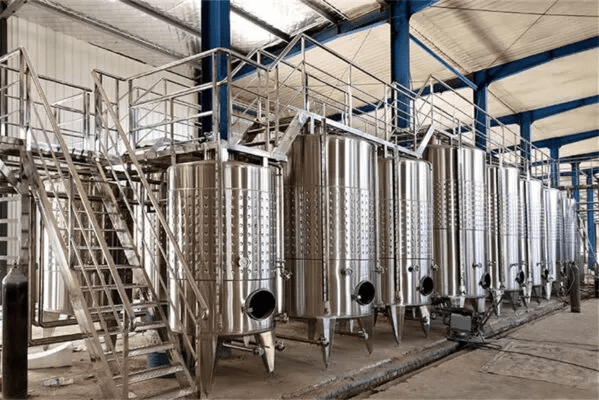
| Fermentación de vino | 5.000 L / 10.000 L | SUS304 o SUS316L | — | Poliuretano, 80–100 mm | — | — |
Conviene destacar dos aspectos de esa tabla. En primer lugar, la capacidad total y la capacidad de trabajo no son iguales: un tanque de 2.000 L contiene aproximadamente 1.800 L de producto una vez que se deja espacio libre para el krausen y el CO2. Los compradores que dimensionan una bodega de fermentación basándose únicamente en la capacidad total suelen calcular una carga de refrigeración insuficiente. En segundo lugar, la línea de fermentación de vino es la única en la que el SUS316L aparece como opción estándar para la envolvente, en lugar de ofrecerse como mejora. La envolvente interior tiene un grosor aproximado de 3,0 mm y la exterior, de 2,0 mm: son más gruesas que las de la mayoría de los fermentadores destinados exclusivamente a cerveza, porque los tanques de vino también están diseñados para manejar mosto con hollejos y semillas que pasan por bombas y válvulas.
SUS304 frente a SUS316L: comparación directa
| Factor | SUS304 | SUS316L |
| Chromium / Nickel | 18% / 8% | Similar, plus molybdenum |
| Chloride resistance | Adequate for municipal water, standard CIP | Better under brine, coastal water, aggressive acids |
| Weld-seam corrosion risk | Standard | Lower, due to reduced carbon content |
| Typical use in this product line | Beer fermenters, bright tanks | Wine fermentation tanks, high-acid or high-chloride runs |
| Relative cost | Baseline | Higher — expect a premium over an equivalent 304 tank |
| Where it’s overkill | High-chloride, high-acid, marine environments | Standard ale/lager fermentation on municipal water |
Compared to painted carbon-steel or plastic-lined vessels still found in some entry-level home-to-commercial upgrade setups, both stainless grades solve the corrosion problem outright — the 304-vs-316L decision only matters once carbon steel is already off the table.
The Misconception That Costs Buyers Money
The most common mistake isn’t picking the wrong grade — it’s assuming a tank is fully one grade when only part of it is. A conical bottom or a set of tri-clamp fittings can be 316L while the cylindrical shell above it is 304, and a spec sheet that just says “SUS304/316L available” doesn’t tell you which component got which grade. On a new build, MICET’s spec sheet resolves this per line item. On a used tank sourced secondhand, the mill certificate is often missing entirely, and the seller’s word is the only documentation available.
If a mill certificate isn’t available, three checks narrow the uncertainty:
- Run a magnet test on the shell, the jacket, and every fitting separately — austenitic 304 and 316L are both weakly magnetic to non-magnetic, but a strongly magnetic patch anywhere signals carbon steel or a repaired weld using the wrong filler rod.
- Inspect weld seams under strong light for surface pitting or a rainbow discoloration — a sign of inadequate post-weld passivation, which shortens service life regardless of the base grade.
- Ask for the tank’s cleaning chemical history — a tank that’s run high-chlorine sanitizer for years on 304 will show more surface degradation than the same age tank in 316L, even if both look clean at a glance.
Buying a Tanque de fermentación usado: What to Check Beyond the Grade
A used tank’s real condition depends on more than the alloy stamped on the nameplate. Before signing off on a secondhand fermenter or bright tank:
- Confirm the design pressure and test pressure match what the original build sheet states (0.2 MPa design / 0.3 MPa test is standard for this tank class) — a tank re-rated downward after a repair should be priced and used accordingly.
- Check the glycol jacket for weld cracks at the jacket-to-shell transition, the most common failure point on tanks that have been through multiple relocations.
- Verify the polyurethane insulation hasn’t compressed or delaminated, since that directly affects glycol consumption and temperature stability, not just cosmetic condition.
- Ask whether the tank was decommissioned for a production reason (contamination, valve failure) or simply because the previous owner upgraded capacity — the two carry very different risk profiles.
Certification: What’s Actually on Paper
Beer and wine tank pressure vessels in this category can carry third-party PED verification rather than a manufacturer’s self-declaration alone. One documented example: a Pressure Equipment Verification (certificate 3N231110.SICS093) issued by Ente Certificazione Macchine Srl covers brewing equipment, beer equipment, and pressure vessels against the EU’s 2014/68/EU Pressure Equipment Directive, tested to EN 1626:2008, valid through November 2028. That kind of third-party sign-off is worth asking for specifically — a generic “CE compliant” line on a spec sheet doesn’t tell you whether an independent body actually tested the pressure rating or whether the manufacturer simply declared it.
For fermentation tanks specifically, no separate certificate numbers are published beyond that pressure-directive coverage, so if a supplier claims additional certifications for the tank line itself, ask them to produce the document rather than take the claim at face value.
Pricing: What’s Published, What Requires a Quote
Standalone fermentation tank pricing isn’t published as its own line item. What is published: microbrewery equipment packages run 30,000–80,000 USD, and commercial brewery systems starting at 10bbl run 50,000–80,000 USD — but those figures cover full brewing systems, not an isolated tank purchase. A single 2T or 4T fermentation tank, new or used, needs a direct quote, and pricing will move with grade (304 vs 316L), wall thickness, and whether it ships with a full glycol jacket or a partial one.
The tradeoff worth stating plainly: 316L costs more up front, and on a standard beer-only production line that premium buys corrosion margin you may never use. It’s the right spend when the product or the water supply demands it, not as a default upgrade.
Preguntas frecuentes
Q: Can a SUS304 fermentation tank be used for wine or kombucha?
A: Yes, for lower-acid runs and standard cleaning cycles. Higher-acid, higher-chloride production is where 316L’s corrosion margin starts to matter — check your specific water and cleaning chemical profile rather than assuming based on product category alone.
Q: Does a thicker shell always mean a better tank?
A: Not by itself. The wine fermentation line’s 3.0mm inner / 2.0mm outer shell reflects the mechanical demands of handling must with skins and seeds, not a general corrosion or pressure advantage — a thinner 304 beer fermenter built to spec for its actual duty isn’t undersized.
Q: How do I know if a used tank still meets its original pressure rating?
A: Ask for the original test certificate showing the 0.2 MPa design / 0.3 MPa test figures, and have any repaired welds re-inspected before relying on the original rating — a repair that wasn’t re-tested is an unknown, not a pass.
Q: Is SUS316L worth it for a standard 10bbl craft brewery on municipal water?
A: Generally no. The corrosion cases where 316L pays for itself involve chloride or acid exposure beyond what standard tap water and routine CIP produce.