

Starting a small brewery does not always require a large investment in brand-new equipment. However, choosing an undersized or incomplete system can limit production and increase future costs. A well-matched refurbished brewing system offers a practical way to enter the craft beer market with professional equipment.
Used nano brewery equipment for sale is available in different capacities, configurations, and levels of refurbishment. For small breweries, 100L, 300L, and 500L systems offer different advantages. The right choice depends on expected beer output, fermentation capacity, available space, utilities, packaging needs, and future expansion plans.

Artikel Gliederung
- What Does Nano Brewery Equipment Mean?
- Who Should Consider Used Nano Brewery Equipment for Sale?
- 100L vs 300L vs 500L: Which Brewing System Is Right for You?
- What Is Included in a Complete Used Nano Brewhouse?
- How Many Fermenters Does a Nano Brewery Need?
- Which Brewhouse Configuration and Heating Method Should You Choose?
- How Important Are Heat Exchangers, Glycol Cooling, and CIP?
- What Packaging Equipment Should a Small Brewery Include?
- Used vs New Brewing Equipment: Which Is Better for a Small Brewery?
- How Can You Get a Ready-to-Brew Nano Brewery Solution?
1. What Does Nano Brewery Equipment Mean?
A nano brewery is a small-scale beer production facility designed for limited batches, local sales, recipe development, or taproom operations. Compared with a large commercial brewery, it requires less floor space and a smaller initial equipment investment.
The term does not have one universal capacity definition. For MICET’s current used equipment range, nano brewery systems cover approximately 100L to 500L. These systems are designed for pilot plants, bars, restaurants, brewpubs, and small craft breweries.
A typical nano brewing system includes:
- Malzmühle
- Mash tun or mash/kettle combination
- Lauter tun, where required
- Brew kettle and whirlpool
- Hot liquor tank (HLT)
- Plattenwärmetauscher
- Stainless steel fermenters
- Glycol cooling system
- Pumps, pipes, and valves
- Bedienfeld
- CIP cleaning equipment
The exact configuration depends on the brewing process and production target.
A small brewery may start with a compact 100L setup for recipe testing and limited sales. A busy brewpub may need 300L or 500L equipment to support regular production.
The important point is that a nano brewery still needs professional process equipment. A home brewing kit is not a substitute for a commercial brewing system designed for repeated operation.
2. Who Should Consider Used Nano Brewery Equipment for Sale?
Used nano brewery equipment can suit businesses that want to enter the beer market without immediately investing in a large production facility.
It is especially useful for entrepreneurs who plan to test customer demand before expanding. A compact brewing system can also help established restaurants and bars develop their own beer brands.
Common Applications
| Business Type | Suitable Capacity to Evaluate | Hauptzweck |
|---|---|---|
| Pilot brewery | 100L | Recipe development and testing |
| Restaurant brewery | 100L–300L | Fresh beer for customers |
| Small brewpub | 300L | Regular taproom production |
| Craft beer startup | 300L–500L | Local commercial distribution |
| Small craft brewery | 500L | Increased production capacity |
| Brewery training center | 100L–300L | Brewing education and process testing |
These are planning suggestions, not fixed industry rules. Actual requirements depend on sales demand, brewing frequency, and fermentation time.
Used equipment is also attractive when a business is expanding or replacing an existing system. Some second-hand assets enter the market through brewery closures, facility upgrades, or changes in production strategy.
However, buying individual used tanks from unrelated sellers can create compatibility problems. A complete, matched system is often easier to integrate than several unrelated machines.
MICET offers factory-refurbished brewing packages based on its established equipment designs, with options for technical customization and project support.
3. 100L vs 300L vs 500L: Which Brewing System Is Right for You?
Capacity is one of the most important factors when choosing a nano brewing system.
A larger brewhouse does not automatically mean better business performance. If production demand is low, oversized equipment can increase utility costs and leave expensive assets underused.
A smaller system may be more suitable for a new business that wants to test recipes and build a local customer base.
Compare Three Popular Capacity Options
| Spezifikation | 100L System | 300L System | 500L System |
|---|---|---|---|
| Working brew volume | 100L | 300L | 500L |
| Approx. US BBL equivalent | 0.85 | 2.56 | 4.26 |
| Typical application | Pilot brewing | Brauereigasthaus | Small craft brewery |
| Fermenters in published package | 3 × 100L | 2 × 300L working volume | 2 × 500L |
| Glycol tank | 200L | 800L | 1000L |
| Heizung | Electric | Electric | Electric |
| Verpackung | Project dependent | Semi-auto bottle filler | Semi-auto bottle filler |
BBL conversions use the US beer barrel (approximately 117.35L). Actual working output and finished packaged volume depend on the brewing process and production losses.
When Is a 100L Brewing System a Good Choice?
A 100L system is useful for pilot brewing, recipe testing, small restaurants, and businesses with limited production requirements.
It has a compact footprint and can support several different beer recipes without requiring a large cellar.
MICET’s published used 100L configuration includes three 100L fermentation tanks, a 100L brewhouse arrangement, a 100L hot liquor tank, a 200L glycol tank, and an approximately 2HP chiller.
This package is suitable for buyers who want a compact professional setup rather than a collection of unrelated small machines.
Explore the Gebrauchte 100L Mini-Brauereianlage configuration.
When Should You Choose 300L?
A 300L system offers more production volume while remaining suitable for smaller facilities.
It can be a practical choice for a brewpub or startup that has moved beyond occasional pilot batches and needs a more regular brewing schedule.
MICET’s published 300L package includes a brewhouse, two fermenters with approximately 300L effective working volume each, an 800L glycol tank, cooling equipment, CIP, and semi-automatic bottle filling.
See the Gebrauchte 300L-Brauereianlage specifications.
Is 500L Better for a Growing Craft Brewery?
A 500L system is worth considering when the business expects higher weekly output or needs more beer for local distribution.
MICET’s published 500L configuration includes a 500L brewhouse arrangement, two 500L fermenters, a 1000L glycol tank, a cooling system, CIP, and bottle-filling equipment.
It provides more production capacity than a 100L or 300L system, but buyers should also plan for greater utility demand, floor space, and packaging requirements.
Explore the Gebrauchte 500L Brauereianlagen page for the published configuration.
4. What Is Included in a Complete Used Nano Brewhouse?
When searching for used brewery equipment for sale, buyers often find individual vessels, pumps, and accessories listed separately.
The problem is that these components may not work together without additional engineering.
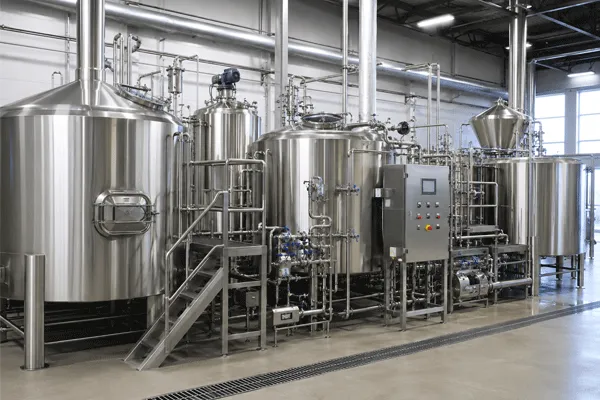
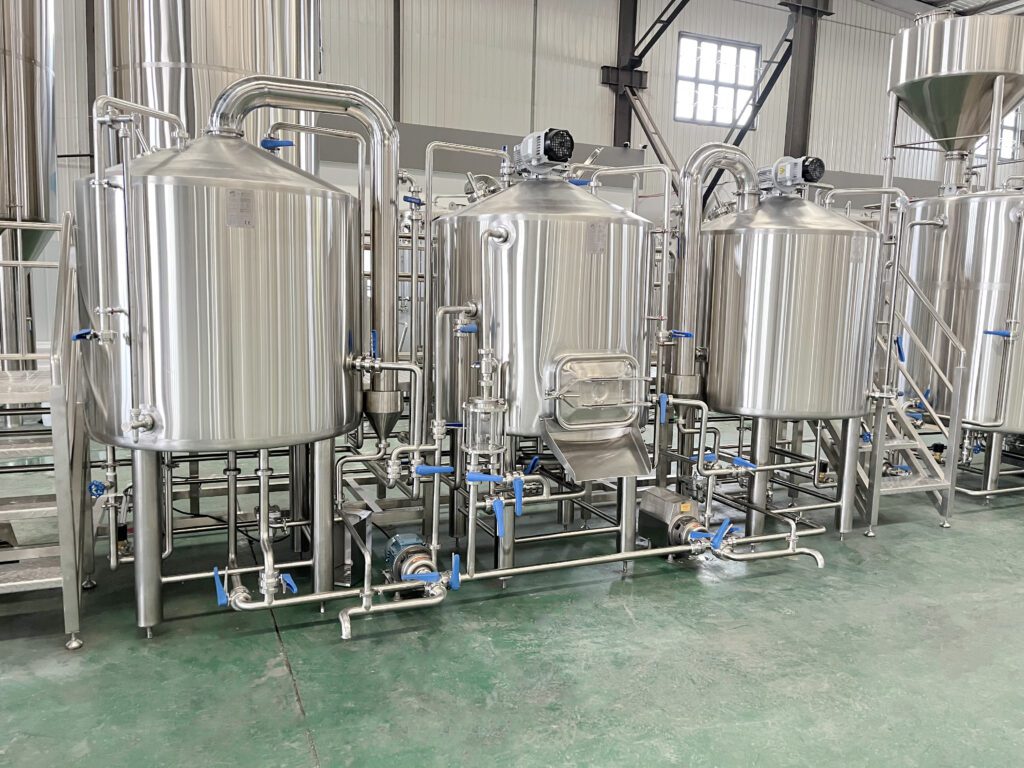
A complete brewhouse should be treated as a connected production system.
Main Brewhouse Components
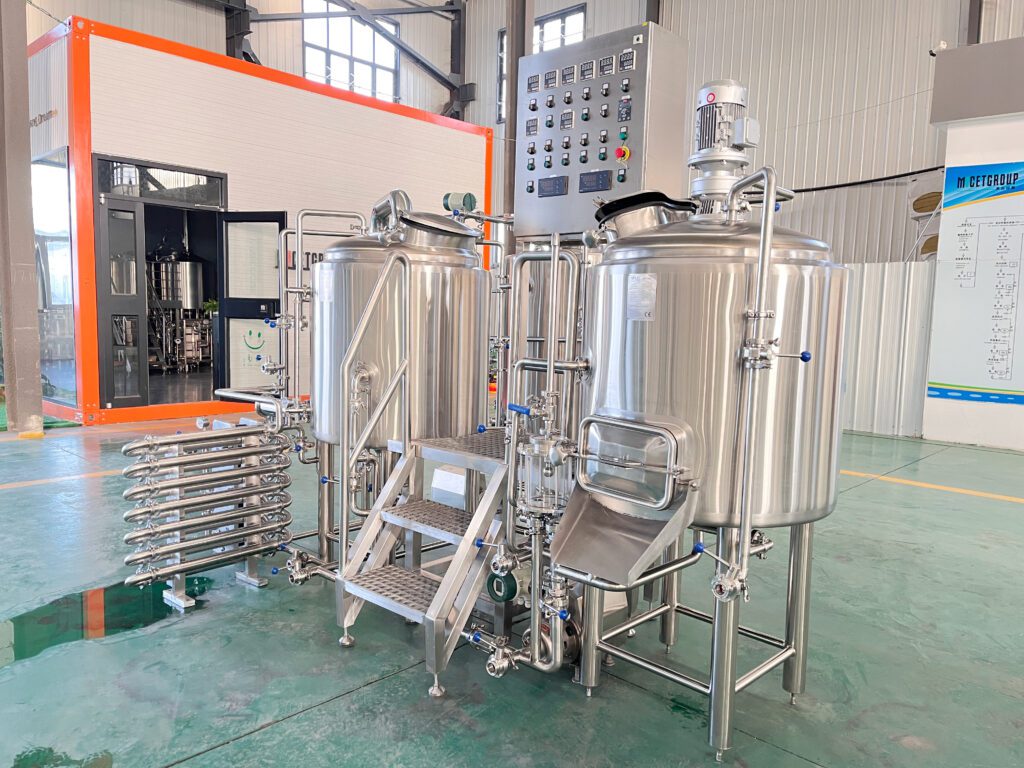
Mash tun: Mixes crushed malt with hot water and supports the conversion of starch into fermentable sugars.
Lauter tun: Separates the liquid wort from spent grain.
Brew kettle: Boils the wort and supports hop additions.
Whirlpool: Helps separate hop particles and other solids before cooling.
Hot liquor tank: Stores heated brewing water for mashing and lautering.
Heat exchanger: Cools hot wort before it enters the fermenter.
Some compact systems combine functions in one vessel to reduce the equipment footprint. Other systems use separate vessels for greater process flexibility.
When reviewing a used package, confirm the actual vessel arrangement instead of relying only on labels such as 2 vessel or 3 vessel.
Also check the included pumps, valves, pipes, gaskets and clamps, control panel, and connection standards.
A system may look complete in product photos but still require additional components before it can operate at your facility.
5. How Many Fermenters Does a Nano Brewery Need?
The brewhouse determines how much wort you can produce in one brewing cycle. Fermentation capacity determines how much beer your business can process over time.
These two capacities must work together.
For example, a 300L brewhouse with only one 300L fermenter may become a production bottleneck if the beer needs several weeks of fermentation and conditioning.
A brewery with several fermenters can manage overlapping batches and different beer styles.
Fermentation Capacity Planning
Consider these factors:
- Number of brewing days per week
- Fermentation time for each beer style
- Conditioning and maturation time
- Cleaning and turnaround time
- Expected sales volume
- Seasonal demand
- Future expansion plans
A useful planning method is to estimate how many batches will be occupying fermenters at the same time.
For example, if you brew two batches each week and each batch occupies a fermenter for two weeks, you need enough cellar capacity to accommodate overlapping production, plus a practical operating buffer.
Do not simply match the fermenter volume to the brewhouse nameplate. Check working capacity, total capacity, and headspace.
Why Stainless Steel Fermenters Matter
Professional stainless steel fermenters provide a durable and hygienic environment for beer production.
Important features include:
- Conical bottom for yeast collection
- Cooling jackets for temperature control
- Isolierung
- Sanitary manways
- Sampling valves
- CIP spray balls
- Pressure gauges and safety valves, where applicable
- Temperature sensors
A good fermenter should be easy to clean and suitable for the intended operating pressure.
For small breweries, properly matched fermenters can improve production scheduling and reduce unnecessary transfers.
6. Which Brewhouse Configuration and Heating Method Should You Choose?
A nano brewery may use a two-vessel or three-vessel brewing arrangement.
The choice depends on production requirements, available space, investment budget, and brewing workflow.
A 2 vessel system may combine mashing and boiling functions to reduce equipment costs. A 3 vessel system can separate more brewing stages and provide additional process flexibility.
Neither configuration is automatically superior.
Electric Brewhouse or Steam Heating?
Electric heating is common in compact brewing systems because it can be installed without a dedicated steam boiler.
It is especially useful for smaller facilities where steam infrastructure is not available.
However, the buyer must confirm the required electrical capacity before ordering.
For example, MICET’s published 300L electric mash/kettle configuration lists approximately 12kW of heating power, while the 500L configuration lists approximately 24kW.
These are equipment-specific examples, not universal requirements for every 300L or 500L brewery.
Before purchasing an electric brewhouse, confirm:
- Local voltage and frequency
- Single-phase or 3 phase power
- Total connected electrical load
- Heating element configuration
- Cable and breaker requirements
- Control panel compatibility
- Local electrical safety requirements
The same checks apply to pumps, motors, and cooling systems.
A system that works well in one country may require electrical adjustments before installation in another.
7. How Important Are Heat Exchangers, Glycol Cooling, and CIP?
A brewing system cannot operate reliably with only the main vessels.
The supporting systems are just as important.
Wärmetauscher
After boiling, wort needs to cool before entering the fermenter.
A plate heat exchanger uses cooling water and, where required, glycol or another suitable cooling medium to reduce wort temperature.
MICET’s published configurations provide useful examples:
| System | Published Heat Exchanger Area |
|---|---|
| 100L | Approximately 2m² |
| 300L | Approximately 4m² |
| 500L | Approximately 6m² |
The correct heat exchange capacity depends on wort flow, inlet temperature, target temperature, and cooling water conditions.
Glycol Cooling System
Fermentation creates heat. A chiller and glycol circulation system help maintain the required temperature inside jacketed fermenters.
The glycol tank, chiller, pumps, pipelines, and cooling jackets should be sized as one system.
MICET’s published nano packages use different glycol tank capacities according to the equipment configuration.
CIP-Reinigungssystem
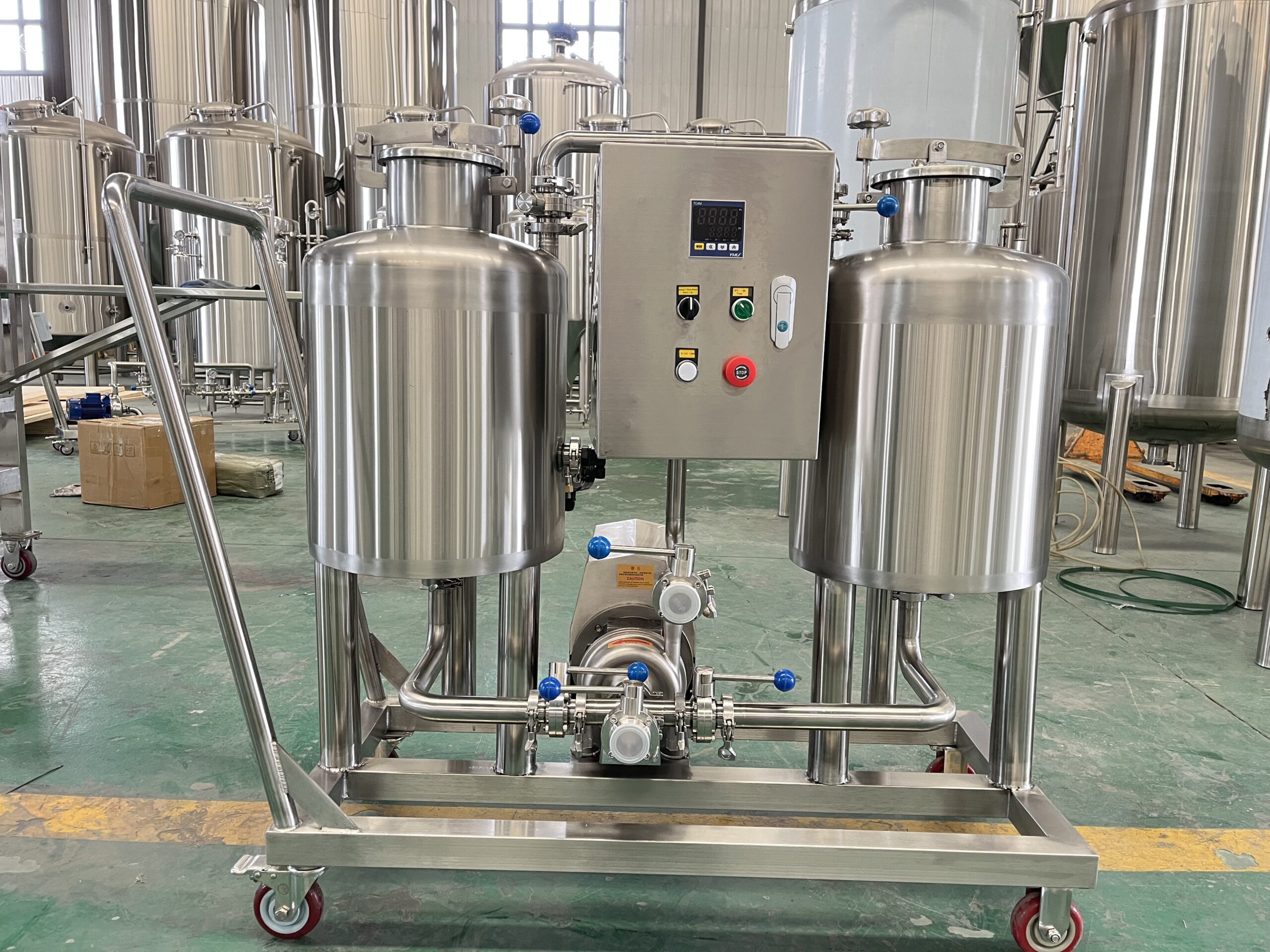
CIP means Clean-in-Place. It allows cleaning solutions to circulate through vessels and process pipelines without dismantling the entire system.
For a commercial brewery, CIP helps improve cleaning consistency and reduce manual work.
When evaluating used equipment, check whether the CIP tanks, pumps, spray balls, return lines, and control components are included.
A complete nano brewery should have a practical cleaning plan from the beginning.
8. What Packaging Equipment Should a Small Brewery Include?
After fermentation and conditioning, beer needs to reach customers in a suitable package.
Your packaging choice depends on your business model.
A taproom may focus on kegs and draft service, while a retail-focused craft brewery may need a bottle or can line.
| Packaging Option | Suitable Equipment | Typical Application |
|---|---|---|
| Fass | Keg washer and filler | Bars and restaurants |
| Flasche | Bottle filler and capper | Retail and local distribution |
| Dose | Can filling and seaming line | Retail and takeaway |
| Draft | Kegging and dispensing setup | Taprooms and brewpubs |
MICET’s published 300L and 500L packages include a semi-automatic 6-filling-head and 6-capping-head bottle machine, with a stated output of approximately 500 bottles per hour.
The actual output depends on the bottle format, operating conditions, and product handling.
A small brewery does not always need an automatic packaging line at the beginning. It may be more cost-effective to start with keg packaging and add a bottle or can line as sales grow.
A Cornelius-style keg or standard commercial beer keg may also be useful for selected small-batch or taproom applications, provided the filling and cleaning setup matches the intended container.
The key is to plan packaging capacity alongside fermentation capacity. There is little value in producing more beer than your packaging operation can handle.
9. Used vs New Brewing Equipment: Which Is Better for a Small Brewery?
Both new and used equipment can be suitable for a nano brewery project.
The right decision depends on budget, operating requirements, equipment condition, and the level of customization needed.
| Faktor | Gebrauchte Anlagen | New Equipment |
|---|---|---|
| Initial investment | Often lower | Usually higher |
| Manufacturing lead time | May be shorter | Requires manufacturing time |
| Personalisierung | Depends on existing configuration | More flexible |
| Equipment condition | Requires inspection and refurbishment | New manufacturing condition |
| Ersatzteile | Must be confirmed | Easier to specify |
| Garantie | Depends on agreement | Manufacturer warranty |
| Installation | Requires planning | Can be designed for the site |
A hybrid approach can also work well.
For example, a brewery may purchase refurbished stainless steel vessels while upgrading selected valves, pumps, gaskets, electrical components, and process controls.
This can balance initial investment with long-term reliability.
What Does Factory Refurbishment Mean?
Refurbishment should involve more than washing an old tank and repainting its exterior.
A professional process may include:
- Initial equipment inspection.
- Disassembly and internal cleaning.
- Weld and surface condition checks.
- Replacement of worn seals and gaskets.
- Pump, motor, and valve testing.
- Electrical and control checks.
- Tank and jacket pressure testing where applicable.
- CIP and leakage checks.
- Final inspection and export packing.
MICETs Gebrauchte Brauereiausrüstung program describes its inspection and refurbishment approach for different equipment capacities.
Buyers should request actual equipment photos, a component list, refurbishment scope, and relevant test records before confirming an order.
10. How Can You Get a Ready-to-Brew Nano Brewery Solution?
Choosing the right system starts with your production plan.
Before asking a manufacturer for a quotation, prepare a few basic details.
| Information | Example |
|---|---|
| Project type | Brewpub or small craft brewery |
| Target capacity | 100L, 300L, or 500L |
| Brewing frequency | Batches per week |
| Beer styles | Ale, lager, stout, IPA |
| Kapazität der Gärung | Number and volume of fermenters |
| Heizung | Electric or steam |
| Kühlung | Glycol chiller |
| Verpackung | Keg, bottle, or can |
| Installation location | Country and city |
| Available space | Building dimensions |
| Budget | Expected investment range |
This information helps the manufacturer recommend a suitable brewing configuration.
Why Choose MICET for Used Nano Brewery Equipment?
MICET is a professional brewery and beverage equipment manufacturer providing customized stainless steel brewing systems, fermentation tanks, brewhouse systems, and turnkey solutions for global B2B customers.
Our used equipment range includes compact systems designed for pilot breweries, brewpubs, restaurants, and small craft beer producers.
We focus on providing matched equipment packages rather than simply selling individual second-hand vessels.
Our project support can include:
- Used and refurbished brewhouse packages
- Stainless steel fermentation tanks
- Glycol cooling systems
- CIP cleaning equipment
- Pumps, valves, and sanitary piping
- Control panels and process controls
- CAD and 3D layout planning
- Equipment customization
- Installation guidance and commissioning support
- Spare parts and after-sales service
We also provide new equipment options for customers who need a different configuration or want to expand their production capacity.
Whether you need a compact 100L pilot brewery, a 300L brewpub system, or a 500L craft brewery package, our engineering team can help match the equipment to your process, available space, and investment plan.
Looking for used nano brewery equipment for sale?
Contact MICET with your preferred capacity, brewing concept, facility layout, and budget. We can help you review suitable equipment configurations and prepare a project-specific proposal.
Häufig gestellte Fragen
What capacity is considered a nano brewery?
There is no single global capacity definition. MICET’s current used nano brewery equipment range focuses on systems from approximately 100L to 500L, suitable for pilot production, brewpubs, and small craft breweries.
Is a 300L nano brewery suitable for a brewpub?
Yes. A 300L system can be suitable for a brewpub that needs regular small-batch production. The final configuration should include enough fermentation capacity, cooling, cleaning, and packaging equipment to support the planned sales volume.
What is included in used nano brewery equipment?
A complete package may include a brewhouse, malt mill, fermenters, heat exchanger, glycol tank, chiller, pumps, control panel, CIP system, and packaging equipment. Always confirm the actual included items in the quotation.
Ist gebrauchte Brauereianlagentechnik zuverlässig?
It can be reliable when the equipment has been properly inspected, refurbished, and tested. Buyers should review tank condition, welding, pressure ratings, electrical systems, pumps, valves, cleaning arrangements, and available documentation.
Can a nano brewery expand to a microbrewery?
Yes. A brewery can expand by adding fermentation tanks, increasing brewhouse capacity, upgrading cooling, and improving packaging. However, future expansion should be considered during the initial layout and utility planning.
Does MICET offer both used and new nano brewery equipment?
Yes. MICET provides used and refurbished brewery equipment as well as new customized brewing systems. The appropriate solution depends on the buyer’s production requirements, budget, facility, and desired equipment configuration.
Wichtigste Erkenntnisse
- Used nano brewery equipment is suitable for pilot breweries, brewpubs, restaurants, and small craft beer businesses.
- MICET’s published nano equipment range includes 100L, 300L, and 500L systems.
- A 100L system is useful for pilot production and recipe testing.
- A 300L system offers a practical option for regular brewpub production.
- A 500L system provides more capacity for growing craft breweries.
- Working volume, total vessel volume, and finished beer output are not the same.
- Brewhouse, fermenters, glycol cooling, and CIP should be planned together.
- Electric heating requires careful checking of local voltage and electrical capacity.
- Packaging equipment should match the brewery’s sales channels.
- Factory refurbishment should include cleaning, inspection, component replacement, and functional testing.
- A hybrid used-and-new equipment solution may help control investment while maintaining reliability.
- Choosing an experienced manufacturer can simplify customization, installation, and future expansion.
A successful nano brewery is not defined by the size of its brewhouse alone. It depends on how well every part of the production system works together. Choosing the right used equipment package can help your business start with a manageable investment and build a clear path toward future growth.