










Nancy Shang | Founder and CEO, MICET | Published August 27, 2026
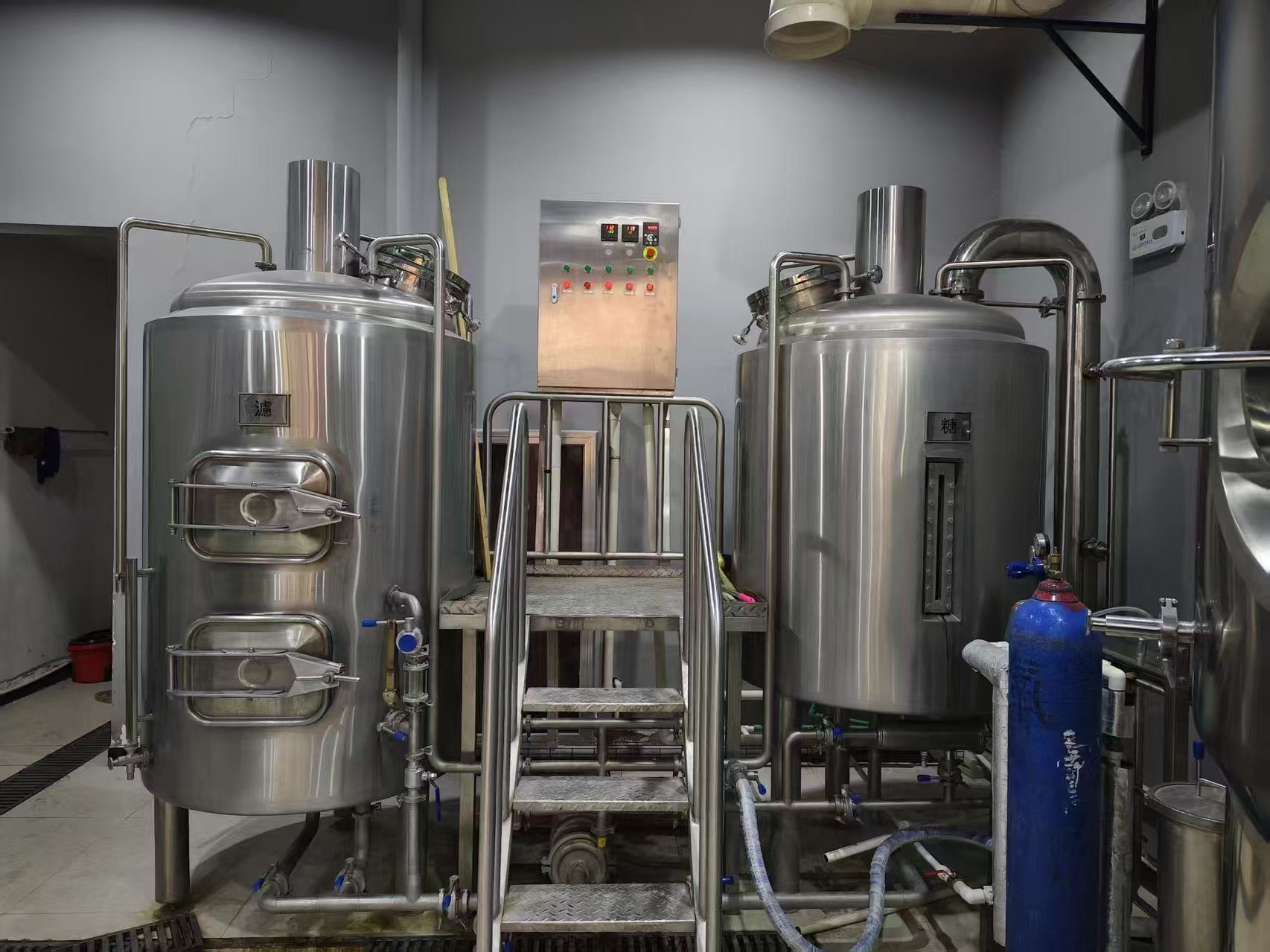
A three barrel brewing system produces roughly 352 litres of wort per batch (3 BBL × 117.35 L). A standard package covers a mash tun, kettle, hot liquor tank, wort pumps, plate heat exchanger, and control panel. It suits taprooms, brewpubs, and small production breweries running frequent small batches.
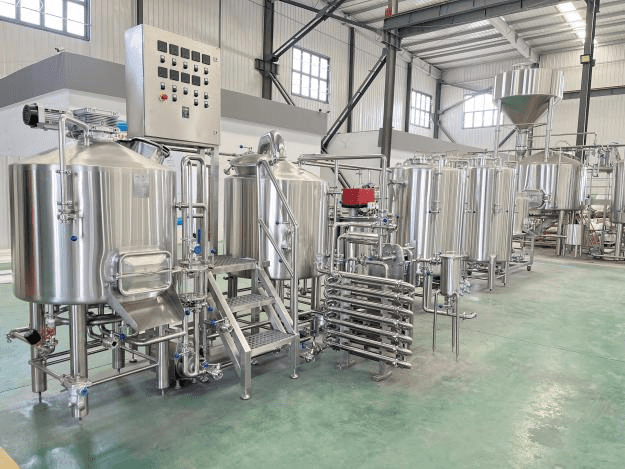
What a 3 BBL package actually contains
The barrel figure describes the kettle’s working batch volume, not the size of every vessel. This trips up first-time buyers who assume all three vessels are the same capacity.
| Composant | Fonction | Sizing relationship to the 3 BBL figure |
| Cuve d'empâtage | Holds grain and strike water for conversion; often combined with lauter function | Total volume must exceed 3 BBL to hold grain bed plus liquor — grain occupies real space |
| Kettle | Boils wort; this is where the 3 BBL rating comes from | Total volume exceeds working volume to allow boil headspace |
| Hot liquor tank (HLT) | Stores and heats strike and sparge water | Usually the largest vessel in the set, or sized to serve double batches |
| Wort pumps | Transfer between vessels and to the fermenter | Count varies with vessel configuration |
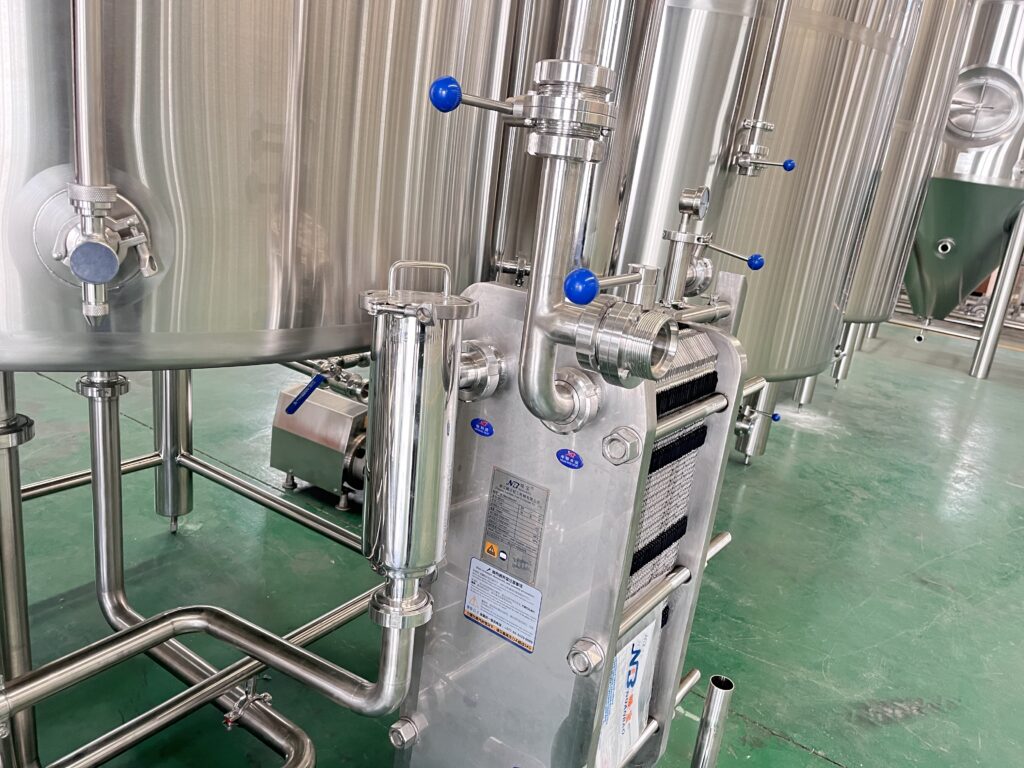
| Échangeur de chaleur à plaques | Drops wort from boil temperature to pitching temperature | Rated by flow rate and cooling water inlet temperature |
| Panneau de contrôle | Runs pumps, heating, and temperature display | Automation depth varies; see the section below |
de MICET équipement de brasserie d'occasion listings cover compact brewhouse configurations from 2 BBL to 10 BBL, supplied as a mash tun plus kettle plus hot liquor tank package with pumps, heat exchanger, and control panel included. A 3 BBL system sits comfortably inside that range on both the new-build and refurbished side.
The spec sheet: published values and honest blanks
This is the table to take into a supplier conversation. I have separated what is published from what is not, because filling blanks with plausible-sounding numbers is how buyers end up with vessels that do not fit through the door.
| Spec field | Published value | Notes |
| Nominal batch size | 3 BBL (≈352 L) | Kettle working volume |
| Configuration range available | 2–10 BBL | Used and new-build packages |
| Vessel count | 3 (mash tun, kettle, HLT) | 2-vessel combined configurations exist at this scale |
| Included ancillaries | Pumps, plate heat exchanger, control panel | Per published package description |
| Shell material | Not published for brewhouse vessels | SUS304 is standard across the fermentation tank line; confirm for brewhouse |
| Vessel diameter | Not published | Required for door and ceiling clearance planning |
| Overall height with legs | Not published | Ask for height with and without the manway open |
| Total vs working volume per vessel | Not published | Ask for both figures on all three vessels |
| Méthode de chauffage | Not published per unit | Electric, direct-fire, and steam all exist at this scale — confirm which |
| Heating element rating (kW) | Not published | Drives your electrical service decision |
| Isolation | Not published for brewhouse vessels | Polyurethane is used on the fermentation tank line |
| Manway type and orientation | Not published | Side vs top changes cleaning ergonomics |
| Heat exchanger plate count / flow rate | Not published | Ask for the rated flow at your local cooling water temperature |
| Pump type and count | Not published | Centrifugal is standard; confirm whether one or two |
| Control panel automation level | Not published | See automation section |
| Certificate number (used units) | Not disclosed | See certification section |
Eleven “not published” rows on one table looks unhelpful. It is the opposite. Every one of those fields is answerable by a supplier in a single email, and a supplier who cannot answer them promptly for a specific unit is telling you something useful.
How 3 BBL compares to its neighbours
Choosing between 2, 3, 5, and 7 BBL rarely comes down to equipment price alone. Batch frequency and cellar economics matter more.
| Dimension | 2 BBL | 3 BBL | 5 BBL | 7 BBL |
| Wort per batch | ≈235 L | ≈352 L | ≈587 L | ≈821 L |
| Kegs per batch (half-barrel) | ~4 | ~6 | ~10 | ~14 |
| Typical use | Pilot, R&D, very small taproom | Taproom, brewpub, small production | Brewpub, regional startup | Established brewpub, distribution entry |
| Grain per batch (rough, mid-gravity) | ~45–55 kg | ~70–85 kg | ~115–140 kg | ~160–195 kg |
| Manual handling | One person comfortably | One person, sacks manageable | Two people or grain handling aid preferred | Grain handling aid effectively required |
| Batches per week to hit 300 BBL/year | Impractical | ~2 | ~1.2 | Under 1 |
| Electrical service (if electric) | Often within existing 3-phase | Usually needs a dedicated circuit | Dedicated supply, possibly upgrade | Supply upgrade likely |
| Available as refurbished | Yes (2–10 BBL range) | Oui | Oui | Oui |
The grain figures are approximations for planning, not spec values — actual grain bills vary by recipe and target gravity.
That fifth row is the one that decides most projects. At 3 BBL, two brew days a week gets you to roughly 300 BBL annually, which is a realistic taproom-plus-limited-distribution volume. Below that, you are brewing constantly for very little beer; above it, you are paying for capacity you fill once a week.
-1024x768.jpg "Three Barrel Brewing System: A Real 3 BBL Spec Breakdown")
Automation: what “control panel included” means and doesn’t
At the 3 BBL tier, control panels usually cover pump start/stop, heating element or steam valve control, and temperature display. That is a semi-automatic system: you confirm each step manually.
Full step-programmed control — stored mash profiles with automatic ramp and rest, timed transfers, automated whirlpool rest — is available at this scale but is generally a specification choice rather than a default inclusion. Compared with the fully skid-mounted plug-and-play units commonly marketed to homebrewers stepping up, a commercial 3 BBL package expects a brewer at the panel and gives you more control over the process in exchange.
Ask three specific questions: is the mash step profile stored and executed automatically, does the panel log temperature over time, and can it be retrofitted with recipe control later without replacing the enclosure. The third answer matters most if you plan to grow.
Pairing the cellar: fermenters for a 3 BBL brewhouse
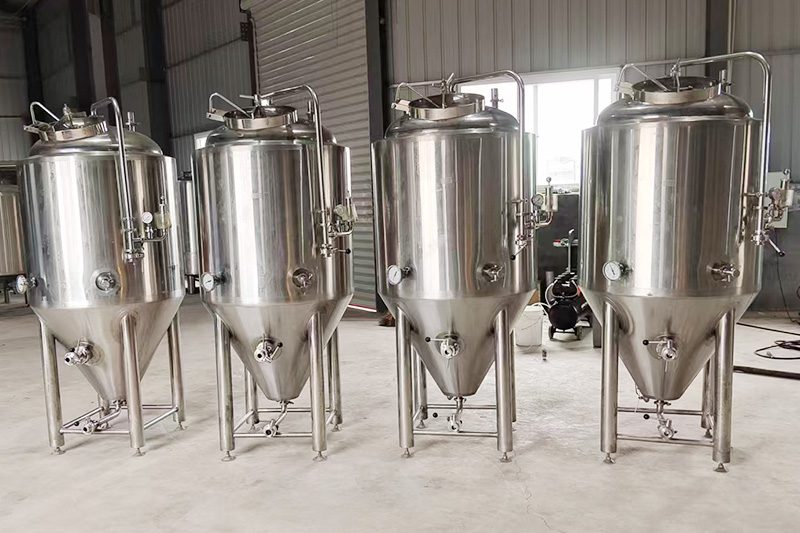
A brewhouse without matched fermentation capacity is an expensive way to make a small amount of beer. Published cuve de fermentation utilisée specifications give you a concrete pairing option:
| Paramètre | Published value |
| BBL sizes listed | 3–5 BBL, 10 BBL, 20 BBL, 40 BBL |
| Metric sizes listed | 2T / 4T / 6T (2,000 L / 4,000 L / 6,000 L total) |
| Working capacity (metric sizes) | 1,800 L / 3,600 L / 5,400 L |
| Shell material | Acier inoxydable SUS304 |
| Refroidissement | Chemise à glycol |
| Isolation | Polyurethane |
| Design pressure | 0.2 MPa |
| Test pressure | 0.3 MPa |
| Jacket zone count | Not published |
| Type de trou d'homme | Not published |
The 3–5 BBL used fermenter is the natural match for a 3 BBL brewhouse, either one batch per tank or as a double-batch vessel if you brew back-to-back on the same day.
How many? Take your target annual barrels, divide by 52 for weekly volume, then multiply by your average tank residency in weeks. A 3 BBL brewery targeting 300 BBL/year with 18-day average residency (roughly 2.6 weeks) needs about 15 BBL of live fermentation capacity — that is five 3 BBL fermenters, or three if you use 5 BBL vessels and double-batch. Add brite tank capacity separately, or packaging becomes your bottleneck instead.
Certification on a 3 BBL system
Brewhouse vessels operate at atmospheric pressure and generally fall outside pressure equipment scope. Fermentation and brite tanks do not — they are pressure vessels, and at 0.2 MPa design pressure they sit within the scope of the EU Pressure Equipment Directive.
MICET holds a PED Verification, certificate 3N231110.SICS093, issued by Ente Certificazione Macchine Srl, covering brewing equipment, beer equipment, brewery equipment, and pressure vessels against Directive 2014/68/EU with verification to EN 1626:2008. Issued November 10, 2023, valid to November 9, 2028. A second voluntary Verification of Conformity, ICR/VC/HM2507146, issued by ICR Co., Ltd., covers brewery, brewing, and fermentation equipment and pressure vessels under PED 2014/68/EU with reference to EN 1626:2008 and EN 10204:2004, issued July 16, 2025 and valid to July 15, 2030.
Both are organization-level verifications held by the manufacturer. They do not automatically transfer to an individual refurbished vessel, and no certificate numbers are disclosed for the used product lines. The used listings reference “ASME/CE” workmanship in general terms without registration numbers or a named issuing body — read that as a description of build practice, not as certification of a specific unit.
If your jurisdiction requires documented pressure vessel status for the fermenters, establish it for those specific tanks in writing before purchase. That is a conversation to have during quotation, not during installation.
Price: new-build and refurbished
Published pricing for this category:
- Microbrewery equipment: 30,000–80,000 USD.A 3 BBL system falls inside this category. The range spans the whole microbrewery tier, so a 3 BBL package sits toward the lower portion rather than the middle — but the published data does not break the range down by barrel size, and I am not going to invent a narrower figure.
- Refurbished 3 BBL pricing: not published.Used equipment pricing depends on the specific unit, its age, condition, and what ancillaries come with it. This requires a quotation on the actual inventory available.
What moves the number on a new-build 3 BBL quote: heating method (steam adds a boiler, which is often a separate scope), automation depth, vessel count (2-vessel versus 3-vessel), whether a glycol chiller is included, and freight terms. On a refurbished unit, condition of the heating elements or steam jacket, pump age, and whether the original control panel is intact or replaced.
Neither figure includes the fermenters, glycol chiller, or installation. Ask what is excluded before comparing two quotes that look similar.
The misstep: measuring the doorway last
The most common expensive mistake at this scale is not choosing the wrong size. It is discovering, after manufacture, that a vessel will not physically reach its position.
A 3 BBL brewhouse is small enough that buyers assume access is trivial. Then the tank arrives and the route runs through a standard commercial door with a fire-rated frame, around a corridor corner, past a structural column, into a room with a 2.4 m suspended ceiling and a sprinkler head directly above the intended kettle position.
Before signing, walk the route with a tape measure and record: narrowest doorway width and height, tightest corner turning clearance, ceiling height at the final position, and floor drain locations. Send those measurements to your supplier and ask them to confirm the vessel dimensions and, where relevant, whether legs ship detached. Detachable legs solve a surprising number of clearance problems, but only if raised before fabrication.
Related and equally overlooked: verify your incoming water supply flow rate and your hot water recovery. A 3 BBL brew day uses more hot water than most buyers estimate, and an undersized HLT or a slow-recovering supply turns a six-hour brew day into a nine-hour one.
A specification sequence before you request quotes
- Confirm your target annual barrelsand use the residency arithmetic above to derive fermentation capacity. Size the cellar first, then the brewhouse.
- Decide your heating method— electric, direct-fire, or steam — based on available utilities and whether a boiler is permittable at your site.
- Measure the delivery route and installation room, recording narrowest clearance and ceiling height.
- Request the full dimension setfor all three vessels: diameter, height with legs, height with manway open, total and working volume.
- Request the electrical or steam loadin kW or kg/hr, and take it to your electrician or building services contractor before you compare prices.
- Ask what the control panel does and does not automate, and whether recipe control can be retrofitted.
- For refurbished units, request the documentation package on the specific vessel, including any certification it carries and what was replaced during refurbishment.
- Confirm what is excluded— chiller, fermenters, freight terms, installation, spare gaskets.
Step 4 is the one buyers skip, and it is the reason step 3 exists.
What to do next
If you are shortlisting 3 BBL systems this month, the highest-return action is sending one email requesting the eleven unpublished dimension and load fields from the table above. Response speed and completeness on that email will tell you more about a supplier than any brochure.
The topic this article has not addressed is the step up from 3 BBL to 7 BBL — specifically what carries over (pumps, heat exchanger, control philosophy) and what has to be replaced entirely when you outgrow this size. Planning that transition at purchase time changes which 3 BBL configuration is worth buying.
FAQ
Q: How many litres is a 3 BBL brewing system?
A: Roughly 352 litres of wort per batch, based on 117.35 litres per US beer barrel. That is the kettle’s working volume. Individual vessels have larger total volumes to allow for grain bed displacement in the mash tun and boil headspace in the kettle.
Q: Is a 3 BBL system available refurbished?
A: Yes. MICET’s used brewery equipment listings cover 2–10 BBL compact brewhouse configurations, supplied as mash tun, kettle, and hot liquor tank with pumps, heat exchanger, and control panel. Refurbished pricing is not published and requires a quotation on the specific unit available.
Q: How many fermenters does a 3 BBL brewhouse need?
A: Divide target annual barrels by 52, then multiply by average tank residency in weeks. A brewery targeting 300 BBL/year with 18-day residency needs roughly 15 BBL of fermentation capacity — five 3 BBL tanks, or three 5 BBL tanks used for double batches. Brite tank capacity is additional.
Q: What does a 3 BBL brewing system cost?
A: New-build systems fall within the published microbrewery equipment range of 30,000–80,000 USD, which covers the whole microbrewery tier rather than 3 BBL specifically. Refurbished pricing is not published and requires a quotation. Neither figure includes fermenters, glycol chiller, freight, or installation.